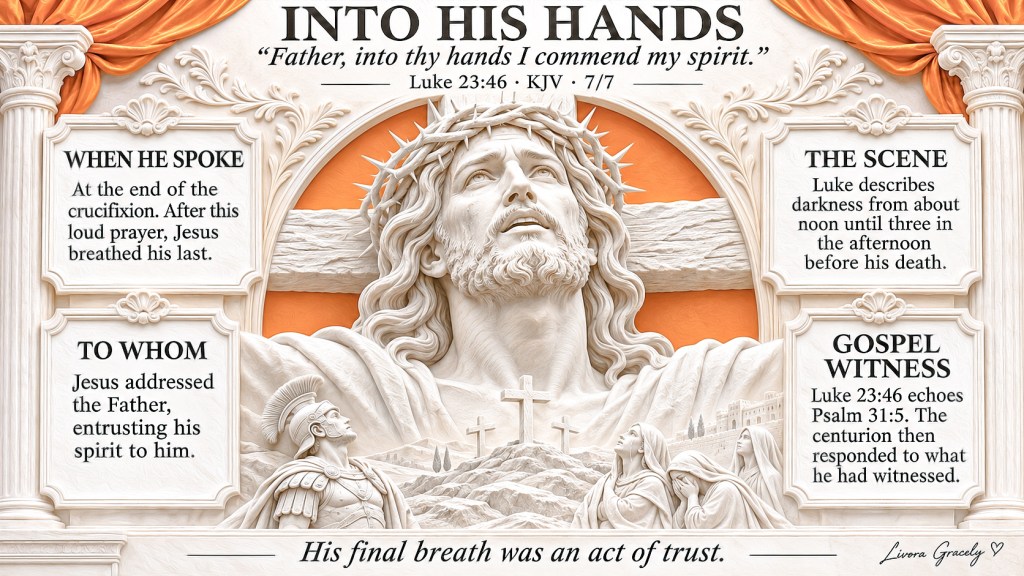
His final breath was an act of trust.
A Prayer to the Father
In Luke’s account, darkness covers the land from about the sixth hour until the ninth. The sun is darkened, and the curtain of the Temple is torn.
Then Jesus cries out in a loud voice. In the King James Version, his prayer is recorded: “Father, into thy hands I commend my spirit.”
Luke places these words immediately before Jesus’ death. The prayer begins with the one to whom it is addressed: the Father. Its movement is one of entrusting—placing his spirit into the hands of the one he calls upon.
The Gospel does not linger over an imagined explanation of his thoughts. It gives the words and tells us that, having spoken them, Jesus gives up his spirit.
Words from a Psalm
The prayer echoes Psalm 31, where the speaker commits his spirit into God’s hand. Earlier in the psalm, the speaker asks for deliverance and describes God as a rock and a fortress. The language of trust appears alongside the need for help. The psalm asks God to listen, to deliver, and to guide its speaker through danger.
Luke’s account includes the address “Father” with the words of entrusting. For Christian readers, the echo of the psalm brings a familiar prayer into the scene at the cross, while the address points to the relationship expressed throughout Luke’s Gospel.
Reading the two passages together does not require us to place every line of the psalm on Jesus’ lips. Luke records this particular prayer. Psalm 31 gives readers a wider setting in which to hear its words.
The image of hands is simple and personal. In the prayer, they are the hands into which the speaker entrusts his spirit.
What the Witnesses Saw
Luke continues with the people who see what has happened. The centurion gives glory to God and, in the King James Version, calls Jesus a righteous man. The crowds who had gathered return, striking their breasts. Jesus’ acquaintances and the women who had followed him from Galilee watch from a distance.
These are Luke’s descriptions. Other Gospels also describe a centurion, but their wording is not identical. Letting Luke’s words remain distinct allows each account to be read in its own voice.
The Gospel does not tell us everything the witnesses felt or later said to one another. It records their responses and their presence, leaving the reader with more than an empty scene after the prayer.
Into His Hands
This saying is traditionally placed seventh in the collection of sayings from the cross. That sequence brings together words from several Gospels; Luke presents this prayer within his own account of Jesus’ death.
Earlier in the series, the cry associated with Psalm 22 gave voice to lament. Here, the words associated with Psalm 31 speak of entrusting one’s spirit. Both are heard in the Gospel narratives against the reality of suffering, and neither needs to silence the other.
For Christians, Luke’s prayer has become a language of trust. Its final words place the spirit in the Father’s hands; the story leaves us listening to the one who is addressed.
Livora Gracely ♥
Sources: Luke 23:44–49, King James Version; Psalm 31:1–5, King James Version; Bible Gateway: Seven Words from the Cross.


Leave a Reply