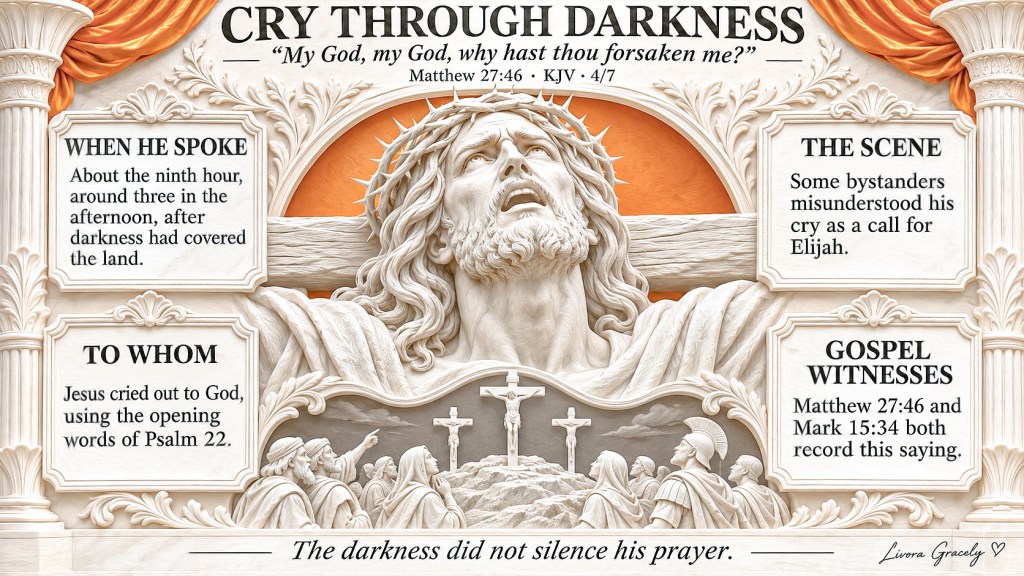
The darkness did not silence his prayer.
A Cry in the Dark
In the Gospel accounts of Matthew and Mark, darkness covers the land from the sixth hour until the ninth. Then, about the ninth hour, Jesus cries out in a loud voice.
The King James Version gives his words in English: “My God, my God, why hast thou forsaken me?”
It is a question spoken to God from the cross. Neither Gospel pauses to provide a full explanation of Jesus’ inner experience. The cry is given to the reader in the midst of the crucifixion, surrounded by darkness and the voices of those standing nearby.
The words can be especially difficult to hear and to understand. They give expression to anguish without first making it tidy. They also address God: even the question of absence is spoken as a prayer.
Words from a Psalm
The cry recalls the opening of Psalm 22. In that psalm, a voice calls to God while describing distress, unanswered cries, and the scorn of others. It is a prayer that does not hide its questions.
The psalm also recalls earlier generations who trusted God and were delivered, setting that memory beside the distress of its speaker. The psalm continues beyond its opening. Its speaker asks for help, and later the words move towards praise and a declaration that God has heard the afflicted. Readers who recognise the opening may hear those later movements alongside the cry recorded by Matthew and Mark.
Yet the later praise should not make us hurry past the first question. Psalm 22 gives its lament room. The opening words remain words of pain, even when read as part of the whole psalm.
Christians have understood the connection between the cross and the psalm in different ways. The Gospels give us the cry; the psalm offers a wider prayer through which readers can attend to its language and its echoes.
What the Bystanders Heard
Matthew and Mark each record that some people standing there thought Jesus was calling for Elijah. Their response enters the story after the cry itself.
The Gospel accounts also describe someone offering sour wine on a sponge. The details are brief. They do not tell us everything the bystanders understood, or what each person intended. Their words show that the cry was heard, even as some interpreted it as a call to Elijah.
Both accounts preserve a difference between what Jesus says and what those listeners think he is saying. The reader is invited to pause at that distance, rather than fill it with invented conversations.
Room for Lament
This saying is traditionally placed fourth among seven sayings gathered from the Gospel accounts of the cross. Matthew and Mark both report it, while the familiar sequence of seven brings together words found in different Gospels.
For Christian readers, the cry belongs to the story of Jesus’ suffering. Its connection to Psalm 22 also keeps open the language of prayer: a voice can address God with a question as well as with praise.
The words do not require the reader to explain away the darkness. They allow lament to be heard within it.
Livora Gracely ♥
Sources: Matthew 27:45–49, King James Version; Mark 15:33–36, King James Version; Psalm 22, King James Version; Bible Gateway: Seven Words from the Cross.


Leave a Reply