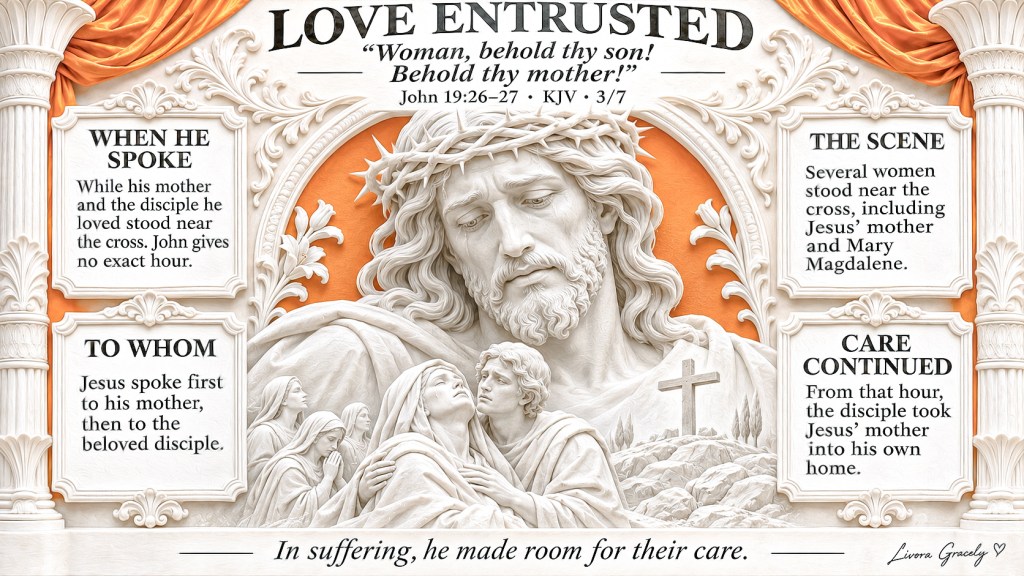
In suffering, he made room for their care.
Standing Near
In John’s account of the crucifixion, a small group stands near the cross. Among them are Jesus’ mother and the disciple whom Jesus loved.
John also names other women at the cross, including Mary Magdalene. The Gospel does not describe every movement or give each person’s thoughts. It tells us that they are there, close enough to be part of the scene as it unfolds.
Jesus sees his mother and the disciple standing nearby. Even in this moment of suffering, his words turn towards the relationship between them.
He speaks first to his mother, then to the disciple. What follows is not a long conversation. John records a few words and an action that continues beyond them.
Mother and Disciple
In the King James Version, Jesus says to his mother, “Woman, behold thy son!” To the disciple he says, “Behold thy mother!”
The words direct each person’s attention towards the other. His mother is not addressed in isolation, and the disciple is given a relationship to receive. John then tells us that, from that hour, the disciple took her into his own home.
The Gospel does not name the disciple in these verses. Christian tradition has often identified him as John, but the passage itself calls him the disciple whom Jesus loved. Keeping that description allows us to follow the story as it is told.
John also gives no exact hour for this exchange. It is traditionally counted as the third of seven sayings gathered from several Gospel accounts, an arrangement that helps readers reflect on each saying without establishing a precise combined timeline.
From That Hour
The phrase “from that hour” carries the story beyond the words at the cross. The disciple responds by welcoming Jesus’ mother into his home. John does not describe the journey there or the conversations that followed. It gives one concrete detail: she is received.
That detail makes the exchange more than a farewell. In the Gospel’s telling, Jesus entrusts his mother and the disciple to a relationship of care, and the disciple acts on what he has heard.
Christian readers have also found a wider meaning in this scene, seeing in the mother and the beloved disciple a picture of relationships within the community of faith. Such readings grow from the passage, while the immediate story remains grounded in these two people and the home that receives her.
The text leaves room for their grief without assigning words to it. Their presence at the cross and the disciple’s action are enough to hold our attention.
Care That Continued
The Gospel does not tell us everything the mother and disciple carried away from that day. It does tell us that they did not simply remain figures at the edge of someone else’s story.
Jesus speaks to each of them. The disciple receives her. A relationship named in a profound moment of loss becomes, in John’s account, a part of life afterwards.
At the cross, words of care are entrusted to those standing near. In the home that follows, care has somewhere to continue.
Livora Gracely ♥
Sources: John 19:25–27, King James Version; John 19, with Notes; Bible Gateway: Seven Words from the Cross.


Leave a Reply