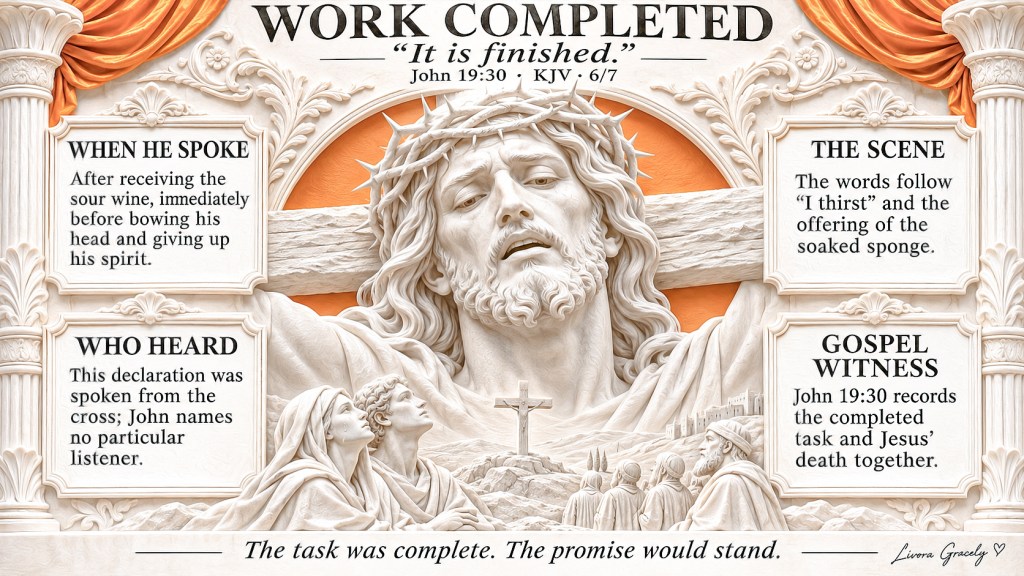
The task was complete. The promise would stand.
After the Sour Wine
In John’s account, a sponge has been lifted to Jesus’ mouth. He has spoken of thirst, and the Gospel says he receives the sour wine.
Then comes another remarkably brief saying: “It is finished.”
John places these words immediately before Jesus bows his head and gives up his spirit. He does not name a particular person to whom the words are addressed. The account lets the declaration stand within the scene of the crucifixion, followed by the act that marks Jesus’ death.
The sentence is short, but it still invites an important question: what does completion mean within the story John has been telling?
Three Words
The King James Version renders the saying in three English words. In the preceding verses, John has already told readers that Jesus knows all things are now accomplished and has connected his expression of thirst with the fulfilment of Scripture.
The account moves from that knowledge to the sour wine, then to the declaration. John does not pause between the words and Jesus’ death to explain every part of their meaning.
For Christian readers, the saying has often been understood as a declaration that the work Jesus came to do has reached completion. That reading takes its place within the Gospel’s wider account of Jesus’ life and death; the words are not merely a notice that a difficult day has ended.
At the same time, the verse does not set out a detailed explanation of every theological question about the cross. Christians have expressed their understanding of its meaning in different ways.
The Work in John’s Gospel
Earlier in John, Jesus prays to the Father and speaks of having finished the work he was given to do. The prayer in chapter 17 comes before the arrest and crucifixion; the declaration in chapter 19 comes at the cross.
Reading the two passages together draws attention to a theme that runs through John: Jesus’ relationship with the Father and the work entrusted to him. It is a connection made by following the Gospel’s language, not a separate conversation added to the scene.
John’s narrative also continues after the words “It is finished.” It tells of Jesus’ death, burial, and, in the following chapter, the discovery of the empty tomb. The declaration at the cross stands within that larger story; the Gospel does not stop telling it at this verse.
A Finished Work
“It is finished” is traditionally placed sixth among seven sayings gathered from several Gospel accounts. John records this saying, but does not present the seven as a single numbered list.
In the passage itself, the sequence is spare: Jesus receives the sour wine, speaks, bows his head, and gives up his spirit. The Gospel gives those actions room without adding a response from the people nearby at that moment.
For readers of John, the declaration can be heard in the light of the work Jesus speaks of before his arrest and the story that follows his death.
Three words mark completion. The Gospel holds them within a story whose meaning Christians continue to contemplate.
Livora Gracely ♥
Sources: John 19:28–30, King James Version; John 17:1–5, King James Version; John 19:38–42 and 20:1–18, King James Version; Bible Gateway: Seven Words from the Cross.


Leave a Reply