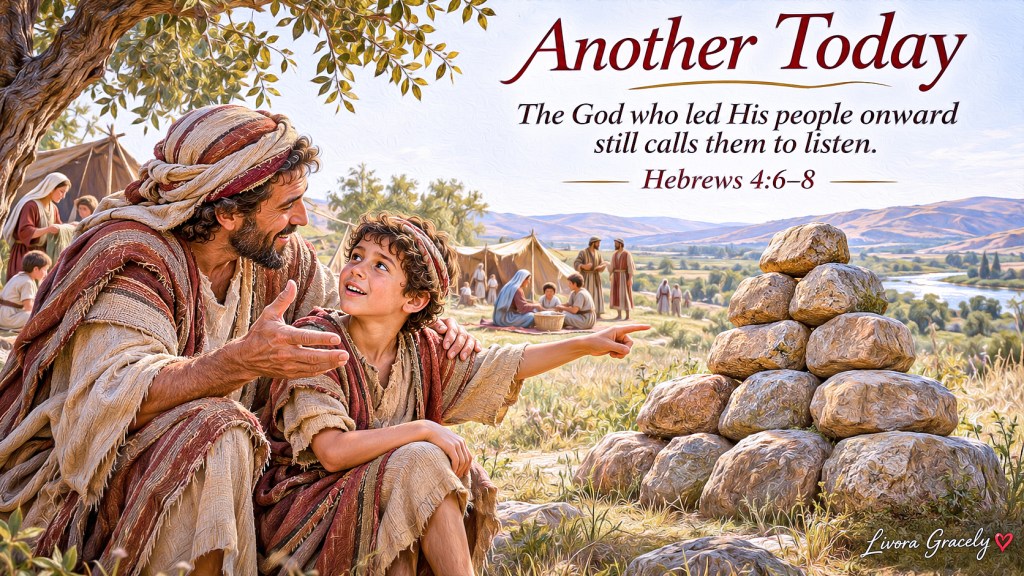
Hebrews 4:6–8
The God who led His people onward still calls them to listen.
The priests stood in the middle of the Jordan while the people crossed.
The river had stopped flowing after the priests carrying the ark of the covenant stepped into the water. When the nation had crossed, Joshua chose twelve men, one from each tribe, to take stones from the riverbed and carry them to the place where the people would stay that night.¹
The stones would become a sign. In the future, when children asked what they meant, their parents were to tell them how the waters of the Jordan had stopped before the ark of the Lord.¹
A generation had heard the story of God bringing Israel through the sea. Now the people who crossed the Jordan had another story to carry to their children.
Stones to Remember
The crossing did not stand alone. God had led His people from Egypt through the wilderness toward the promised land. The stones invited later generations to remember His mighty hand.¹
Under Joshua, the people entered the land. The book of Joshua says that the Lord gave Israel rest on every side and that His good promises to them were fulfilled.² That rest was real, and it belonged to the history of God’s faithfulness to Israel.
The previous generation’s refusal had also left a warning. Those who first heard the promise did not enter because of disobedience.³ The story carried forward held both God’s patient care and the seriousness of resisting Him.
Children could hear what happened at the Jordan and how their ancestors had tested God. Both stories invited them to know the One who led His people.
A Later Voice
Hebrews returns to those journeys and makes an observation: there remains an opportunity for some to enter God’s rest. Those who had first heard the good news did not enter because they disobeyed.³
Then the writer turns to Psalm 95. Long after the wilderness generation, God again speaks through words attributed in Hebrews to David: “Today, if you hear his voice, do not harden your hearts.”³ ⁴
Why speak of another day after the people had already entered the land under Joshua?
This is the question behind Hebrews’ argument. The rest given in Joshua’s day was real; the later psalm did not erase it. Yet the psalm’s continuing call to hear God’s voice points beyond what that generation had already received. If Joshua had brought God’s people into the full rest the writer is describing, there would have been no need to speak afterward of another day.³
The promise introduced in the previous article is still before the community. The story has moved from the wilderness to the Jordan, and from Joshua’s day to the psalm. Now Hebrews brings the word “today” to its own hearers.
They are not asked merely to admire the stones or repeat the story. They are called to listen to the living God.
Listen to the Son
At the beginning of Hebrews, God is described as having spoken through the prophets and, in these last days, through His Son.⁵ The letter directs its hearers to Jesus, faithful as the Son over God’s house.⁶
On a mountain, Peter, John, and James heard a voice from a cloud identify Jesus as God’s chosen Son and tell them to listen to Him.⁷ Later, Jesus described His sheep as those who listen to His voice; He knows them, and they follow Him.⁸
Listening is more than hearing a familiar name. It means attending to what Jesus says and trusting the One who speaks: His invitation to the weary, His warnings, His commands to love, and His promise to remain with those He sends.⁹
The “today” in Psalm 95 is a call not to harden the heart. Hebrews directs that call to hearers of the Son. The voice worth listening to is not an uncertain guess hidden inside every passing thought. The Son has spoken, and His words can be heard in the witness of Scripture.
A Promise Beside a Cross
Near the end of Jesus’ earthly life, two criminals were crucified with Him. One mocked Him. The other acknowledged that their punishment was deserved and that Jesus had done nothing wrong. Then he turned to Jesus and asked to be remembered when He came into His kingdom.¹⁰
Jesus answered with a promise: “Today you will be with me in paradise.”¹⁰
The man had no record of achievement to offer. In a moment of suffering, he turned toward Jesus and received His word. At the centre of that promise was being with Him.
The “today” Jesus spoke from the cross belongs to that particular promise. The “today” quoted in Hebrews comes from Psalm 95 and calls God’s people to hear His voice. The passages do not use the word in identical settings. Yet the man beside Jesus shows a person turning to the Son and hearing a promise in a moment when hope seemed far away.
The stones taken from the Jordan gave children a reason to ask what God had done. Psalm 95 called another generation to hear His voice. Hebrews brings that call to the people who have heard of the Son.
And the letter has not finished speaking of rest. Its next words say that a Sabbath rest remains for the people of God.³
Scripture References
- Joshua 3:14–17; 4:1–7, 19–24.
- Joshua 21:43–45.
- Hebrews 4:6–9; main passage, verses 6–8.
- Psalm 95:6–11.
- Hebrews 1:1–2.
- Hebrews 3:1–6.
- Luke 9:28–35.
- John 10:27–28.
- Matthew 11:28–30; John 13:34; Matthew 28:20.
- Luke 23:39–43; quotation from verse 43, NIV.


Leave a Reply