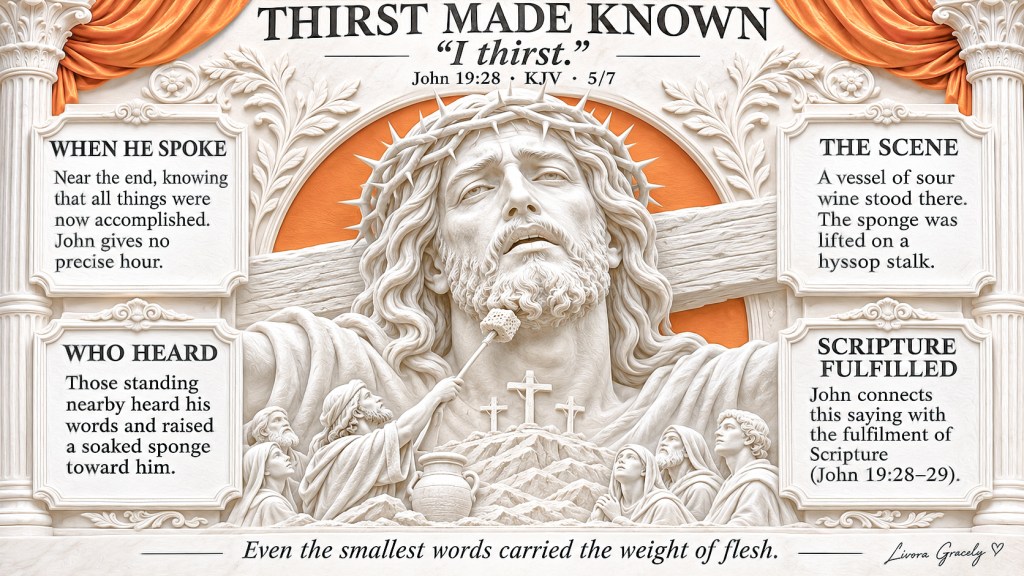
Even the smallest words carried the weight of flesh.
Two Short Words
In John’s account of the crucifixion, Jesus speaks two short words: “I thirst.”
The sentence is brief enough to pass over quickly. Yet John places it near the end of the account, after Jesus has spoken to his mother and the disciple he loved. A need of the body is made known in the middle of a story of suffering.
The Gospel does not give a precise hour for the saying. It tells us that Jesus, knowing that all things were now accomplished, speaks in connection with the fulfilment of Scripture. Then John turns our attention to what is nearby: a vessel containing vinegar, or sour wine.
The words do not describe the whole experience of crucifixion. They name one need, plainly and without elaboration.
A Vessel Nearby
John records a response. A sponge is filled with the liquid, placed on hyssop, and brought to Jesus’ mouth. The King James Version says “they,” without naming the person or people who carry out the action in these verses.
The account does not explain what those people were thinking. Nor does it tell us whether they understood the words as John presents them. It gives us the spoken need and the act that follows.
A vessel, a sponge, and hyssop are small details beside the public events of the crucifixion. They draw the reader close to a particular moment: words are spoken, and something is lifted towards the person who spoke them.
John goes on to say that Jesus receives the vinegar. What follows in the Gospel is another short saying, traditionally considered separately in the next article of this series.
Scripture in John’s Account
John connects the saying with the fulfilment of Scripture, though he does not name a particular verse in John 19:28. Readers often notice Psalm 69:21, where the speaker describes being given vinegar for thirst. The resemblance is worth considering without claiming that John explicitly identifies that verse here.
For Christian readers, the connection places this small scene within a larger scriptural story. At the same time, the words “I thirst” remain a clear expression of bodily need. Their place in that wider story need not make the need less real in the telling. The brevity of the saying leaves the reader with a simple human need rather than a detailed account of it.
The Gospel offers a detail that can be read on more than one level: a person speaks of thirst, and John invites attention to Scripture. Both belong to the passage.
A Human Need Spoken
“I thirst” is traditionally placed fifth among the seven sayings gathered from the Gospel accounts of the cross. The numbering brings sayings from different Gospels together; John does not present them as one numbered sequence.
Here the focus rests on the words John records and the response that follows. The passage does not ask us to imagine every sensation or supply a conversation that is not there.
In two words, a need is made known. A sponge is lifted. The Gospel’s account continues, but it gives this moment room to be heard.
Livora Gracely ♥
Sources: John 19:25–30, King James Version; Psalm 69:21, King James Version; Bible Gateway: Seven Words from the Cross.


Leave a Reply