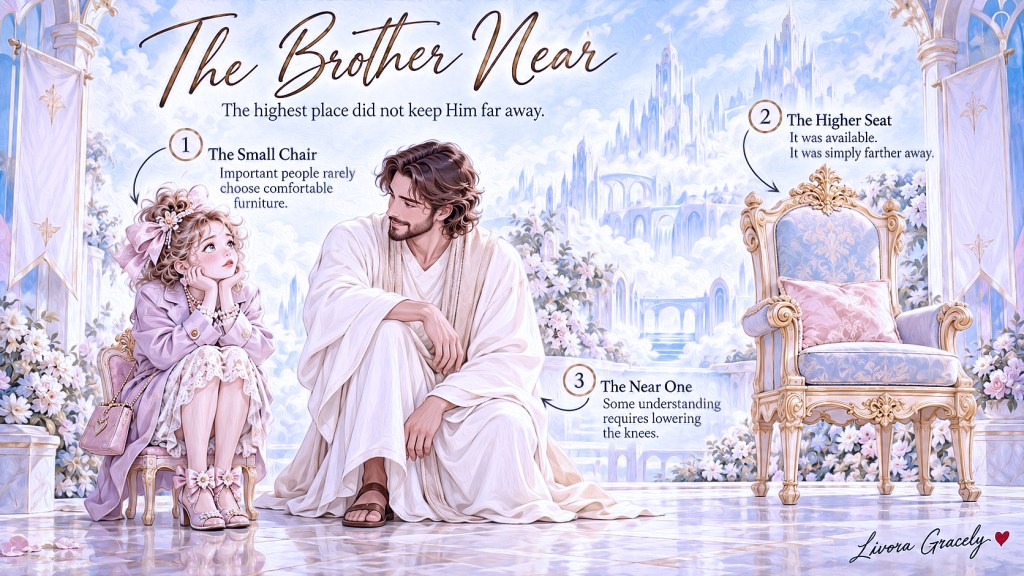
The highest place did not keep Him far away.
The chair was too small for the visitor.
It had been placed beside the waiting room window for a child who was still learning how to tie his shoes. The visitor, however, was a tall man in a dark coat, carrying a folder that made people sit straighter whenever he entered the room.
There were larger chairs available.
He chose the small one.
His knees rose awkwardly. The folder rested on the floor. When the child’s shoelace came undone again, the man leaned forward and tied it without making an announcement.
No one asked whether he was important.
The chair had already answered a different question.
How close is he willing to come?
A king may be recognized by his throne. A priest may be recognized by the room in which he serves. But a person who truly understands human weakness is often recognized by the distance he is willing to cross.
Hebrews begins by placing Jesus above angels, prophets, and every earthly authority.
Then it brings Him close enough to share human flesh.
Above the Angels
The movement is easy to miss because Hebrews begins so high.
Jesus is the Son through whom God made the ages. He is the radiance of God’s glory and the exact imprint of God’s nature. He is greater than the angels, and the angels worship Him.
Nothing about this introduction suggests an ordinary religious teacher.
Hebrews wants the reader to understand that Jesus does not become important because human beings eventually give Him a higher title. He is already higher. His position does not wait for public approval.
Then the letter begins to move downward.
Not downward as though Jesus is losing something.
Downward as an act of entering.
This is the surprise. The One who is higher than the angels does not remain at a safe distance from the people He comes to help. He does not send a message, appoint a committee, or provide instructions from a comfortable height.
He comes near.
The writer of Hebrews is careful here. He does not make Jesus smaller in order to make Him relatable. He does not say that Jesus becomes close by ceasing to be glorious. The glory remains.
The distance changes.
This is important because human beings often imagine greatness as a reason to stay apart. A powerful person is protected from ordinary inconvenience. A successful person is surrounded by people whose job is to prevent awkwardness. A king does not usually sit in the child’s chair.
But Hebrews presents a greatness that moves toward weakness rather than away from it.
The higher Jesus is, the more astonishing His nearness becomes.
Sharing Flesh
Hebrews says that the children share in flesh and blood, and that Jesus also shared in the same things.
The sentence is quiet, but it carries considerable weight.
Jesus does not merely appear human from a safe distance. He enters the condition of those He has come to save. He shares the material life of the people around Him: breath, skin, tiredness, hunger, pain, sleep, tears, and the vulnerability of having a body that can suffer.
Salvation is not performed from outside the human story.
This matters because distance can make compassion very inexpensive. Someone may speak beautifully about hunger without missing a meal. Someone may offer advice about grief without sitting beside the person who cannot yet speak. Someone may explain weakness while remaining carefully protected from it.
Hebrews does not describe Jesus as an observer of human pain.
He enters it.
The letter connects this nearness with death. Jesus shares flesh and blood so that through death He might break the power of the one who held the power of death and release those who had lived in fear of it.
The argument is not that human beings needed a distant demonstration of strength.
They needed someone who could enter the place where fear had built its house.
The One who created life accepts the conditions of mortal life.
He does not pretend that death is harmless. He passes through it.
This is not a costume change.
It is a descent into the actual room.
Not Ashamed
Then Hebrews gives us one of its most startling descriptions.
Jesus is not ashamed to call human beings brothers.
The sentence would be easier if the people involved were already impressive.
They are not.
Hebrews has just described human beings as weak, mortal, tested, and in need of help. The people Jesus calls brothers are not introduced as a polished family portrait. They arrive carrying fear, failure, and the long record of their inability to save themselves.
Yet Jesus is not ashamed to name them.
This brings Philemon quietly back into the room.
Paul asked Philemon to receive Onesimus no longer merely as a slave, but as a beloved brother. The request was difficult because Onesimus carried a history that could not simply be erased. The word brother had to become more than a theological idea. It had to affect where someone stood, how someone was addressed, and whether the old arrangement would be allowed to define the future.
Hebrews shows the larger surprise behind that request.
Christ is not ashamed to call human beings brothers.
The movement begins with Him.
Human acceptance does not persuade Christ to come near. His nearness makes acceptance possible.
This does not mean that every human relationship becomes easy the moment a new title is spoken. Filemon’s house still had to decide what brotherhood would require. Hebrews does not make that decision vanish.
It gives the decision a deeper foundation.
If the Son is willing to name weak and troubled people as brothers, then the word brother has become larger than social status, former usefulness, reputation, or an uncomplicated past.
The name is not a prize for those who have managed to become impressive.
It is a gift received by those who discover that Christ is not embarrassed by their need.
Tested Like Us
Hebrews later says that Jesus is able to help those who are being tempted because He Himself suffered when He was tempted.
The writer does not mean that Jesus became sinful in order to understand sinners. He means that temptation was not an abstract subject to Him.
He knew what it was to be tested.
He knew what it was to endure pressure without taking the shorter road. He knew what it was to face suffering without concluding that the Father had abandoned Him. He knew what it was to remain obedient when obedience did not produce immediate comfort.
This is why Hebrews can later invite its readers to approach the throne of grace with confidence.
They are not approaching a ruler who understands weakness only as a theory.
They are approaching a High Priest who has been tested in every way as they are, yet without sin.
The invitation is not sentimental.
It does not say that suffering is pleasant or that fear is imaginary. It says that weakness no longer has to be hidden before the One who understands it.
There is a difference between being observed and being known.
An observer stands outside the problem and records what happens. A brother comes near enough to carry part of the weight. A priest comes near enough to represent the people before God. In Jesus, Hebrews brings these movements together.
He is above the angels.
He shares human flesh.
He is not ashamed of His brothers.
He has been tested.
He helps.
The order matters.
His nearness is not created by our courage. We do not become brave enough to approach Him and then discover that He is willing to help. We approach because He has already come near.
The child in the waiting room eventually managed to tie his shoe. The visitor stood, unfolded his trousers, retrieved the folder, and returned to the larger room where people expected him to sit in a larger chair.
The small chair remained beside the window.
It had been designed for someone much smaller.
For a few minutes, however, it had held someone who could have chosen a better one.
Perhaps that is one way to begin Hebrews.
The One who is highest did not remain far away.
He came close enough to share the room, the weakness, the test, and finally the name:
brother.