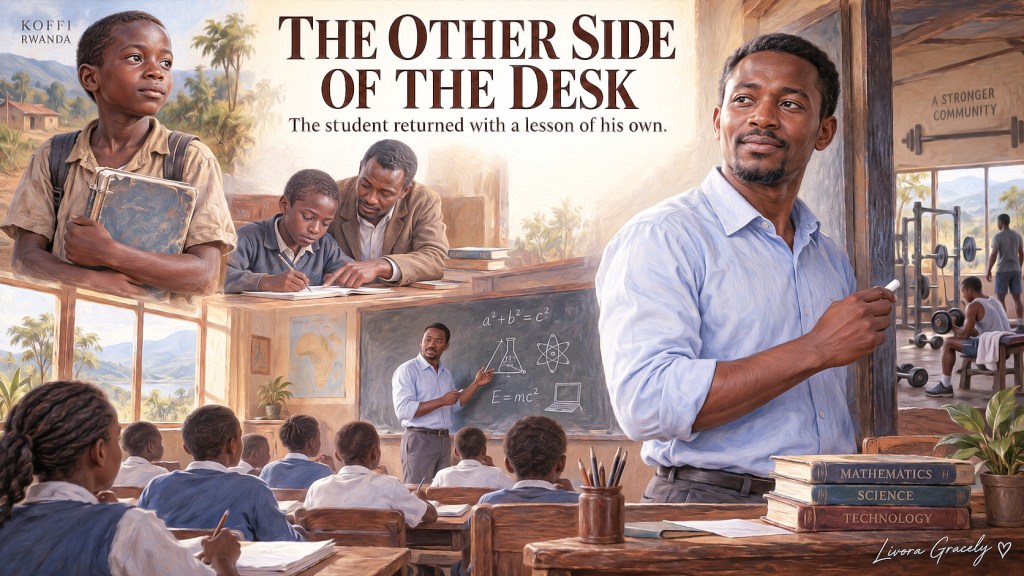
Koffi was already at the board when the first students came in.
A line of mathematics ran across the black surface. Beneath it, he had written a second line and stopped halfway through a third.
The classroom was still arranging itself.
A chair moved.
A book fell open.
Someone near the window whispered about football.
Koffi turned from the board and looked at the students.
There was always one who had arrived before the lesson had properly begun. There was another who needed more time to find a pen. Someone else was watching the chalk instead of the equation.
Koffi knew the room well.
He had once entered a classroom carrying a different kind of problem.
The School Fee
Koffi was born in Rwanda in 2003. His parents worked in small-scale agriculture. When his father died, Koffi was six, and his mother raised him alone.
He passed the national examination.
Then secondary school began.
The examination had opened a door. The school fees stood behind it.
For a while, the door remained difficult to enter.
Koffi continued as far as he could. His mother continued as far as she could. The numbers did not become kinder simply because the boy had passed his examination.
In September 2022, Forward Africa Education Trust took over his school fees and provided further support.
Koffi returned to his studies.
The classroom had not become easier.
There were still lessons to understand, assignments to complete, and days when the distance between wanting an education and being able to afford one felt uncomfortably short.
But the fees were covered.
The books remained open.
Koffi continued.
The Other Side
Later, Koffi stood at the front of a classroom again.
This time, he was the teacher.
He taught Mathematics, Science, and Technology at Right School in Kinyinya, in Gasabo district. His students arrived with their own questions, their own unfinished work, and their own reasons for looking toward the door.
Koffi placed the chalk on the desk.
One student raised a hand.
He waited.
The question came.
Koffi turned back to the board.
There was no need to make the answer seem easy. He had spent enough time with difficult things to know that a question could remain on the desk for a while without becoming a disaster.
He wrote the first step.
Then the next.
The students watched.
A few years earlier, someone else had stood in front of a classroom and made room for Koffi to continue.
Now Koffi was using the same room differently.
He did not leave the past outside the door. It had followed him into the classroom, along with the memory of unpaid fees, his mother’s work, and the long distance between an examination result and a school place.
But the past was no longer sitting in the teacher’s chair.
Koffi was.
After the Lesson
A teacher’s salary does not turn into a fortune simply because the teacher has a good story.
Koffi saved what he could.
Then he started a small community gym.
It gave young people and older people a place to exercise. It also gave Koffi another source of income.
The gym had its own equipment, its own noise, and its own collection of people who arrived with plans to become fit and immediately discovered that the equipment had opinions.
Koffi ran it independently.
In one place, he taught equations.
In another, he taught people how to keep returning after the first attempt had gone badly.
The two rooms were different.
The chair was not.
At the end of the school day, Koffi could leave the classroom and walk toward the gym. There were still lessons waiting in both places, although the equipment was less polite than the students.
Somebody would ask for help.
Somebody would misunderstand.
Somebody would return tomorrow with the same question.
Koffi would turn back toward the board.
The chalk would leave a white line.
Then another.
On the desk, beside the lesson plan, one chair remained available.
For the next student.
And perhaps for the teacher too.


Leave a comment