Livora Gracely

Writing to remember, sharing to inspire

  • Not every beautiful place needs to be reached in a hurry.


    The old man had been overtaken by six birds, two dogs, and his own wife.

    It was not yet nine in the morning.

    He considered this an unnecessarily competitive start to the day.

    His wife was perhaps twelve steps ahead, walking beneath the enormous trees with one of their white retrievers trotting beside her. The second dog had stayed with him, although mostly because it had discovered an interesting smell near a fallen leaf.

    The old man stopped.

    The dog stopped.

    They looked at each other.

    “Good,” he said. “Someone understands pacing.”

    Above them, white birds crossed the pale sky.

    Fff—fff—fff.

    The old man watched them disappear toward the lake.

    Show-offs.

    The Long Way

    They had been walking this path for years.

    It curved beside the water, passed beneath tall trees, climbed slightly near the old stone wall, and eventually returned to the village.

    Once, they could finish it quickly.

    Very quickly, according to the old man.

    His wife remembered this differently.

    “You always stopped for coffee.”

    “That was hydration.”

    “You ordered cake.”

    “Emergency carbohydrates.”

    Some historical disagreements are unlikely to be resolved.

    This morning, however, neither was in a hurry.

    Autumn had arrived gently.

    The air smelled of damp earth, dry leaves, and the faint mineral coolness of the lake. Under their shoes came the soft crrk—crrk of fallen leaves.

    One dog ran ahead.

    The other investigated a tree with such concentration that it appeared to be reading confidential correspondence.

    The old woman waited.

    Her husband caught up.

    Then they continued.

    The Bench

    Halfway around the lake stood a wooden bench.

    Years ago, they had rarely used it.

    Benches, back then, belonged to other people.

    Older people.

    People who apparently had nowhere urgent to be.

    Now the bench looked remarkably well designed.

    They sat.

    The dogs collapsed at their feet with the theatrical exhaustion of animals that had spent the morning doing exactly what they wanted.

    For a while, nobody spoke.

    A breeze moved through the trees.

    Leaves brushed one another overhead.

    Shhhhhhh.

    Across the lake, someone rowed a small boat. Each stroke entered the water with a quiet dip… pull… dip… pull.

    The old man rubbed one knee.

    His wife noticed.

    She did not ask.

    Instead, she moved slightly closer.

    Their shoulders touched.

    Above them, another group of white birds passed.

    He looked up.

    “They’re still winning.”

    She followed his gaze.

    “Where are they going?”

    He considered this.

    “No idea.”

    “Then how do you know they’re winning?”

    This was irritatingly strong evidence.

    Things Beside the Path

    They stood again.

    Near the old stone wall, the old man stopped.

    “Mushrooms.”

    His wife looked down.

    Three small brown caps stood beneath the fallen leaves.

    “Were those here last year?”

    “Probably.”

    A little farther on, she stopped beside two rocks.

    A tiny blue flower had grown between them.

    The old man bent slightly to inspect it.

    His knee objected.

    He straightened immediately.

    “I saw it.”

    “You barely looked.”

    “I saw enough.”

    They continued.

    A low sound came from somewhere above them.

    Eeeehhh…

    The old man stopped again.

    An enormous tree leaned slightly over the path, its branches shifting in the wind.

    Eeeehhh…

    He looked up.

    “That tree complains more than I do.”

    His wife kept walking.

    “Not even close.”

    He followed.

    Near the reeds, the lake smelled greener, almost muddy. Small insects hovered above the shallows, flashing briefly whenever they crossed the light.

    One retriever pushed its nose into the grass.

    The other stood perfectly still, watching something invisible.

    The old man looked back.

    The bench had disappeared behind the curve.

    The mushrooms were somewhere behind that.

    The blue flower too.

    He could not remember seeing any of them last autumn.

    He adjusted his cap.

    Then the dogs moved on, so he did too.

    The Shortcut

    Near the end of the path, his wife pointed toward a narrow trail.

    “Shortcut?”

    Her husband looked at it.

    The shortcut would save perhaps eight minutes.

    Once, that would have settled the matter.

    Eight minutes was eight minutes.

    He looked toward the narrow trail.

    Then toward the longer path.

    It curved beneath another row of trees where pale leaves were falling slowly through the air.

    One dog had already chosen it.

    The second followed.

    This was suspicious.

    The old man narrowed his eyes.

    “Did you train them?”

    “Of course not.”

    “Are you sure?”

    She began walking.

    He followed.

    The longer path it was.

    A leaf landed on his cap.

    His wife noticed and said nothing.

    Another landed on his shoulder.

    Still nothing.

    A third caught briefly in the collar of his coat.

    By the time they reached the lakeside again, he was carrying enough autumn to qualify as minor landscaping.

    She finally laughed.

    He looked down at himself.

    “Very dignified.”

    “Extremely.”

    He brushed the leaf from his shoulder and shook the one from his collar.

    Then he removed the leaf from his cap.

    He looked at it.

    Yellow at the edges.

    A little brown near the stem.

    He turned it once between his fingers.

    Then, for reasons he could not explain, put it in his pocket.

    Arrival

    They reached home almost an hour later than they once would have.

    Nothing terrible had happened.

    No appointment had been missed.

    Civilization remained operational.

    The dogs rushed to their bowls.

    Lap-lap-lap-lap.

    The old woman put water on for tea.

    Her husband stood at the kitchen table and emptied his pockets.

    Keys.

    A handkerchief.

    Two dog treats.

    And the leaf.

    His wife picked it up.

    “You brought this home?”

    “It followed me.”

    She examined it for a moment, then placed it beside the window.

    Outside, the afternoon had turned pale gold.

    The old man looked toward the sky.

    The white birds were gone.

    He looked at the leaf.

    Click.

    The kettle switched off.

    He poured two cups.

    His wife handed him his.

    “Same path tomorrow?”

    He took a sip.

    “Depends.”

    “On what?”

    He glanced toward the window.

    Then toward the two retrievers, already asleep on the kitchen floor.

    “How much of a hurry the dogs are in.”
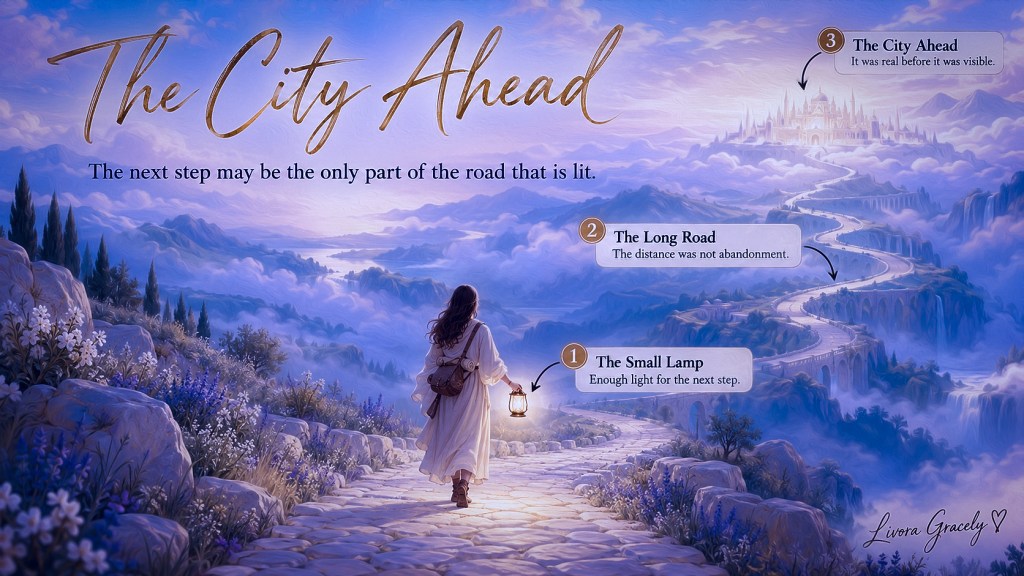
  • The next step may be the only part of the road that is lit.


    The traveller had been walking long enough to stop asking when the city would appear.

    At first, every rise in the road had seemed promising. He would climb, shield his eyes, and expect to see towers beyond the next line of hills. Instead, there would be another valley, another bend, another stretch of ground turning blue in the evening.

    Now he carried only a small lamp, a rolled piece of cloth, and a promise he could not unfold into a map.

    The lamp gave him enough light to see the stones near his feet. It did not illuminate the city. That would have been useful, but apparently the lamp had been assigned a more modest task.

    He lifted it, took the next step, and kept walking.

    Hebrews 11 begins with people like this. Not people who possessed a complete picture of the future, but people who acted because they trusted the One who had spoken about it. Their faith was not an escape from history. It was a way of moving through history when the destination remained beyond sight.

    The People Before

    Hebrews does not introduce its witnesses as a parade of people who found faith easy. Abel, Noah, Abraham, Sarah, Moses, and the others appear as men and women whose lives were shaped by a promise that had not yet become fully visible.

    The chapter is often remembered as a list of heroes. The writer seems to remember something more human: these people had to make decisions before they could see how the decisions would end.

    Abel offered what he believed was acceptable before anyone could measure the outcome. Noah prepared for a judgment that had not yet arrived. Abraham left his country without carrying a complete address for the place he would receive. Sarah trusted a promise that had become physically unreasonable.

    Their lives did not unfold inside a well-lit room.

    The road contained uncertainty, delay, disappointment, and the ordinary difficulty of continuing after the first excitement had passed. A promise can sound bright when it is first given. It becomes heavier when the years begin adding their weight to it.

    Hebrews does not hide that weight. It says that some of these people died in faith without receiving the things promised, though they saw them and welcomed them from a distance. They confessed that they were strangers and exiles on the earth.

    That is not the language of people who had mistaken optimism for faith. It is the language of people who had learned to live with a future they could not yet hold.

    They carried the promise as one might carry a letter through a long journey. The letter does not become less real because the destination is far away. But the traveller must still walk through weather, hunger, unfamiliar roads, and nights when the writing cannot be read.

    The people before us are not important because they never felt uncertainty. They are important because uncertainty did not become the final authority over their next action.

    Faith Without Proof

    Hebrews defines faith as confidence in what is hoped for and assurance about what is not seen. The sentence has often been made to sound like an instruction to stop thinking. In the letter, it means something more demanding.

    Faith is not the ability to feel positive while facts remain inconvenient. It is the way a person orders life when the promise is trusted before the result can be displayed.

    Noah builds before the rain. Abraham leaves before the map is complete. Moses chooses identification with an oppressed people rather than the temporary advantages of the royal household. These actions are not proofs that the future has already arrived. They are responses to a word that has become more trustworthy than the comfort of staying where one is.

    This is where the old wilderness returns.

    In the wilderness, the shorter road looked persuasive because the destination was good. Bread was good. Protection was good. Kingdom was good. The pressure came from trying to possess the good thing without receiving the road that belonged to it.

    Hebrews does not present the long road as evidence that God has forgotten the traveller. Sometimes the length of the road becomes the place where trust changes from an idea into a habit.

    Anyone can promise to be patient while the answer is still nearby. Patience becomes visible when the answer remains absent and the person still tells the truth, keeps the promise, returns to the work, or refuses to exchange faithfulness for a faster reward.

    This kind of faith rarely looks impressive from the outside. A person goes to work. A person keeps caring for someone who cannot repay the effort. A person tells the truth without knowing whether honesty will protect the future. A person opens the door again after disappointment, though the hinges have not become more cooperative.

    There may be no dramatic proof.

    There is simply another step taken in the direction of the promise.

    The lamp does not need to prove the existence of the city. It only needs to give enough light for the foot that is about to move.

    The Better City

    The people in Hebrews 11 were not merely waiting for a safer house, a better harvest, or a piece of land they could finally call their own. The letter says that they were longing for a better country, a heavenly one. Therefore God is not ashamed to be called their God, for He has prepared a city for them.

    This is where the horizon expands.

    The promise is not reduced to private escape. The people of faith are being gathered toward a home prepared by God, a city that gives shape to their wandering and meaning to their endurance.

    A city is different from a hiding place. It has streets, gates, neighbours, memory, work, worship, and a shared life. The image suggests not only arrival but belonging. The traveller is not being rescued into emptiness. He is being led toward a place where the scattered pieces of life can be gathered into a community.

    Hebrews later speaks of Mount Zion, the city of the living God, the heavenly Jerusalem, and the assembly of the firstborn. The letter does not need to describe every street in order to make the direction clear. Its readers are already being taught to see themselves as people whose true home is not exhausted by the present arrangement of the world.

    The language quietly opens toward the final biblical vision of a city where God dwells with His people. Hebrews does not unfold the whole scene from Revelation here, and it does not need to. A horizon can be real without being fully drawn.

    What matters is that the city ahead is better than the security the traveller could build alone. It is designed by God, and it gathers people who have learned to walk by faith rather than by possession.

    This gives the road a different meaning. The traveller is not wandering because there is no destination. He is walking because the destination is larger than anything he could have invented from the roadside.

    The city remains ahead.

    That is not a failure of the promise. It is the reason the promise continues to pull the traveller forward.

    Outside the Camp

    By the time Hebrews reaches chapter 13, the language of pilgrimage becomes more physical. The readers are told to go to Jesus outside the camp, bearing the disgrace He bore, because here we do not have an enduring city but we are looking for the city that is to come.

    The sentence does not sound like a travel advertisement.

    There is no promise of a comfortable route, a flattering reception, or a clean pair of sandals at the end of the day. To go outside the camp means leaving the place where respectability is most easily maintained. It means accepting that loyalty to Christ may place a person beyond the boundaries of safety, approval, and familiar religious arrangement.

    Yet Hebrews does not turn this into a contest for dramatic suffering. The call is not to perform hardship so that God will be impressed. It is to remain with Jesus where faithfulness has taken Him, even when the place is inconvenient and the city is not yet visible.

    This is where the great language of Hebrews returns to the body.

    The pilgrim has feet that become tired. The lamp needs oil. A companion may fall behind. Someone must share food. Someone must remember the prisoner, welcome the stranger, honour marriage, resist the love of money, and keep doing good when applause has gone elsewhere.

    The future city is not an excuse to neglect the present road. It is the reason the present road can be walked with courage.

    The people before us did not receive a complete map. The readers of Hebrews do not receive one either. They receive a better Priest, an open way, a living promise, and enough light to obey the next instruction.

    The traveller reaches the top of another hill. The lamp has grown dim. Below him, the road bends through the dark, and beyond the darkness there is still no city to be seen.

    He could sit down and call the unseen destination unrealistic. He could turn back and announce that the road had been misleading. Or he could protect the small flame, listen for the footsteps of the others, and take the next step.

    The city is still ahead.

    So is the road.

    And for tonight, the lamp is enough.

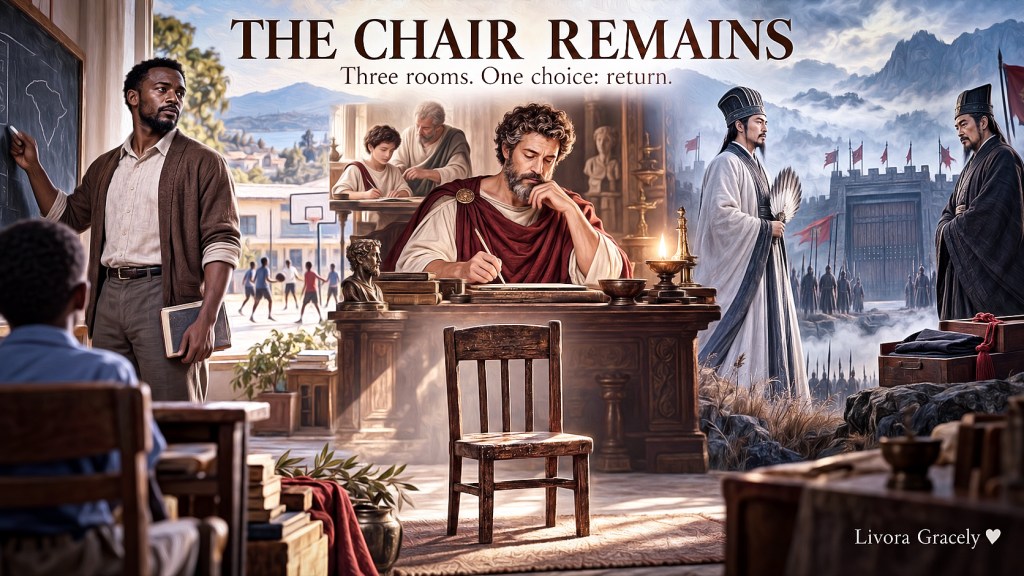
  • Three rooms had been left behind.

    A classroom after the lesson.

    A palace after the lamp had burned low.

    A military camp after the drums had stopped.

    In each room, something remained.

    A chair.

    A piece of chalk.

    A writing tablet.

    A closed gate.

    Nobody had promised that the next day would be easier.

    The rooms simply waited.

    A Waiting Chair

    Koffi had once entered a classroom as a student carrying the weight of school fees.

    Later, he stood at the front of another classroom with chalk in his hand.

    The students did not know how many difficulties had brought him there.

    They only knew that the equation on the board had stopped making sense.

    One student raised a hand.

    Koffi turned around.

    He did not erase the problem.

    He wrote one step beneath it.

    Then another.

    The chair behind him remained empty.

    It had belonged to the teacher before him.

    Now it was waiting for the next student who would discover that understanding sometimes arrived after the third attempt.

    At the end of the day, Koffi left the classroom and went to the gym he had built from his savings.

    Different room.

    Different equipment.

    The same returning bodies.

    Someone lifted a weight and placed it down too quickly.

    Someone else watched.

    Koffi adjusted the equipment.

    “Again,” he said.

    The person tried once more.

    The room did not applaud.

    It simply made space for another attempt.

    The Second Answer

    Marcus Aurelius had been surrounded by people who expected answers.

    They came to the palace carrying disputes, requests, and reports.

    He gave them an answer.

    Then he returned to his books.

    Sometimes the first answer remained.

    Sometimes it did not.

    A sentence was read once.

    Then twice.

    A stylus rested above the tablet.

    The emperor looked at the words again.

    Outside, a messenger waited.

    Inside, Marcus crossed out what he had written.

    The correction made the tablet less beautiful.

    It also made the decision safer.

    He had teachers who corrected his speech.

    Teachers who corrected his habits.

    Teachers who reminded him that a person could wear authority and still misunderstand a difficult thought.

    So he kept returning to the work.

    Not to produce a perfect answer.

    To make the next one less careless.

    The lamp burned down.

    The messenger waited.

    The emperor read again.

    The Closed Gate

    At Wuzhang Plains, Zhuge Liang sent a gift that was meant to provoke Sima Yi.

    The garments were placed before him.

    The officers wanted the gate opened.

    They wanted horses.

    They wanted the enemy to pay for the insult immediately.

    Sima Yi looked at the clothes.

    Then he looked at the map.

    The order from the emperor was still clear.

    Hold the position.

    Do not attack.

    The gate stayed closed.

    Beyond it, Zhuge Liang’s army waited.

    Inside, Sima Yi asked about his rival’s sleep, food, and workload.

    The questions sounded smaller than the war.

    They were not.

    A commander could be invited to fight by a message.

    He could be forced to fight by an order.

    He could also refuse to let another man choose the moment for him.

    Days passed.

    The soldiers grew tired of waiting.

    The gate remained where it was.

    After Zhuge Liang died, the Shu army withdrew.

    Its banners turned.

    Its drums sounded.

    Sima Yi stopped his pursuit.

    The dead commander had left one final uncertainty behind him.

    Sima Yi did not rush toward it.

    He let the road empty.

    Still Standing

    Koffi returned to the board.

    Marcus returned to the tablet.

    Sima Yi returned to the closed gate.

    None of them received a final announcement.

    No voice entered the room to say that the difficult part had ended.

    Koffi still had students who did not understand.

    Marcus still had judgments that required a second look.

    Sima Yi still had enemies who knew how to make waiting feel like defeat.

    The work continued because the room continued.

    A chair was pulled back.

    A piece of chalk broke.

    A hand reached for another.

    The tablet received one more correction.

    The gate held through another night.

    There were no guarantees attached to any of these actions.

    The student might fail again.

    The emperor might still choose badly.

    The army beyond the gate might find another way in.

    Koffi placed the chalk on the desk.

    Marcus closed the tablet.

    Sima Yi listened to the silence outside.

    Then each returned to the place where the work had stopped.

    The chair remained.

    Not as a monument.

    As an invitation.

    Someone would sit there tomorrow.

    The lesson would begin again.

  • New places. Same simple joys.


    Three boats.

    Three ropes.

    Two knots.

    The third rope was floating in the water.

    This seemed important.

    The seagull standing on that boat disagreed.

    He was busy looking at a piece of bread.

    It floated six inches from the hull.

    The boat moved seven.

    The bread remained where it was.

    The seagull looked at the bread.

    Then at the boat.

    Then back at the bread.

    By the time he had completed this investigation, breakfast was nine inches away.

    The tide had begun its work.

    New Place

    The little white boat drifted slowly from the wall.

    Not dramatically.

    There were no storms.

    No heroic waves.

    Just blue water nudging the hull with small wet sounds.

    Lap. Lap. Lap.

    The harbor smelled of salt, old rope, warm wood, and something being fried somewhere beyond the white buildings.

    The seagull remained aboard.

    Leaving now would suggest poor planning.

    A second boat passed nearby.

    Another seagull stood on its bow.

    They looked at each other.

    One was travelling.

    One was technically parked.

    Neither mentioned the difference.

    The boats touched gently.

    Tok.

    The second seagull stepped across.

    Now the drifting boat had two passengers.

    This improved nothing.

    New Friends

    Near the stone wall sat a third boat.

    A third seagull occupied it.

    He had been watching the entire operation with professional concern.

    As the drifting boat approached, he leaned forward.

    The two passengers leaned forward.

    The gap narrowed.

    Three feet.

    Two.

    One.

    The third seagull hopped aboard.

    The empty boat rocked behind him.

    Now there were three.

    The harbor widened ahead.

    Sunlight broke into little silver pieces across the turquoise water.

    A bell rang somewhere uphill.

    The frying smell became stronger.

    All three birds turned their heads at exactly the same time.

    Priorities had survived the journey.

    Same Feeling

    The loose boat eventually reached the opposite side of the harbor.

    Its rope caught around an old wooden post.

    The boat swung once.

    Twice.

    Stopped.

    The three seagulls looked around.

    Different wall.

    Different boats.

    Different patch of sunlight.

    One gull pecked at the bench.

    Another inspected the rope.

    The third found something beneath the rear seat.

    A crumb.

    Very small.

    Possibly ancient.

    He swallowed it anyway.

    The other two stared.

    He stared back.

    Then, from the promenade above—

    a child dropped a corner of bread.

    It landed on the water.

    All three seagulls froze.

    The bread floated six inches from the hull.

    Three heads turned toward it.

    Then toward one another.

    The boat moved seven inches.

    Nobody waited for an investigation this time.

    Three white wings opened at once.

    Ffflap.

    The boat rocked gently behind them.

    The loose rope floated beside it.

    Apparently tomorrow already had transportation.

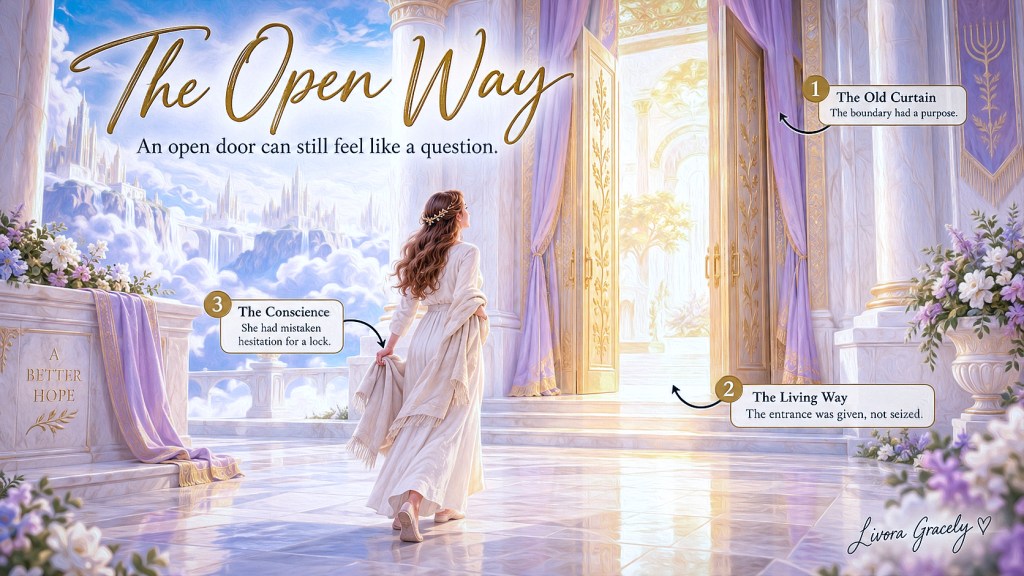
  • An open door can still feel like a question.


    The door had been open since sunrise.

    There was no lock in the keyhole, no guard beside it, and no sign asking visitors to wait. Light fell across the threshold in a pale rectangle, warming the dust on the floor. From inside came the soft movement of people preparing the room.

    Still, the woman stood several steps away.

    She had arrived early enough to be first. She had even rehearsed what she might say if someone asked her name. But every time her foot moved toward the doorway, her hand returned to the fold of her coat.

    An open door, unfortunately, does not always feel like an invitation.

    Sometimes the body remains outside because the conscience has memorized the distance.

    Hebrews understands this kind of hesitation. It has already shown us the priest entering behind the curtain on behalf of people who could not simply walk into the holy presence. Now the letter moves closer to the threshold and asks what the work of Christ has done to the distance itself.

    The Old Curtain

    The tabernacle had an outside and an inside, a place where people gathered and a place where the priest entered according to the order God had given. There were vessels, washings, offerings, garments, and boundaries. The arrangement was not designed to make worship mysterious for the pleasure of making people wait.

    It taught that access mattered.

    The curtain was a physical sentence. God was present, but human beings could not approach Him carelessly. The priest could enter, but not as though the room belonged to him. He entered with reverence, with blood, and with the awareness that he represented more people than himself.

    The outside worshipper could hear the work without seeing all of it. The curtain made the nearness of God visible and the limitation of human approach visible at the same time.

    Hebrews calls the earthly sanctuary and its rituals a copy and shadow of heavenly realities. That language can sound dismissive if we hear “shadow” as though it meant useless. But a shadow is evidence that something is standing nearby. It has shape because it belongs to a body.

    The older arrangement was therefore not a foolish attempt to reach God. It was a faithful sign that the problem of access was real and that access would require more than human enthusiasm.

    The trouble is that a sign can become a permanent waiting room if we forget what it was pointing toward.

    The priest entered and came out. The offering was made and had to be made again. The boundary remained. The people were near enough to worship, but not yet invited to treat the innermost presence as their ordinary room.

    The curtain did not say that God had no desire to dwell with His people. It said that the way into His presence had not yet been opened in its final form.

    That is why Hebrews does not stop at the curtain. It asks what kind of sacrifice, what kind of priest, and what kind of covenant could carry the meaning of the sanctuary all the way to its intended end.

    The Better Blood

    The language of blood can make modern readers step backward. It belongs to a world of sacrifice, altar, animal life, and covenant, and it cannot be reduced to a decorative religious metaphor. Hebrews uses it because life, guilt, cleansing, and reconciliation are not weightless ideas.

    Something has happened between God and humanity, and something must be done about it.

    The sacrifices of the former covenant were repeated. Their repetition did not mean that they were meaningless. It meant that they belonged to a system in which the work of approach remained ongoing. The priest served again. The offering was brought again. The people returned again to the place where the problem had been acknowledged and covered.

    Again is a small word, but it can become a heavy one.

    Anyone who has apologized for the same failure, reopened the same argument, or promised to begin again with the same tired voice knows that repetition does not automatically produce transformation. A person may keep returning to the doorway without becoming more certain that he is welcome inside.

    Hebrews places the repeated sacrifices beside the work of Christ and sees a decisive difference. Christ enters not with the blood of goats and calves but with His own blood. The letter describes His offering as once for all, not because the suffering is cheap, but because its work is complete in a way the earlier sacrifices could not be.

    The contrast is not between a cruel God and a kinder religious system. It is between signs that must be repeated and a self-giving act that reaches its intended depth.

    Christ does not merely perform another ceremony in a longer sequence. He gives Himself as the One who has already become the Priest, the offering, and the living access to God. The old arrangement kept pointing toward a cleansing that could not remain only on the surface.

    The work has to go deeper than the hands.

    It has to reach the heart that keeps returning to the same accusation.

    The Conscience

    Hebrews says that the blood of Christ cleanses the conscience from dead works so that people may serve the living God.

    The sentence is large. The experience it touches is not.

    A person can stand close to religious activity and still feel locked outside. He may know when to stand, when to speak, when to bow, and where to place his hands. He may be able to explain the correct vocabulary while carrying an inner room that remains dark and crowded with old voices.

    The conscience keeps its own archive.

    It remembers the sentence spoken too sharply, the promise broken quietly, the person treated as disposable, the opportunity to tell the truth postponed until it became harder. It can also remember things nobody else saw, which is one reason public respect does not always create private peace.

    This is not an argument that every feeling of guilt is accurate. Some consciences accuse where God has already forgiven. Some people carry shame borrowed from cruel voices that never had the right to name them. Hebrews is not asking the conscience to become another judge with a cleaner robe.

    It is announcing a deeper cleansing.

    The aim is not merely to make a person look acceptable at the doorway. It is to release the person from the dead works that keep him circling the same room, trying to purchase an entrance that cannot be bought.

    The woman in the morning scene had not been stopped by a locked door. She had been stopped by the question she carried inside herself: what if I am not the sort of person who is allowed to enter?

    There are moments when a person can no longer hide behind activity. The hands are busy, the prayers are familiar, the calendar is full, but the heart is still standing at a distance. The old curtain may have disappeared from the architecture while remaining perfectly intact in memory.

    Hebrews speaks into that inward distance by saying that Christ’s work reaches the conscience. The person who draws near does not come because he has successfully edited his past. He comes because the cleansing has been given before he can present a convincing version of himself.

    That is the difference between religious performance and access.

    One keeps asking, “Have I done enough to enter?” The other hears, “Come because the way has been made ready.”

    Draw Near

    Near the centre of Hebrews comes an invitation that would have sounded almost startling after so much language about priests, blood, sanctuary, and boundaries: let us draw near with a sincere heart and with the full assurance that faith provides.

    The invitation is not careless. It does not flatten holiness into friendliness or turn God into a room that exists for our convenience. The confidence comes from Christ’s work, not from the visitor’s personality.

    This is why Hebrews can speak of a new and living way opened through the curtain, that is, through Christ’s flesh. The curtain is no longer simply the barrier that explains why people must stay outside. In Christ, the barrier becomes the place through which access has been created.

    The way is living because it is not a dead technique. It is not a sequence of steps that works whether or not anyone is alive to receive the person who comes. The way is living because the Priest who opened it lives.

    This changes the posture of the person at the threshold.

    He does not storm the room. He does not demand entrance as though holiness were a public service that had failed to process his application. He comes with a true heart, cleansed from an accusing past, and with confidence that has been given rather than manufactured.

    The woman looks once more at the open door. The light has not changed. The room has not become less holy because she has taken a step. What has changed is the reason she is standing there.

    She does not enter to prove that she belongs.

    She enters because she has been invited through a way she could not build herself.

    That is the movement Hebrews wants its readers to carry forward. The old curtain taught that God cannot be approached casually. The better blood shows that Christ has dealt with the deeper obstacle. The cleansed conscience no longer has to remain outside rehearsing its failures. The invitation is not to seize God, but to draw near to the God who has made nearness possible.

    The doorway remains quiet. No trumpet announces the woman’s arrival. No guard steps aside with theatrical seriousness. She simply crosses the threshold, and the coat that had been clutched so tightly begins to loosen in her hands.

    The door had been open since sunrise.

    She had mistaken her hesitation for a lock.

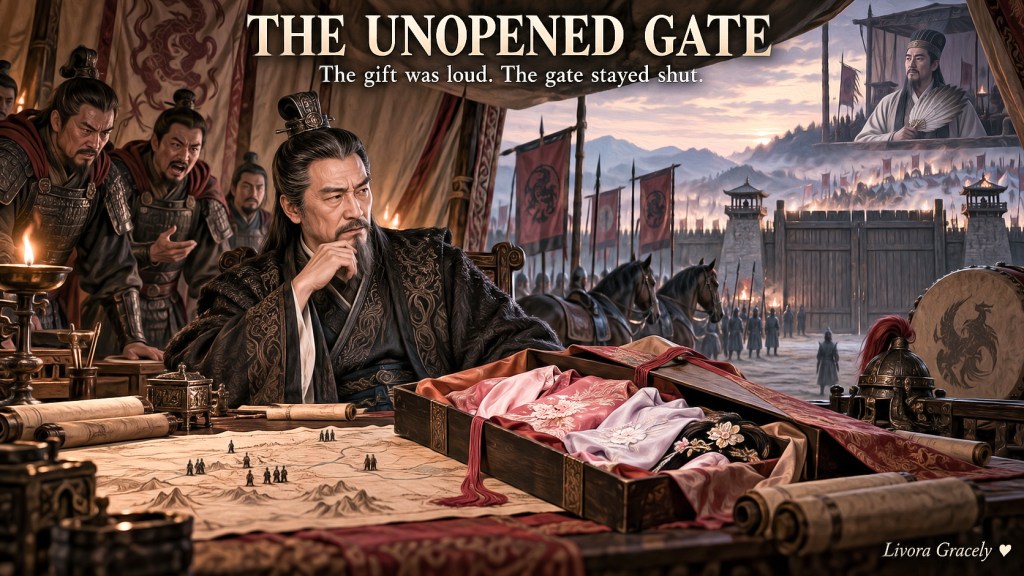
  • The package arrived before breakfast.

    It was wrapped in fine cloth and tied with a red cord.

    A soldier carried it across the Wei camp while the men watched from beneath their helmets.

    Sima Yi was seated beside a map.

    “From the Shu camp,” the soldier said.

    Sima Yi looked at the package.

    “Put it there.”

    The soldier placed it beside the military reports.

    Nobody touched it.

    Outside, the armies faced each other across the Wuzhang Plains.

    Inside, the package waited.

    The Gift Arrives

    Sima Yi untied the cord.

    The cloth opened.

    A woman’s garments lay inside.

    There was a head covering.

    A robe.

    Ornaments.

    The kind of things a man might send when he wanted an enemy commander to feel smaller than his army.

    One officer saw the garments and struck the table with his palm.

    “Commander, this is an insult.”

    Another reached for his sword.

    The tent filled quickly with voices.

    Zhuge Liang had sent messages before.

    He had invited battle.

    He had moved troops where they could be seen.

    He had made the silence between the armies feel deliberate.

    This gift was different.

    It did not ask Sima Yi to read a military report.

    It asked him to answer an insult.

    Sima Yi lifted the robe by its edge.

    The cloth hung from his hand.

    He examined it for a moment, then placed it back inside the package.

    “Send word to the emperor,” he said.

    The officers turned toward him.

    “You will not fight?”

    “Send word to the emperor.”

    The package remained open on the table.

    The men around it were ready to turn cloth into fire.

    Sima Yi closed the lid.

    A Burning Question

    The soldiers wanted an answer that could be heard from the walls.

    They wanted the gates opened.

    They wanted horses saddled.

    They wanted Zhuge Liang to see that an insult had consequences.

    Sima Yi wanted information.

    When an envoy later arrived from the Shu camp, Sima Yi did not ask about troop positions.

    He did not ask how many arrows had been prepared.

    He did not ask which gate was weakest.

    “How does Zhuge Liang sleep?” he asked.

    The envoy looked at him.

    Sima Yi continued.

    “What does he eat?”

    “How much work does he handle himself?”

    The questions seemed too small for two armies.

    The envoy answered.

    Zhuge Liang rose early.

    He went to sleep late.

    He personally reviewed punishments and official matters.

    He ate very little.

    Sima Yi listened.

    The tent had become quiet again.

    He did not need to know what Zhuge Liang wanted him to see.

    He wanted to know what the man’s body was beginning to reveal.

    “Too little food,” Sima Yi said.

    Too many affairs.

    He touched the edge of the table.

    “How long can that continue?”

    The envoy returned to the Shu camp.

    The soldiers waited for news of battle.

    Sima Yi returned to the map.

    The robe remained folded inside its box.

    The Quiet Camp

    The emperor’s order was clear.

    Hold the position.

    Do not attack.

    Wait.

    This was difficult advice for soldiers to admire.

    A man could understand a charge.

    He could point to a wall and call it courage.

    Waiting had no such shape.

    It looked like hesitation from a distance.

    It sounded like weakness when men were tired.

    Sima Yi’s officers came to him again.

    They spoke about honor.

    They spoke about the shame of remaining behind the gates.

    They spoke about the eyes of the army.

    Sima Yi listened until the room had emptied itself of anger.

    Then he wrote a memorial.

    The message carried the insult to the emperor.

    Zhuge Liang had sent women’s garments.

    The Wei commander had been mocked.

    His soldiers were eager to fight.

    He requested permission to answer.

    The memorial left the camp.

    The answer came back with Xin Pi, carrying the emperor’s authority.

    No attack.

    Hold position.

    The officers stared at the messenger.

    Sima Yi stared at the floor.

    The garments were still in the tent.

    The gate remained closed.

    Beyond it, Zhuge Liang’s army waited for movement.

    Nothing happened.

    That was the movement.

    A horse stamped in the darkness.

    A sentry changed shifts.

    A cooking fire went out.

    The army that had been invited to rush forward remained where it was.

    Sima Yi did not explain himself to the night.

    He only gave the order.

    “Keep the gates shut.”

    After The Drums

    The armies stayed opposite each other.

    Days collected around the camps.

    The Shu army had traveled far from its supplies.

    The Wei army had something Sima Yi valued more than applause.

    Time.

    Then news came from the Shu camp.

    Zhuge Liang had died.

    The Shu soldiers began to withdraw.

    Sima Yi followed.

    The retreat looked orderly.

    Too orderly.

    The banners moved.

    The drums sounded.

    Then the Shu army turned.

    The banners faced the Wei troops.

    The drums beat as if the dead commander had given one final order.

    Sima Yi stopped.

    For a moment, the road held its breath.

    Someone near him shouted that Zhuge Liang might still be alive.

    Sima Yi raised his hand.

    The soldiers halted.

    No one moved toward the retreating army.

    The Shu troops disappeared into the valley.

    Only then did they announce Zhuge Liang’s death.

    The soldiers began whispering about the commander who had frightened the living after he was gone.

    Sima Yi heard them.

    He laughed once.

    “I can judge the living,” he said. “The dead are more difficult.”

    Later, he inspected the abandoned Shu camp.

    The arrangements were precise.

    The defenses were carefully placed.

    The roads had been measured.

    The stores had been guarded.

    Sima Yi stood among the empty tents.

    The clothes sent to mock him were no longer important.

    The man who had sent them was gone.

    Yet the camp still carried his hand.

    Sima Yi looked across the ground.

    “An extraordinary talent,” he said.

    The words were not offered to an enemy soldier.

    They were spoken to the men beside him.

    The gate had remained closed.

    The army had survived the insult.

    The war had outlasted the message.

    Sima Yi had not won by becoming louder.

    He had kept his army from obeying the first feeling that entered the tent.

    The garments had been sent to make him move.

    He had let the cloth remain still.

    Outside, the wind crossed the abandoned camp.

    Inside the Wei position, the package was finally folded away.

    No sword had touched it.

    No soldier had worn it.

    No answer had been sent in anger.

    The road ahead was still dangerous.

    Another challenge would come.

    Another voice would demand a response.

    Sima Yi returned to the map and sat down.

    The gate remained shut.

    And somewhere beyond it, the next decision waited.

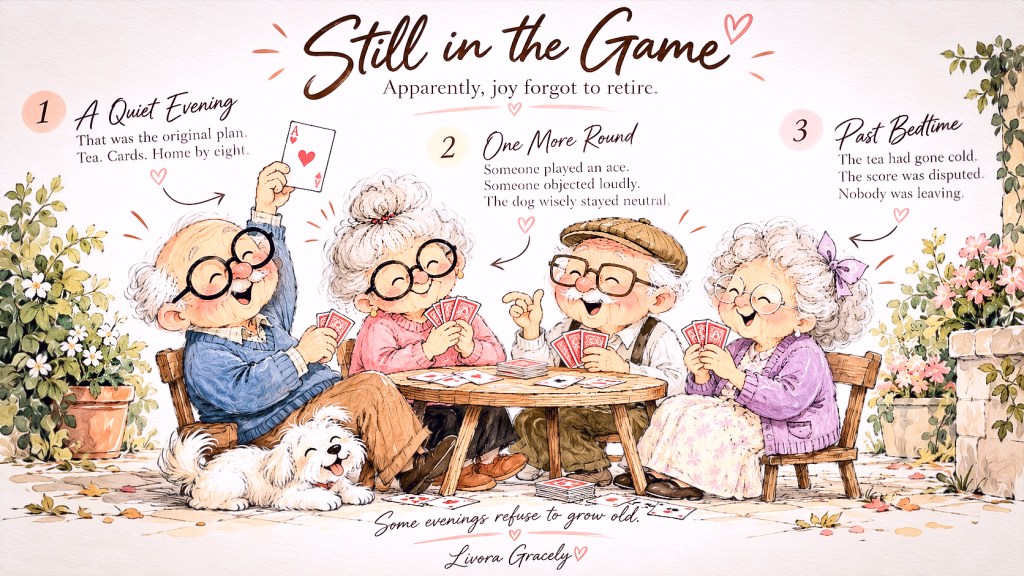
  • Apparently, joy forgot to retire.


    SLAP.

    The ace landed in the middle of the table.

    “Absolutely not.”

    Grandma Rosa pushed her glasses higher.

    Across from her, Arthur leaned back with the peaceful expression of a man who had just committed something technically legal.

    “It’s an ace.”

    “I can see that.”

    “Good.”

    “I can also see you smiling.”

    Arthur stopped smiling.

    This did not improve his case.

    Beside the table, the little white dog opened one eye.

    Four people were playing cards.

    Three were now accusing the fourth.

    The dog closed his eye again.

    He had seen enough.

    The Original Agreement

    The evening had begun respectably.

    Tea at seven.

    Cards at seven fifteen.

    Home by eight.

    Nobody had objected.

    Margaret brought butter biscuits in a round tin.

    Henry shuffled.

    Rosa poured the tea.

    Arthur announced that he had forgotten his reading glasses.

    “You’re wearing them,” said Henry.

    Arthur touched his face.

    “So I am.”

    This was considered an encouraging start.

    Cards whispered between dry fingers.

    Fffft. Fffft.

    Cups clicked against saucers.

    Outside, the last light rested against the windows while leaves scratched softly along the path.

    The dog slept beneath Rosa’s chair.

    At 7:28, Henry won.

    At 7:36, Margaret won.

    At 7:44, Arthur won and became unbearable.

    At 7:51, Rosa announced:

    “Last round.”

    Everyone agreed.

    The Last Round

    At 8:03, another hand was dealt.

    Nobody mentioned this.

    Margaret opened the biscuit tin.

    One remained.

    Four people looked at it.

    Henry broke it into four pieces.

    The dog stood up.

    Five people looked at it.

    Henry sighed and broke his quarter in half.

    The dog accepted the settlement.

    At 8:17, Rosa played a queen.

    Arthur frowned.

    “Where did that come from?”

    “My hand.”

    “It wasn’t there before.”

    “You’ve been studying my cards?”

    “No.”

    “Then how would you know?”

    Arthur adjusted his glasses.

    The defense had encountered difficulties.

    Margaret laughed so hard her cards slipped onto the floor.

    Henry bent to help.

    Their heads bumped.

    Tok.

    The dog moved to a safer jurisdiction.

    A Small Dispute

    By 8:31, the tea was cold.

    Nobody noticed.

    The score sheet had acquired arrows, corrections, two question marks, and one number that might have been a six or an angry nine.

    Henry pointed at it.

    “You owe me twelve.”

    “Points?” asked Arthur.

    “What else?”

    Arthur looked toward the kitchen.

    “Biscuits?”

    Rosa removed her glasses.

    Margaret put hers on.

    They examined the score together.

    Nobody agreed.

    So they did the sensible thing.

    They dealt again.

    Outside, the street had gone quiet.

    A motorbike passed at the far end.

    Somewhere a gate clicked shut.

    Inside, four voices rose simultaneously.

    “No—”

    “You can’t—”

    “I just did—”

    “Whose turn is it?”

    The dog crawled beneath the side table.

    Home by Eight

    At 8:47, Henry checked his watch.

    He tapped it.

    “Stopped?”

    Rosa asked.

    “No.”

    A pause.

    “That seems unnecessary.”

    Henry lowered his wrist.

    At 8:55, Margaret gathered her cards.

    “Well.”

    Everyone nodded.

    Arthur pushed his chair back.

    The dog emerged.

    Rosa stacked the cups.

    Henry folded the score sheet.

    Margaret reached for her cardigan.

    The dog stretched luxuriously.

    At last.

    Then Arthur looked down.

    One card was lying beneath the table.

    He picked it up.

    An ace.

    Silence.

    Rosa slowly turned.

    “Where did that come from?”

    Arthur looked at the card.

    Then at Rosa.

    Then at the deck.

    The dog froze halfway through a yawn.

    “I can explain.”

    Three chairs moved back toward the table.

    The dog stared at them.

    Arthur sat.

    Rosa sat.

    Henry sat.

    Margaret sat.

    “Last round?” Arthur asked.

    Four heads nodded.

    The dog looked at the clock.

    Then at the four people.

    Then at his bed.

    He picked up his blanket in his teeth and dragged it beneath the table.

    Apparently he had stopped waiting.

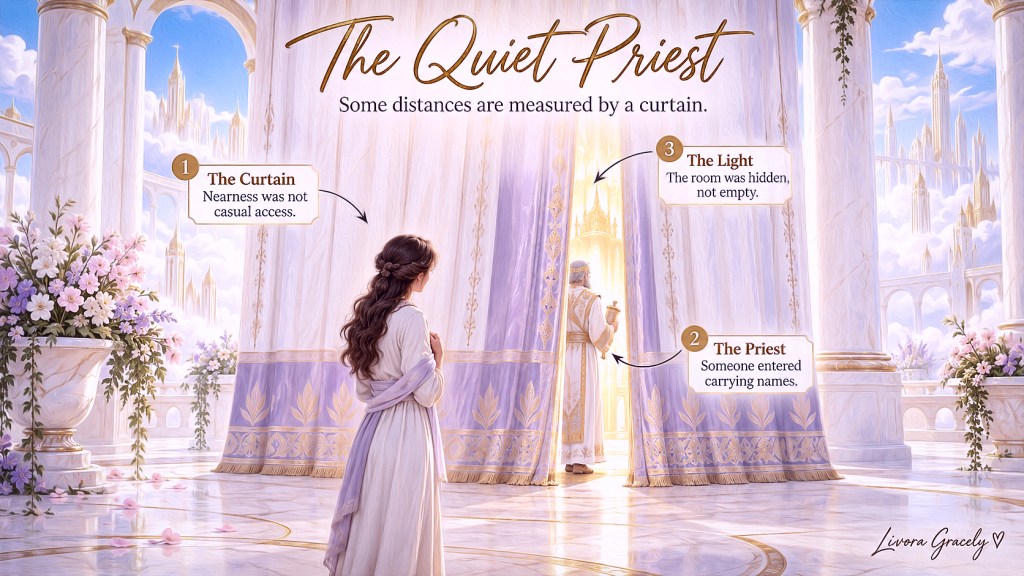
  • Some distances are measured by a curtain.


    Imagine a worshipper standing near the entrance of the sanctuary while the morning work is already under way.

    There is the smell of smoke in the air, wool brushing against wool, the dull shine of metal, and the careful movement of people who know which vessels belong where. Someone has brought an offering. Someone else is checking a garment. A priest has washed his hands and is preparing to enter the place assigned to him.

    The room is busy enough to suggest that heaven must be very close.

    Then the curtain moves.

    Only slightly. A fold lifts, a strip of light appears, and the hand of the priest disappears behind it. The worshipper remains where he is, close enough to hear the work but not close enough to see everything it means.

    The curtain has not been placed there to make God seem absent. It has been placed there because nearness is not the same as casual access.

    The Holy Distance

    Hebrews enters the world of priests, offerings, sacred vessels, washings, blood, and the tabernacle with great seriousness. It does not treat Israel’s worship as a collection of strange decorations left behind by a less enlightened age. The arrangements matter because they teach a difficult truth through physical space: God is near, and God is holy.

    The two statements belong together.

    The tabernacle was not a sign that God had abandoned His people to an empty wilderness. It was a sign of His presence among them. The cloud, the tent, the altar, the priestly garments, and the repeated acts of worship all gathered around the same astonishing fact: the God who made the heavens had chosen to dwell in the midst of a people.

    But the presence of God was not treated as a public convenience. Nobody simply wandered into the innermost room because the day felt spiritually promising. The priest entered according to an order larger than personal confidence, carrying an offering and representing people who could not cross that distance by their own strength.

    This is where modern readers can mishear the older arrangement. We may think the curtain only says, “Stay away.” Hebrews sees something more precise. The curtain says that the distance between God and humanity is real, but it also says that the distance can be approached through appointed means.

    There is an altar because guilt is not imaginary. There is a priest because human beings do not merely need better information about God. There is a sanctuary because holiness is not an idea to be admired from across a room. It is a reality before which a person must learn how to stand.

    The system is not failing because people cannot enter however they please. It is revealing why they need help to enter at all.

    The worshipper outside may understand only part of this. He hears the steps. He feels the heat of the fire on his face. He watches the curtain settle back into place. The work has happened inside, but he has not performed it himself.

    That is the quiet ache at the centre of priesthood. Someone must go where others cannot yet go, and that someone must not go merely as a private individual. He goes carrying names.

    Another Priest

    Hebrews then brings forward a figure who appears briefly in the older Scriptures and refuses to remain small: Melchizedek.

    He meets Abraham after the battle, brings out bread and wine, blesses him, and receives a tenth. The scene is short. Melchizedek does not receive the kind of biography we might expect from someone who will later become important. There is no long family record placed beside his name, no explanation of where his priesthood began, and no closing sentence announcing how it ended.

    He arrives, blesses, and disappears from the page.

    Hebrews notices the silence.

    The writer does not claim that Melchizedek was secretly wandering through history as an immortal priest. The argument is literary and theological: in the scriptural record, his priesthood is presented without the genealogy that normally defines the Levitical line. That makes him a fitting pattern for a different kind of priesthood, one not established by ancestry alone.

    Psalm 110 had already spoken of a king who would be a priest forever according to the order of Melchizedek. Hebrews reads that promise in relation to Jesus.

    The point is not that Jesus has found a more impressive title. It is that His priesthood does not depend on the same structure as the priests who serve under the law. He is not simply another descendant taking his turn in a sacred sequence. He belongs to a priesthood that the older pattern had suggested but could not fully contain.

    This is one of the ways Hebrews reads Israel’s Scriptures. It does not throw away the earlier image when a larger image appears. It looks again and discovers that the old lines had been carrying more than they could say in one moment.

    The altar, the garment, the blessing, the blood, and the curtain were not meaningless because they were temporary. A lamp can be useful even when dawn is approaching. A map can be true even when the traveller finally reaches the country it described.

    Melchizedek becomes a quiet interruption in the family register. He reminds the reader that God’s purpose is not trapped inside the most obvious line of succession.

    And then Hebrews turns toward Jesus, not as a priest who has wandered in from nowhere, but as the One whose priesthood answers a need the earlier arrangements had kept displaying.

    Not Temporary

    The priests of the former covenant served faithfully within a ministry that had one unavoidable weakness: each priest eventually had to stop.

    He might be wise, careful, devout, and deeply aware of the people he represented. He might know the prayers by heart and perform every duty with reverence. Yet his body remained mortal. His service would be followed by another man’s service, and that man would one day be followed by someone else.

    The work continued because the priests did not.

    Hebrews places this beside Jesus and changes the shape of the argument. He does not hold the priesthood temporarily, as though He has been given a shift in the heavenly schedule. He continues forever. Because He lives, His priesthood does not pass to a successor.

    The difference is more than administrative.

    A temporary representative can help for a season. A living priest who continues forever can become the lasting ground of hope. The person who comes to God through Him does not need to wonder whether the one who represents him will be replaced tomorrow by someone who knows less, cares less, or has already begun preparing to leave.

    Hebrews is not presenting Jesus as a religious employee with an unusually long contract. It is presenting Him as the Son who has passed through suffering, death, and exaltation, and who now remains before God on behalf of His people.

    The letter says that He is able to save completely those who draw near to God through Him because He always lives to intercede for them.

    Intercession is a quiet word. It does not sound like conquest. It does not arrive with a trumpet or require a crowd to admire it. It describes someone standing for others, carrying their need into a place where they cannot secure a hearing for themselves.

    That is why the phrase “always lives” matters. The work of Christ is not a moment that has been preserved in memory while He has moved on to something more interesting. His life remains the life of the risen One who represents, welcomes, and helps.

    The worshipper outside the curtain may have thought the priest’s disappearance meant that the important person had left the room. Hebrews suggests the opposite. The priest enters in order to keep the people from being forgotten.

    The Quiet Work

    The climax of this movement is not a louder ritual. It is a deeper one.

    Hebrews does not say that Israel’s priests were foolish for serving at the altar, or that the tabernacle was an embarrassing mistake waiting to be corrected. It says that the priests and sacrifices belonged to a copy and shadow of heavenly realities. Their work was real within the covenant given to them, but it pointed beyond itself.

    The shadow is not the enemy of the body. It tells us that a body is nearby.

    In Jesus, the pattern reaches its centre. He is both the Son who stands above the heavenly servants and the Priest who comes near to the people He represents. He is not distant from weakness, because He has shared human flesh, endured testing, and suffered. He is not trapped by weakness, because He has passed through death and lives forever.

    This is the strange quietness of His priesthood. The great work is not always visible from the outer room.

    There may be no dramatic announcement when a frightened person begins to pray again. No audience hears the moment someone stops hiding a failure from God. A hand loosens its grip on the doorframe. A person who has stayed outside for years takes one step nearer, not because the holiness has become smaller, but because the Priest has become trustworthy.

    The movement is modest. The distance is not.

    Hebrews will soon speak more directly about the way into God’s presence, about a new and living way, about confidence to draw near, and about the blood of Christ cleansing the conscience. But before the way is described as open, the Priest must be known.

    The room matters. The curtain matters. The altar matters. Yet none of them is the final centre of the hope. The centre is the One who enters on behalf of others and does not disappear from the work when the ceremony is over.

    Imagine the sanctuary again near the end of the morning. The smoke has thinned. The vessels have been put away. The folds of the curtain hang quietly, concealing the room beyond them. Outside, the worshipper is still holding the edge of his garment, though he no longer knows why.

    He has not crossed the curtain by his own courage.

    But someone has gone in carrying his name.

    And the Priest, unlike the curtain, is still there.

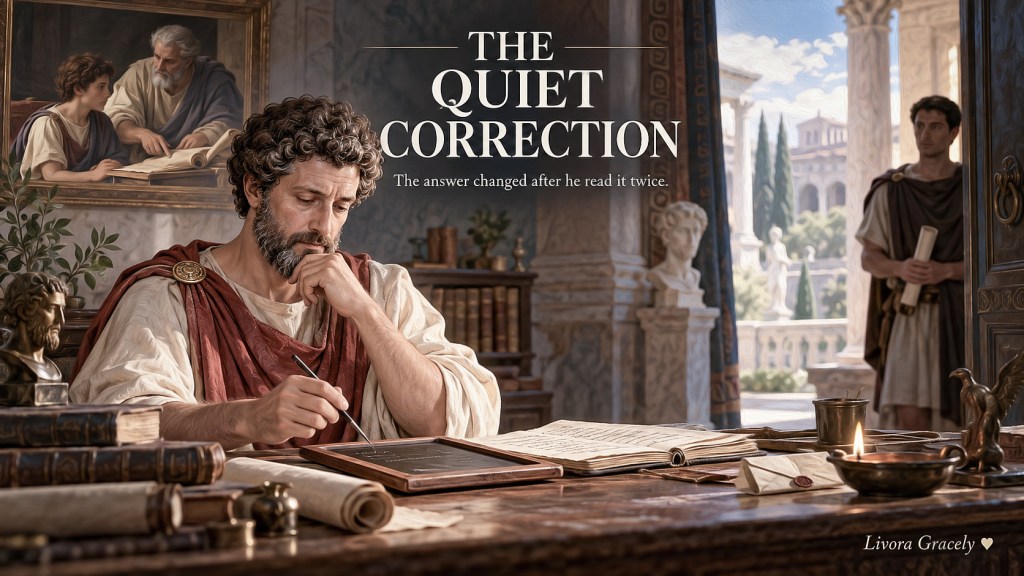
  • The emperor had a book with his own name nowhere on it.

    No title.

    No dedication.

    No list of victories.

    Only pages covered in a small, careful hand.

    Marcus Aurelius kept it close while Rome kept asking for decisions.

    A messenger waited outside the room.

    A guard stood by the door.

    Somewhere beyond the walls, someone was looking for the emperor.

    Marcus turned another page.

    Then he stopped.

    A sentence had been written too quickly.

    He drew a line through it.

    The page became untidy.

    He left it that way.

    The Other Teachers

    Marcus had not learned everything from one teacher.

    His early lessons came from many rooms.

    There was Alexander, who taught grammar.

    There was Fronto, who taught rhetoric and trained him to care about words.

    There was Apollonius, the Stoic philosopher.

    There was Sextus.

    There was Claudius Severus.

    And there was Rusticus.

    The names did not sit quietly in Marcus’s memory.

    They returned whenever he was tempted to become impressed with himself.

    Fronto could hear weakness in a sentence.

    Rusticus could hear weakness in a character.

    One corrected the word.

    The other waited for the man behind it.

    Marcus had once enjoyed beautiful phrases.

    He could write them.

    He could arrange them carefully, give them balance, make them sound as if they had been polished with oil.

    Rusticus did not appear to be impressed.

    A clever sentence could still hide a careless thought.

    A fine speech could still come from a person who had not corrected himself.

    So Marcus began keeping two things close.

    A book.

    And the discomfort of being shown where he was wrong.

    A Waiting Messenger

    A young emperor was not expected to look uncertain.

    People came to him carrying petitions, reports, disputes, and requests.

    They wanted decisions.

    They wanted confidence.

    They wanted the face of a man who already knew.

    Marcus gave them the face they needed.

    Then he returned to his room.

    On one evening, he read a passage again.

    The first reading had seemed sufficient.

    He understood the general meaning.

    That was usually where a busy man stopped.

    A servant entered with fresh tablets.

    Marcus raised a hand.

    The servant waited.

    Marcus read the passage again.

    Then once more.

    The oil lamp made the edges of the page tremble.

    The words had not changed.

    His understanding had.

    He reached for a narrow piece of wood and placed it between the pages.

    “Leave this here,” he said.

    The servant looked at the open book.

    “There is a meeting, Caesar.”

    “I know.”

    The servant waited for the emperor to close the book.

    Marcus did not.

    He picked up the tablet.

    The meeting could begin without him for another moment.

    The page could not.

    That was the arrangement he had made with himself.

    A crown could make other people listen.

    It could not make a difficult passage become clear.

    A title could bring a teacher into the room.

    It could not do the reading.

    The Hard Passage

    Years passed.

    Marcus became older.

    The empire became heavier.

    Letters arrived from distant places. Some carried news of war. Others carried arguments between men who believed their disagreement deserved the emperor’s entire attention.

    There were days when he read late into the night.

    There were other days when he read the same short passage and discovered that tiredness had been pretending to be understanding.

    His book grew crowded.

    Some lines were crossed out.

    Some were rewritten.

    Some were left unfinished.

    He did not make the pages beautiful.

    He made them useful.

    When a person praised him, he turned to a sentence that made praise uncomfortable.

    When anger rose, he remembered the kind of correction Rusticus had given him.

    When a speaker talked too long, Marcus listened for the first thing that had not been examined.

    When he was tempted to make a public display of discipline, he put the display away.

    The lesson had become practical.

    It appeared in small places.

    A reply delayed.

    A judgment softened.

    A speech shortened.

    A door opened again for someone who had offended him.

    No statue recorded these moments.

    No trumpet announced them.

    The emperor simply returned to the page.

    Before Deciding

    Marcus did not write his book as a lesson for Rome.

    He wrote as a man trying to remain teachable while surrounded by people who had learned to call him wise.

    That was a dangerous room.

    A ruler could become accustomed to agreement.

    A powerful man could mistake silence for proof.

    A celebrated man could begin to believe that correction belonged to other people.

    Marcus kept writing.

    Not because he had solved himself.

    The pages would have been shorter if he had.

    He wrote because the work kept returning.

    The same temper.

    The same impatience.

    The same desire to be admired for being disciplined.

    The same need to read carefully before deciding that he understood.

    One morning, the book lay open beside a folded report.

    The report concerned a dispute between officials.

    The decision looked obvious.

    Marcus read it once.

    Then he reached for the book.

    A sentence waited in the margin.

    He had written it there weeks earlier.

    The handwriting was his.

    The warning was also his.

    Do not answer the first version of yourself.

    Marcus looked again at the report.

    The room remained quiet.

    The guards remained outside.

    Rome continued waiting.

    He took up the stylus.

    The first answer was crossed out.

    A second one followed.

    This time, he left space beneath it.

    For a correction.

    For another fact.

    For the possibility that the person making the decision still had something to learn.

    The emperor closed the book only after the page had become difficult enough to trust.

    And when the next message arrived, he opened it with the same hand that had just corrected him.

    Marcus had teachers before he had an empire.

    He kept them after the empire began listening.

    The crown changed the number of people who waited for his answer.

    It did not change the work required before giving one.

    The book remained beside him.

    The margins filled slowly.

    And the emperor kept returning to them.

    Not because he had nothing more to learn.

    Because he knew exactly how much a person could lose by believing he was finished.

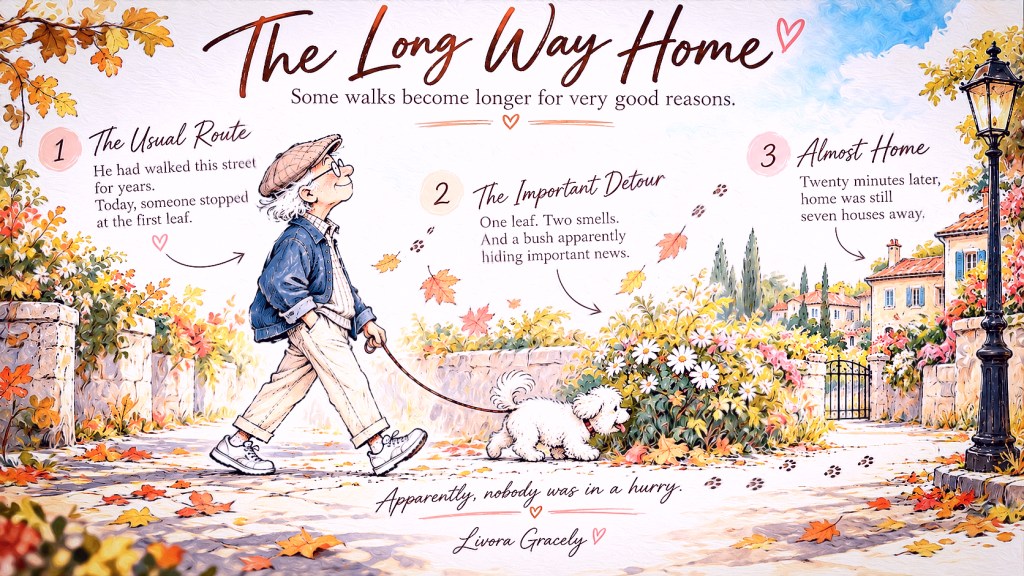
  • Some walks are too good to finish quickly.


    Something beside the wall smelled important.

    The dog stopped immediately.

    Grandpa did not.

    This created a brief disagreement involving a leash, one cream trouser leg, and Grandpa’s dignity.

    He took two steps backward.

    “What?”

    The little white dog pushed his nose beneath a cluster of leaves.

    Snff. Snff. Snff.

    Grandpa waited.

    One leaf.

    Apparently important.

    A second smell followed near the gate.

    Then a third beside a flowerpot.

    Grandpa looked toward the end of the street.

    Home was twelve minutes away.

    At the present rate, possibly Thursday.

    The Usual Route

    Grandpa knew this road well.

    Left at the stone wall.

    Past the bakery.

    Across the narrow lane.

    Seven houses after the black lamp.

    Home.

    The dog knew none of this.

    Or knew it and had rejected the itinerary.

    At the bakery he stopped because warm bread was escaping through an open window.

    Grandpa smelled it too.

    Butter.

    Yeast.

    Something sweet with cinnamon.

    The baker was carrying a tray toward the counter.

    Grandpa raised two fingers.

    The baker raised the tray.

    The dog sat.

    “No.”

    The dog remained sitting.

    “Absolutely not.”

    The tail began sweeping the pavement.

    Grandpa bought one small roll.

    For himself.

    The dog received a piece roughly the size of a philosophical objection.

    The Important Detour

    They continued.

    Twenty steps later, the dog turned sharply toward a low garden wall.

    A dry leaf skittered across the pavement.

    Scritch-scritch-scritch.

    The dog chased it.

    Grandpa followed because the leash had constitutional authority.

    Behind the wall grew white daisies, rosemary, and a bush with tiny red berries.

    A woman was watering the flowers.

    She looked up.

    “Well, hello.”

    Grandpa touched the brim of his cap.

    The dog pushed his nose through the railing.

    “Nosy,” Grandpa said.

    The woman laughed.

    “He remembers my biscuits.”

    Grandpa looked down.

    The dog looked away.

    This was not a denial.

    A biscuit appeared.

    Then another conversation did.

    The weather.

    The bakery.

    Her leaking kitchen tap.

    A grandson who had recently discovered drums.

    Grandpa leaned against the wall.

    Somewhere behind the houses, a church bell sounded once.

    Then twice.

    The rosemary smelled sharp in the afternoon warmth.

    Eventually Grandpa looked at his watch.

    He had been standing there eleven minutes.

    The dog was lying down.

    Seven Houses Away

    They resumed.

    Home was now seven houses away.

    The dog stopped beneath a tree.

    Grandpa stopped too.

    Nothing happened.

    No biscuit.

    No leaf.

    No interesting smell that Grandpa could detect.

    Just wind moving through branches.

    A few yellow leaves turned slowly above them.

    One came down and landed on Grandpa’s cap.

    He did not notice.

    They walked on.

    At the fifth house, two children were drawing with chalk on the pavement.

    At the fourth, someone was practicing scales on a piano.

    At the third, a bicycle bell rang twice.

    At the second, the dog stopped again.

    Grandpa sighed.

    “What now?”

    The dog sat.

    Grandpa waited.

    The dog looked up at him.

    That was all.

    Grandpa looked toward his blue front gate.

    Then at the dog.

    Then at the small stone bench beside the road.

    He sat.

    The dog jumped up beside him.

    Neither appeared surprised.

    Home

    By the time they reached the gate, the walk had taken forty-three minutes.

    Grandpa unlocked the door.

    The dog went directly to his water bowl and drank noisily.

    Lap-lap-lap-lap.

    Grandpa hung the leash on its hook.

    A yellow leaf fell from his cap onto the floor.

    He picked it up.

    Looked at it.

    Then placed it on the little shelf beside his keys.

    The dog watched.

    “Don’t start.”

    The tail moved once.

    That evening Grandpa set his shoes by the door.

    The leash was already hanging there.

    He checked the weather through the window.

    Clear.

    He looked down.

    The dog was waiting.

    “Tomorrow,” Grandpa said, “we take the short route.”

    The dog wagged.

    Grandpa pointed at him.

    “I mean it.”

    The dog wagged again.

    Grandpa put two biscuits in his jacket pocket.

    Apparently negotiations had already begun.