Some temptations arrive looking helpful.
The stone had been waiting in the wilderness for a very long time. It had survived heat, wind, and the occasional opinion of a lizard, but it had never before been asked to become bread.
Then Jesus was hungry.
The Gospel tradition places Him in a wilderness where the ground is hard, the air is dry, and hunger has a way of making ordinary objects look persuasive. The suggestion comes in a familiar form: if You are the Son of God, turn this stone into bread.
The stone is not evil. Bread is not evil. Hunger is not a moral failure. The difficulty lies in the small word between them: if.
The question is not really about lunch. It is about identity, trust, and the sort of road a Son should take when the Father’s promise has not yet become comfortable.
Hebrews does not retell this wilderness scene step by step. It seems to know the scene without needing to repeat it. Instead, it follows the question beneath the question: what kind of Son remains faithful when an easier road is placed directly in front of Him?
A Stone Waiting
By the time Hebrews speaks, the story of Jesus has already travelled through the early church. His words, His works, His suffering, His death, and His resurrection are being remembered alongside the older Scriptures. The writer does not treat these as separate collections of religious material. The prophets, the wilderness, the priesthood, the promises, and the life of Jesus are brought into one long conversation.
That is why Hebrews begins by saying that God spoke in many ways through the prophets and has now spoken through a Son. The sentence does not erase the earlier voices. It places them in relation to the final one.
The writer knows that God’s people have heard promises before. They have also heard voices that made faith sound unnecessarily slow. The wilderness generation received food from heaven and still learned how quickly people can become impatient with the shape of a promise. They wanted the destination, but the road kept containing weather.
Jesus enters that same human landscape, although He enters it as more than another traveller. Hebrews calls Him the Son through whom God made the ages, the radiance of God’s glory, and the exact imprint of God’s being. Yet the same letter also brings Him close to weakness, suffering, and testing.
This combination is not an accident of the argument. It is the argument.
The Son does not prove His identity by avoiding every condition of human life. He reveals it by remaining faithful within them. The stone stays a stone. Hunger remains hunger. The Father’s care is not measured by how quickly discomfort disappears.
The Higher Place
The second temptation moves upward, from the wilderness to the temple. The height changes, but the pressure remains similar. If Jesus is truly the Son, He can throw Himself down and require God to demonstrate His protection.
It is a clever proposal because it borrows the language of trust while quietly replacing trust with theatre. Instead of resting in God’s care, Jesus can make care visible on demand. Instead of waiting for the Father’s purpose, He can arrange a scene in which heaven must respond publicly.
Human beings have been conducting smaller versions of this experiment ever since. We may not climb a temple and expect angels to catch us, but we can make a decision mainly so that God will have to rescue it. We can turn prayer into a receipt, faith into a dare, and uncertainty into a stage on which divine approval is expected to appear before the audience goes home.
Hebrews refuses that arrangement. Its invitation to draw near to God is not an invitation to manipulate Him. It is an invitation to approach the throne of grace because the great High Priest understands weakness and has passed through suffering without abandoning faithfulness.
That distinction matters. Confidence is not the same as control. A person may come boldly while still receiving the future rather than scripting it. The Son does not need to throw Himself from the height in order to be held by the Father.
The temple remains standing. The angels are not summoned for a demonstration. The crowd, if there is one, receives no spectacle.
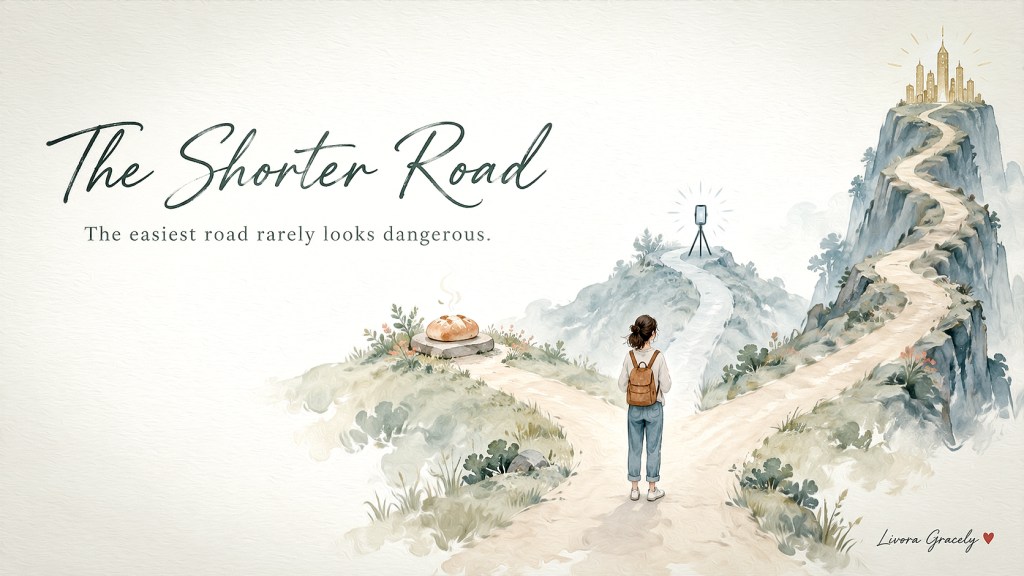
The Shorter Road
The third temptation offers the largest prize and the most efficient route. The kingdoms of the world are placed before Jesus, together with the possibility of receiving them without the long passage through rejection, suffering, and death.
The offer is not a kingdom without a cost. It is a kingdom at the cost of the wrong allegiance.
This is where the wilderness pattern becomes especially recognizable. We often want good things by methods that quietly change what the good thing means. We want influence without responsibility, success without formation, reconciliation without an honest conversation, spiritual authority without surrender, and a crown that has never had to pass through a cross.
The shortcut is persuasive because it does not always ask us to abandon the destination. It only asks us to reach it by a route that seems more efficient.
Hebrews presents Jesus as the One who refuses that efficiency. He is the Son, but He is also the One who suffers. He is the creator of the ages, but He becomes a brother to those who share flesh and blood. He is the great High Priest, but He is not distant from the people He represents.
The letter says that He learned obedience through what He suffered. It does not mean that He was previously disobedient, as though suffering had to repair a moral defect. It means that obedience became visible in the full weight of human experience. It moved from intention into endurance, from declaration into action.
This is the part of faith that rarely photographs well. Nobody applauds a person for refusing a compromise that no one else noticed. There is no dramatic soundtrack when someone waits, tells the truth, keeps an undeserved promise, or returns to the same difficult task the next morning.
Still, the choice alters the room.
Still Walking
Hebrews says that Jesus was tempted in every way as we are, yet without sin. It also says that because He suffered when tempted, He is able to help those who are being tested.
The writer does not describe Jesus as someone who studied temptation from a safe distance. He places Him inside the pressure. The help comes from a person who knows what it is to remain faithful while the easier answer is close enough to touch.
This gives the letter a different way to understand maturity. The mature person is not the one who never feels hunger, doubt, fear, or the attraction of a shortcut. Maturity becomes visible in what the person does next.
The hand does not reach for the stone.
The body does not turn the temple height into a performance.
The kingdom is not accepted from the wrong hand simply because it is offered quickly.
These are not three unrelated tests. They are three ways of asking whether sonship can exist without trust: satisfy yourself immediately, force God to prove Himself, or possess the promise without walking the road assigned to it.
Hebrews answers by placing the Son before us again and again. The Son is higher than angels, yet near to the weak. He is seated in glory, yet He knows suffering. He opens the way to God, yet He does not turn nearness into control. He leads people toward rest, but He does not confuse rest with escape from every demand of faith.
Before we begin reading Hebrews verse by verse, this is worth carrying into the room. The letter is not merely explaining that Jesus is greater than the prophets, Moses, angels, priests, sacrifices, or former covenants. It is showing what greatness looks like when it refuses the shorter road.
The wilderness has changed its scenery by now. It may be an office, a family conversation, a private decision, a public reputation, or a prayer that has not yet received the answer we hoped would arrive on schedule. The stone may look like an opportunity. The height may look like proof. The kingdom may look like success.
The pattern returns, but the answer remains recognizable.
The stone stayed a stone. Jesus remained the Son. And the road, inconveniently, remained the road.


Leave a comment