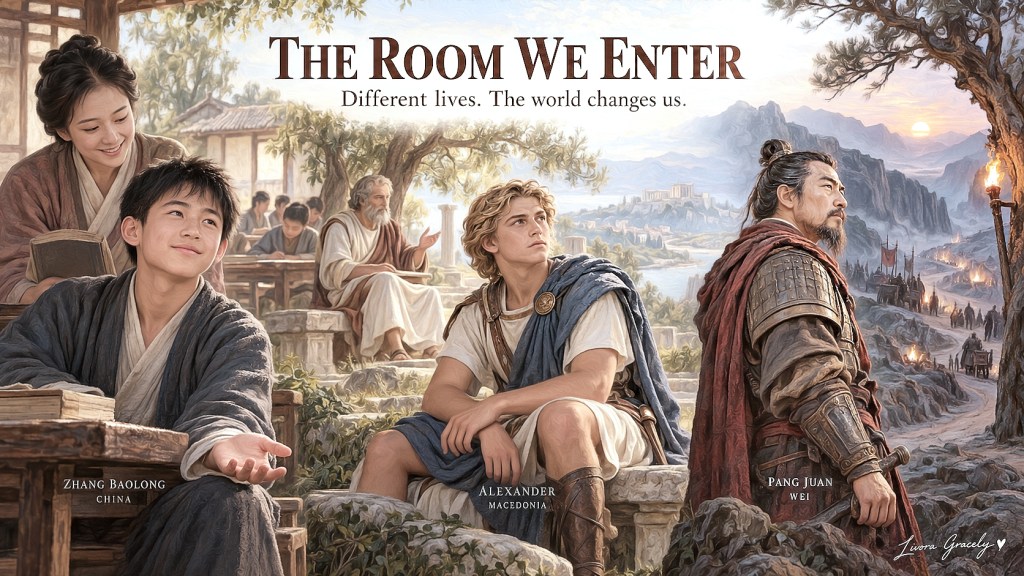
Zhang Baolong had a hand.
Alexander had a stone seat.
Pang Juan had a fire.
None of those things looked large enough to carry a story.
A hand could be cleaned.
A stone seat could be left beneath a tree.
A fire could be counted, then abandoned beside a road.
But each one remained after the larger event had moved on.
The First Hand
Zhang was a quiet child in a rural classroom in China. His mother was gone, his family had little, and he rarely seemed interested in being noticed.
Wang Qianqian called him over and asked to see his hand.
She cleaned it.
Then she kept calling him.
She told him that she liked him. She told him that he was handsome. She gave him a place near her and allowed him to imagine that a teacher could also feel like family.
Nothing around Zhang changed at once.
The desks remained. The lessons continued. His family’s difficulties did not disappear.
But Zhang began to look up.
Then he smiled.
Later, he played, danced, and turned toward the camera.
The hand that had first been offered because Wang asked for it was eventually lifted by Zhang himself.
He was still a child.
He was simply no longer hiding inside the room.
The Second Seat
Alexander entered a different kind of room.
He was a prince, and the future had already made arrangements for him. One day he would inherit a kingdom. For the moment, Philip sent him to Mieza to study with Aristotle.
The school had no palace walls.
There were trees, shaded paths, and stone seats. Alexander sat among other young men while Aristotle spoke about literature, politics, ethics, and the questions that refused to become simple.
A sword could prepare a boy to act.
A question could make him wait.
Alexander eventually became a king and crossed a world much larger than the one he had known as a child. He gathered cities, armies, languages, customs, and problems that could not be solved by command alone.
The stone seats remained behind.
They had held a prince before he became a ruler.
They had given him a room large enough to discover that a kingdom was only one part of what could be learned.
The Last Fire
Pang Juan was already an expert.
He knew how to read an army by its movement, its speed, and the traces it left behind.
Sun Bin knew that.
As the Qi army retreated, it left cooking fires behind. Many fires became fewer fires. Fewer fires became a convincing story.
Pang Juan counted what was missing.
He followed.
At Maling, a tree waited beside the narrow road. Words had been carved into its pale wood. Pang Juan ordered a torch to be lit so he could read them.
The fire showed him the message.
It also showed the hidden crossbowmen where to aim.
The army broke apart. Pang Juan died. The torch went out.
The tree remained.
So did the road and the empty places where the fires had been.
Pang Juan had not been defeated because he could not read the signs.
He had been defeated by signs prepared for the way he read them.
The Room We Enter
Zhang received a hand.
Alexander received a room.
Pang Juan received a trail of fires.
One came through care.
One came through education.
One came through an enemy who understood his habits better than he did.
The outside world did not offer the same kind of help to all three.
For Zhang, another person made the room gentler.
For Alexander, another person made the room larger.
For Pang Juan, another person made the room dangerous.
Still, each story began with something outside the person.
A teacher’s hand.
A philosopher’s question.
An opponent’s sign.
None of the three men or boys remained exactly where the story found them.
Zhang began to appear.
Alexander began to see beyond inheritance.
Pang Juan followed his own certainty into a narrow pass.
A person can be changed by kindness.
A person can be enlarged by instruction.
A person can also be exposed by the way he responds to what another mind places in front of him.
The room is never entirely ours.
Someone else may enter it carrying affection, knowledge, criticism, opportunity, or a trap.
Sometimes the door opens.
Sometimes another person opens it.
Sometimes we walk through because we think the way ahead is already clear.
The hand, the stone seat, and the fire remain.
The people move on.
The room becomes larger.
And whatever enters next may change what we are able to see.


Leave a comment