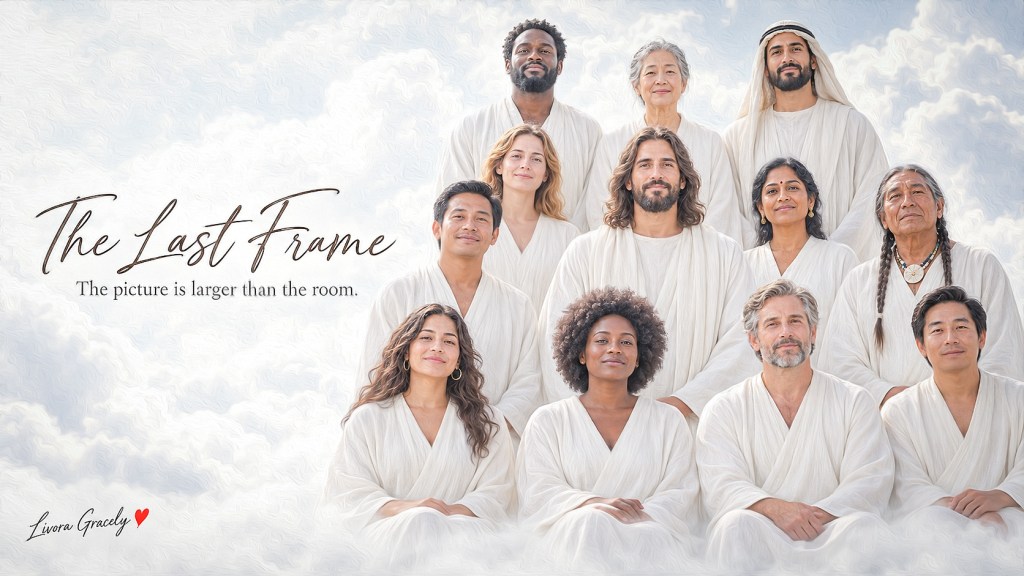
The picture is larger than the room.
A photographer can take three hundred pictures and still miss the person who stepped outside for a moment.
It happens.
Someone goes to fetch a coat. Someone answers a phone. Someone notices that the light is better on the other side of the building. By the time the camera is ready, one place in the group is empty.
The photograph still looks complete.
That is what makes it dangerous.
We may not notice who is missing until much later, when someone asks where they were standing.
The Bible has a beginning.
It has a long middle.
And, unusually, it also gives us something like a final frame.
Not every question is solved.
Not every face is identified.
But the picture becomes large enough for us to see Christ, His people, the nations, the city, the throne, the river, the tree, and the end of death itself.
Hebrews stands somewhere in the middle of this great photographic roll.
It does not show us the first exposure.
It does not yet give us the final frame.
But it teaches us how to look at the images that came before—and how to recognize the One who stands at the centre of them all.
First Exposure
The first picture begins with light.
Before there is a nation, a priest, a king, a temple, or a church, there is a world being called into existence.
The camera has not yet been invented.
The photographer has not yet entered the room.
There is only God, creation, and a word that does not require assistance.
Light appears.
The waters separate.
The earth opens.
Living things arrive with an enthusiasm that seems to have escaped the schedule.
Then comes humanity.
The first people are not placed in the world as spectators. They are given a place inside it. They are made to see, to name, to tend, to walk with God, and to live beneath His presence.
The first frame is bright.
The later ones become complicated.
A garden gives way to exile. A family becomes a people. A promise moves through generations. Altars are built. Names are called. Nations rise and fall. Kings sit on thrones, some wisely and some with remarkable confidence in their own opinions.
The picture keeps developing.
But it does not yet reveal everything.
Long Roll
A roll of film is not one photograph.
It is a sequence.
One image may show a face. Another shows the room. Another reveals what was happening just outside the frame. The pictures belong together, even when none of them is large enough to explain the whole story.
The same is true of the Bible’s long middle.
Abraham receives a promise, but not its complete fulfilment.
Moses leads a people, but not into the final rest.
The priests serve in the sanctuary, but their work must be repeated.
The kings receive authority, but none of them is able to carry the weight of a permanent kingdom.
The prophets speak of a future they can see only from a distance.
The images are real.
They are not false because they are incomplete.
A shadow is not a lie.
It is simply evidence that something is standing between the light and the ground.
Hebrews understands this better than most books.
It looks at priests, sacrifices, covenants, tents, curtains, blood, and holy places. It does not throw them away as meaningless religious furniture.
It studies them.
Then it turns the photograph over.
There is writing on the back.
The objects were pointing beyond themselves.
The priesthood was pointing toward a greater priest.
The sanctuary was pointing toward a greater dwelling.
The sacrifice was pointing toward a work that would not need to be repeated in the same way.
The old covenant was carrying the outline of something better.
Hebrews is not merely another picture in the roll.
It is the darkroom where earlier pictures begin to make sense.
Central Image
In Hebrews, Jesus does not appear at the edge of the photograph.
He is not a useful figure standing beside the main subject.
He is not one more messenger among many.
He is the Son through whom God made the ages.
He is the radiance of God’s glory and the exact imprint of His nature.
He sustains all things by His powerful word.
The camera has moved closer.
The image is no longer a distant outline.
Then Hebrews does something unexpected.
It brings the eternal Son into human weakness.
He tastes death.
He enters suffering.
He is not ashamed to call human beings brothers.
This is where the picture becomes difficult to hold.
We can manage glory if it stays far away.
We can admire light from a safe distance.
But Hebrews places glory inside the human story—not as an ornament, but as a participant.
The One who is higher than the angels becomes the One who understands weakness from within the body.
The One who sustains all things becomes the One who learns obedience through suffering.
The One who belongs to heaven becomes the great High Priest who opens a way for people from earth to draw near.
It is almost as if the central figure has stepped out of the frame and into the room where the viewers are sitting.
That changes the room.
It also changes the viewers.
Darkroom Light
Much later, another man is given a camera.
Not literally.
Although the book of Revelation contains enough lamps, lampsstands, stars, thrones, crowns, lightning, horses, trumpets, bowls, rivers, and flying creatures to make an ordinary camera feel under-equipped.
The man we call John is told to write what he sees.
That instruction appears more than once.
Write this.
Write what you see.
Write these words.
There are moments when he is told not to write.
The seven thunders speak, and John is about to record their message. Then a voice tells him to seal up what they have said and not to write it down.
Even heaven has an editing department.
John does not receive permission to photograph everything.
Some things are revealed.
Some things remain outside the written frame.
The visions are not presented as a tidy lecture.
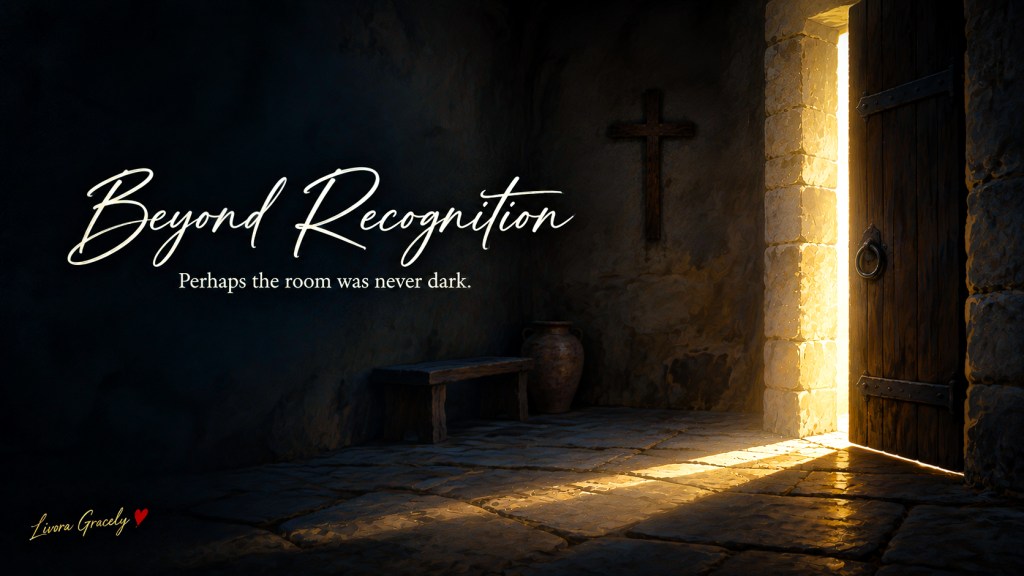
A door opens.
A throne appears.
A scroll is held.
No one is found worthy to open it.
Then the Lion is announced.
But John sees a Lamb.
The image refuses to stay simple.
A sea becomes glass.
A city descends.
A woman appears.
A dragon appears.
A multitude gathers.
The sky changes.
The earth changes.
The camera seems to move faster than the sentence.
We should not imagine John as careless.
He is not a journalist who forgot to bring enough paper.
He is a witness standing before scenes that exceed ordinary language.
Sometimes the line arrives late because the vision has not finished moving.
Final Frame
Revelation gives us something rare.
It does not merely tell us that Christ wins.
It shows us what the completed picture looks like.
The Christ who stood at the centre of Hebrews now appears as the Lamb, the King, the Judge, the Bridegroom, and the One whose presence makes the city bright.
The church is not reduced to a small group gathered in a single house.
The final crowd is drawn from every nation, tribe, people, and language.
The room has become a horizon.
The story has not ended with one household deciding whether to receive one returning man.
It has widened into a people no one can count.
There is worship.
There is endurance.
There is judgment.
There is grief.
There is victory.
There is a city in which God dwells with His people.
There is no temple in the city, because the Lord God Almighty and the Lamb are its temple.
There is no need for the sun or moon, because the glory of God gives it light.
The final picture is not simply a bright version of the first.
It is creation brought through history, suffering, redemption, judgment, and restoration.
The garden has become a city.
The river still runs.
The tree is still there.
The story has travelled a long way, but it has not lost its beginning.
The Missing Place
Here is where the camera becomes uncomfortably personal.
A group photograph can look complete and still have one missing person.
A person can stand near the church and remain outside its life.
A person can know the language of faith, recognize the names, admire the architecture, and still refuse the centre of the picture.
This is not about earning a place by appearing impressive.
The final frame is not a reward for people who have managed to arrange their lives without wrinkles.
The people in Hebrews are not presented as flawless specimens.
They are pilgrims.
They are runners.
They are people who grow tired, hesitate, endure, fail, return, and continue.
Faith is not pretending that the journey is easy.
It is continuing toward a promise that has not yet become visible in full.
The question is not whether we can force ourselves into the photograph.
The question is whether we are willing to remain where grace is calling us.
That is different.
The first frame did not begin with human achievement.
The central image was not produced by human imagination.
The final frame will not be completed by human applause.
The light was there before anyone knew how to describe it.
Still There?
The Bible begins with a world made by God.
It moves through a people being formed.
It reaches its centre in Christ.
It continues through a church learning to endure.
And in Revelation, the camera pulls back far enough for us to see a multitude gathered around the Lamb.
The picture is larger than the room.
Larger than one house.
Larger than one century.
Larger than the part of the story we currently understand.
Perhaps that is why Hebrews asks us to run with endurance.
The final frame has not yet become our ordinary view.
We are still somewhere between the first exposure and the completed image.
The question is not whether the photographer knows where everyone belongs.
He does.
The question is whether we will remain in the room long enough for the light to find us.
And somewhere beyond the edge of the frame, the city is already bright.