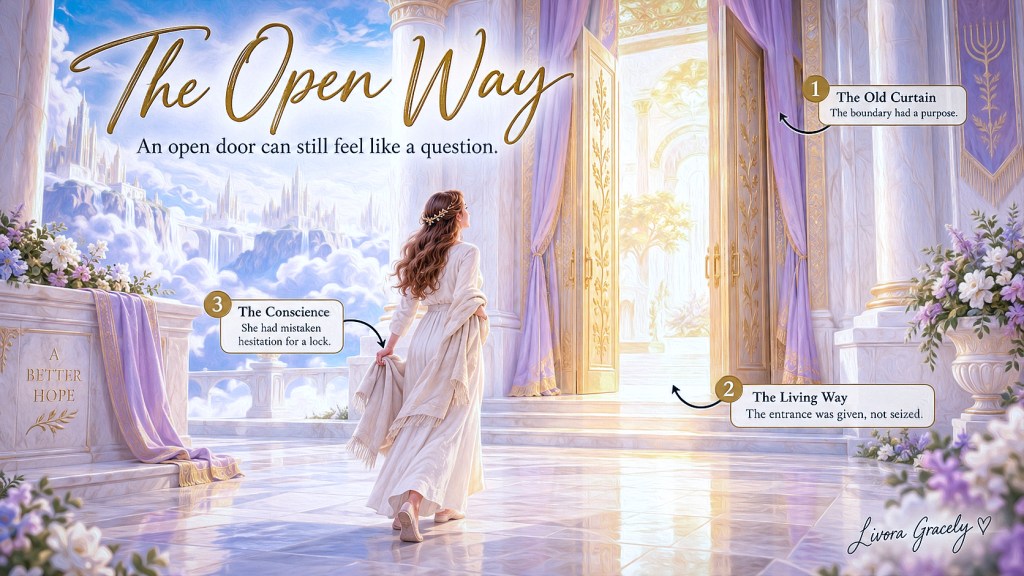
An open door can still feel like a question.
The door had been open since sunrise.
There was no lock in the keyhole, no guard beside it, and no sign asking visitors to wait. Light fell across the threshold in a pale rectangle, warming the dust on the floor. From inside came the soft movement of people preparing the room.
Still, the woman stood several steps away.
She had arrived early enough to be first. She had even rehearsed what she might say if someone asked her name. But every time her foot moved toward the doorway, her hand returned to the fold of her coat.
An open door, unfortunately, does not always feel like an invitation.
Sometimes the body remains outside because the conscience has memorized the distance.
Hebrews understands this kind of hesitation. It has already shown us the priest entering behind the curtain on behalf of people who could not simply walk into the holy presence. Now the letter moves closer to the threshold and asks what the work of Christ has done to the distance itself.
The Old Curtain
The tabernacle had an outside and an inside, a place where people gathered and a place where the priest entered according to the order God had given. There were vessels, washings, offerings, garments, and boundaries. The arrangement was not designed to make worship mysterious for the pleasure of making people wait.
It taught that access mattered.
The curtain was a physical sentence. God was present, but human beings could not approach Him carelessly. The priest could enter, but not as though the room belonged to him. He entered with reverence, with blood, and with the awareness that he represented more people than himself.
The outside worshipper could hear the work without seeing all of it. The curtain made the nearness of God visible and the limitation of human approach visible at the same time.
Hebrews calls the earthly sanctuary and its rituals a copy and shadow of heavenly realities. That language can sound dismissive if we hear “shadow” as though it meant useless. But a shadow is evidence that something is standing nearby. It has shape because it belongs to a body.
The older arrangement was therefore not a foolish attempt to reach God. It was a faithful sign that the problem of access was real and that access would require more than human enthusiasm.
The trouble is that a sign can become a permanent waiting room if we forget what it was pointing toward.
The priest entered and came out. The offering was made and had to be made again. The boundary remained. The people were near enough to worship, but not yet invited to treat the innermost presence as their ordinary room.
The curtain did not say that God had no desire to dwell with His people. It said that the way into His presence had not yet been opened in its final form.
That is why Hebrews does not stop at the curtain. It asks what kind of sacrifice, what kind of priest, and what kind of covenant could carry the meaning of the sanctuary all the way to its intended end.
The Better Blood
The language of blood can make modern readers step backward. It belongs to a world of sacrifice, altar, animal life, and covenant, and it cannot be reduced to a decorative religious metaphor. Hebrews uses it because life, guilt, cleansing, and reconciliation are not weightless ideas.
Something has happened between God and humanity, and something must be done about it.
The sacrifices of the former covenant were repeated. Their repetition did not mean that they were meaningless. It meant that they belonged to a system in which the work of approach remained ongoing. The priest served again. The offering was brought again. The people returned again to the place where the problem had been acknowledged and covered.
Again is a small word, but it can become a heavy one.
Anyone who has apologized for the same failure, reopened the same argument, or promised to begin again with the same tired voice knows that repetition does not automatically produce transformation. A person may keep returning to the doorway without becoming more certain that he is welcome inside.
Hebrews places the repeated sacrifices beside the work of Christ and sees a decisive difference. Christ enters not with the blood of goats and calves but with His own blood. The letter describes His offering as once for all, not because the suffering is cheap, but because its work is complete in a way the earlier sacrifices could not be.
The contrast is not between a cruel God and a kinder religious system. It is between signs that must be repeated and a self-giving act that reaches its intended depth.
Christ does not merely perform another ceremony in a longer sequence. He gives Himself as the One who has already become the Priest, the offering, and the living access to God. The old arrangement kept pointing toward a cleansing that could not remain only on the surface.
The work has to go deeper than the hands.
It has to reach the heart that keeps returning to the same accusation.
The Conscience
Hebrews says that the blood of Christ cleanses the conscience from dead works so that people may serve the living God.
The sentence is large. The experience it touches is not.
A person can stand close to religious activity and still feel locked outside. He may know when to stand, when to speak, when to bow, and where to place his hands. He may be able to explain the correct vocabulary while carrying an inner room that remains dark and crowded with old voices.
The conscience keeps its own archive.
It remembers the sentence spoken too sharply, the promise broken quietly, the person treated as disposable, the opportunity to tell the truth postponed until it became harder. It can also remember things nobody else saw, which is one reason public respect does not always create private peace.
This is not an argument that every feeling of guilt is accurate. Some consciences accuse where God has already forgiven. Some people carry shame borrowed from cruel voices that never had the right to name them. Hebrews is not asking the conscience to become another judge with a cleaner robe.
It is announcing a deeper cleansing.
The aim is not merely to make a person look acceptable at the doorway. It is to release the person from the dead works that keep him circling the same room, trying to purchase an entrance that cannot be bought.
The woman in the morning scene had not been stopped by a locked door. She had been stopped by the question she carried inside herself: what if I am not the sort of person who is allowed to enter?
There are moments when a person can no longer hide behind activity. The hands are busy, the prayers are familiar, the calendar is full, but the heart is still standing at a distance. The old curtain may have disappeared from the architecture while remaining perfectly intact in memory.
Hebrews speaks into that inward distance by saying that Christ’s work reaches the conscience. The person who draws near does not come because he has successfully edited his past. He comes because the cleansing has been given before he can present a convincing version of himself.
That is the difference between religious performance and access.
One keeps asking, “Have I done enough to enter?” The other hears, “Come because the way has been made ready.”
Draw Near
Near the centre of Hebrews comes an invitation that would have sounded almost startling after so much language about priests, blood, sanctuary, and boundaries: let us draw near with a sincere heart and with the full assurance that faith provides.
The invitation is not careless. It does not flatten holiness into friendliness or turn God into a room that exists for our convenience. The confidence comes from Christ’s work, not from the visitor’s personality.
This is why Hebrews can speak of a new and living way opened through the curtain, that is, through Christ’s flesh. The curtain is no longer simply the barrier that explains why people must stay outside. In Christ, the barrier becomes the place through which access has been created.
The way is living because it is not a dead technique. It is not a sequence of steps that works whether or not anyone is alive to receive the person who comes. The way is living because the Priest who opened it lives.
This changes the posture of the person at the threshold.
He does not storm the room. He does not demand entrance as though holiness were a public service that had failed to process his application. He comes with a true heart, cleansed from an accusing past, and with confidence that has been given rather than manufactured.
The woman looks once more at the open door. The light has not changed. The room has not become less holy because she has taken a step. What has changed is the reason she is standing there.
She does not enter to prove that she belongs.
She enters because she has been invited through a way she could not build herself.
That is the movement Hebrews wants its readers to carry forward. The old curtain taught that God cannot be approached casually. The better blood shows that Christ has dealt with the deeper obstacle. The cleansed conscience no longer has to remain outside rehearsing its failures. The invitation is not to seize God, but to draw near to the God who has made nearness possible.
The doorway remains quiet. No trumpet announces the woman’s arrival. No guard steps aside with theatrical seriousness. She simply crosses the threshold, and the coat that had been clutched so tightly begins to loosen in her hands.
The door had been open since sunrise.
She had mistaken her hesitation for a lock.


Leave a comment