Livora Gracely is a pen name.
This little corner gathers whimsical stories, gentle reflections, and Scripture-inspired writing for readers who still enjoy noticing small things.
Some stories begin with questions.
Others begin with a quiet morning, a cup of tea, an old bench, or a verse that refuses to be forgotten.
The person behind the name simply prefers the words to arrive before the writer.
Writing to remember.
Sharing to inspire.
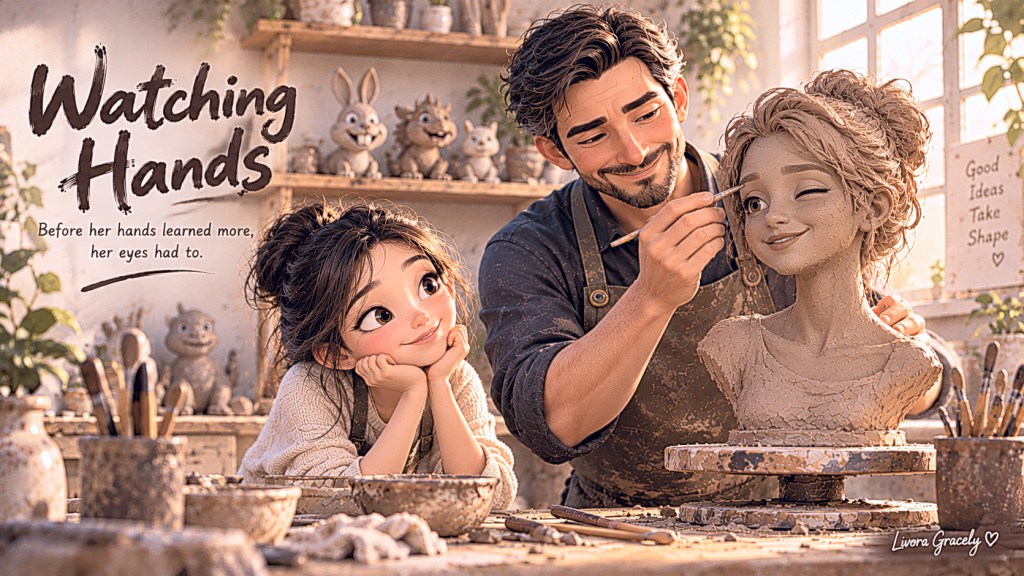
Her father had been working on the same eye for eleven minutes.
She knew because she had counted.
Not intentionally at first.
But after the fourth minute, it became suspicious.
The girl rested her chin in both hands and watched.
The studio was unusually quiet. Afternoon light poured through the tall window, laying warm rectangles across the wall and the cluttered worktable. Somewhere near the sink, water dripped at patient intervals.
Tik.
Her father moved the wooden tool half a centimeter.
Tik.
He turned the clay bust.
Tik.
Another tiny scrape.
That was it.
She looked toward the shelf behind them.
Her own creatures were sitting there.
The rabbit with the two enormous teeth occupied the middle like someone who had accidentally become mayor. Beside it sat the first lumpy creature, still wearing the expression of something surprised to exist.
She loved them both.
But now she looked back at the bust.
This was different.
A face was emerging from the wet clay.
Not all at once.
The nose had appeared slowly beneath her father’s thumbs. The corners of the mouth had been lifted so slightly that she had not noticed the smile until it was already there.
And now the eye.
One remained open.
The other was beginning to wink.
She leaned closer.
Her father scraped beneath the eyelid.
Then stopped.
He did something she had not expected.
Nothing.
For several seconds, he simply looked.
The girl looked too.
She had always thought skill lived mostly in the fingers.
Quick fingers.
Steady fingers.
Fingers that somehow knew exactly where to press.
But her father’s hands spent a surprising amount of time doing absolutely nothing.
They waited.
His eyes moved across the face.
Forehead.
Cheek.
Mouth.
Back to the eye.
Only then did the tool touch the clay again.
A tiny movement.
Suddenly the wink worked.
The girl sat upright.
“How did you do that?”
Her father smiled.
“Do what?”
She pointed accusingly at the sculpture.
“That.”
He looked at the face as though it had done something without consulting him.
“The eye?”
“It wasn’t alive before.”
He laughed.
“It’s still clay.”
She knew that.
Obviously.
But she also knew what she had seen.
Ten minutes earlier there had been a lump with a nose.
Now somebody seemed to be looking back at her.
Winking, no less.
She returned her chin to her hands.
This time she stopped watching the sculpture.
She watched him.
His thumb did not press immediately.
His tool did not rush toward every uneven surface.
He turned the bust toward the window. Light slid across the damp cheek and caught in the shallow grooves around the mouth.
He waited.
Looked.
Touched.
Stopped.
Looked again.
And suddenly she understood something her own clay animals had been trying to teach her.
Her father did not make fewer corrections because he made fewer mistakes.
He made fewer unnecessary corrections because he could see more before touching anything.
That was different.
The realization was slightly inconvenient.
She had hoped becoming good meant acquiring better tools.
Perhaps a special knife.
A professional brush.
Possibly one of those expensive wooden things in his drawer that she was not supposed to borrow.
Instead, apparently, she would have to learn patience.
Terrible news.
She glanced toward her rabbit.
Its giant teeth offered no sympathy.
Her father continued working.
The smell of wet earth hung in the warm room. Fine curls of clay collected beneath the turntable. Outside the window, a branch moved through the sunlight, and its shadow slowly crossed the sculpture’s shoulder.
The girl said nothing more.
Neither did her father.
But something had shifted.
Until that afternoon, she had watched finished things and wondered how hands could make them.
Now she was beginning to watch the spaces between the movements.
The hesitation before a touch.
The inspection after it.
The decision to leave something alone.
There are skills we learn because someone explains them.
Others arrive quietly because we stay close enough to notice.
A child watches a parent repair something.
An apprentice watches a craftsperson choose not to cut.
A young writer notices where an older writer stops adding words.
A musician hears not only the notes, but the rests between them.
Mastery often looks impressive from across the room.
Up close, much of it looks like attention.
Her father finally put the tool down.
The clay face smiled.
One eye remained open.
The other winked mischievously at the girl.
She smiled back.
Behind her, two crooked little animals waited patiently on the shelf.
Tomorrow, perhaps, her hands would return to them differently.
But today they had learned something without touching clay at all.
A trusted heart is asked for one difficult kindness. Then prayer leaves room for more than anyone can see.
Philemon 1:20–22
A Prepared Room
The guest room had been cleaned before anyone knew whether the guest would come.
The sheets were fresh. A small lamp waited beside the bed. The chair near the window had been moved slightly forward, as though someone had already imagined a conversation there. Nothing in the room proved that the visitor would arrive. It only made room for the possibility.
That is how hope sometimes looks before it becomes an event.
Paul writes to Philemon from prison with a hope of his own. He has asked Philemon to receive Onesimus, the man who has become his child and his beloved brother. He has offered to assume any legitimate charge that may remain. Now he asks for something more personal:
“Yes, brother, let me have some benefit from you in the Lord; refresh my heart in Christ.”
The scene of the prepared room is imagined. The letter is not. Its request is concrete, its affection is personal, and its future remains open.
One Person
Paul does not ask Philemon to demonstrate a general commitment to reconciliation.
He asks him to respond to one person.
That distinction matters because a reputation can survive on broad impressions. Someone may be known as generous, welcoming, or spiritually mature because many people have experienced those qualities in easy circumstances. Then one particular person returns—carrying history, uncertainty, and the possibility of pain—and reputation meets reality.
Philemon has already been described as someone whose love and faith refresh the saints. Paul has already given thanks for the good that has become visible through him. Now the letter brings that praise into a narrower space.
Let me receive something from you in the Lord.
The wording may echo the name Onesimus, which is related to benefit or usefulness. The possible wordplay is gentle, but its direction is important. Paul is not asking for an impressive religious feeling. He is asking Philemon to let the grace already associated with his life become an act toward Onesimus.
The man at the center of the request is not an example invented to prove a principle. He is Onesimus—a person whose former circumstances are not fully explained, whose present change has been witnessed by Paul, and whose future now depends on a welcome that the letter does not record.
Paul’s heart is involved because Onesimus is involved.
A Personal Request
“Refresh my heart in Christ.”
Paul could have spoken only about duty. He could have reminded Philemon of apostolic authority. Instead, he speaks as a brother whose inner life will be touched by Philemon’s response.
This is not sentimental language detached from the issue. Paul’s heart is connected to the man he is sending back. To refresh Paul is therefore not merely to comfort him with kind words. It is to act toward Onesimus in a way that confirms the new relationship Paul has described.
The request also reveals something about Christian fellowship. What happens between two people in one household can reach someone far away. A decision made in Colossae can bring relief to a prisoner. A welcome extended to Onesimus can become refreshment for Paul.
This echoes the earlier description of Philemon’s life, but it does not simply repeat it. Before, Paul spoke about the way Philemon’s love had affected the saints. Now that known quality is being tested by one difficult name.
The question is not whether Philemon has ever refreshed anyone.
The question is whether he will allow Christ to teach him what refreshment requires here.
More Than Asked
Paul then writes, “Confident of your obedience, I write to you, knowing that you will do even more than I ask.”
The word obedience can sound like the end of freedom, but Paul’s letter has carefully prepared a different atmosphere. He has chosen appeal over command. He has asked Philemon’s goodness to be voluntary. He has trusted their fellowship rather than treating Philemon as a reluctant subordinate.
Now he expresses confidence.
He does not specify the “more.”
That silence is part of the force of the sentence. Paul believes that Philemon may understand the heart of the request more deeply than a written instruction could explain. If Onesimus is truly a beloved brother, then the appropriate response may exceed the minimum language Paul has used.
We should not claim to know what happened afterward. The letter does not preserve Philemon’s answer. Nor should we turn Paul’s confidence into evidence that every detail of the future was guaranteed.
The text gives us a hope, not a transcript of the result.
Yet it also gives us a picture of mature obedience. It is not merely doing the smallest thing that can be defended. It is perceiving what love is moving toward and taking responsibility for the next faithful step.
Sometimes a request is deliberately smaller than the good it hopes to awaken.
Praying Forward
“Prepare a guest room for me,” Paul continues, “because I hope to be restored to you in answer to your prayers.”
The letter now looks beyond the immediate decision.
Paul hopes to return. He does not present that hope as a private plan secured by his own confidence. He places it within the prayers of Philemon and the household around him.
Prayer is not added as a pious decoration. It is part of the expected means by which the future may unfold.
Paul’s imprisonment is real. His desire to return is real. His confidence in Philemon is real. None of these realities cancels uncertainty. He can ask for a room without pretending that he controls the road back.
That is a useful distinction for Christian hope. We may prepare faithfully for what we desire while still receiving the future from God. A prepared room is not a claim that the guest must come. It is a sign that love is willing to make space before the outcome is visible.
The same may be true of Philemon’s decision. Paul asks him to make room for Onesimus before the letter can tell us whether the welcome has occurred.
The Larger Room
The room at the beginning of this article is still quiet.
The sheets remain smooth. The lamp is still lit. The chair waits near the window. We do not know whether the guest has arrived, whether the conversation has taken place, or whether the room has remained prepared through another night.
That uncertainty protects the text from an ending it does not give us.
But Filemon 1:20–22 does give us a direction.
Paul asks Philemon to let his faith become personal. He asks him to refresh a heart by receiving the person who carries it. He trusts that Philemon will do more than the letter requires. He asks for a room and places his hope within prayer.
The deepest request is therefore not, “Can you perform one more religious duty?”
It is, “Will the life Christ has formed in you become larger when one difficult person stands before you?”
We may never know what Philemon did. We do know what the letter asks us to notice: love is not finally measured by the reputation it has built, but by the person it is willing to receive.
Sometimes the hands learn because another pair stays still.
The rabbit had two enormous front teeth.
Not slightly enormous.
Architecturally enormous.
The girl leaned closer.
The rabbit appeared delighted with them.
She was not.
A thin strand of hair slipped across her cheek as she pressed one thumb into the wet clay. The studio smelled faintly of damp earth. Wooden tools clicked against the table whenever her elbow nudged them, and afternoon sunlight had begun drawing long window-shaped shadows across the wall.
Beside the rabbit sat her previous creature.
Small. Lumpy. Still slightly ridiculous.
It watched with enormous dark eyes, looking rather pleased to have survived its own creation.
Her father stood behind her.
He had been there for several minutes.
He said nothing.
The girl pinched the rabbit’s left cheek.
Too narrow.
She added clay.
Too fat.
She scraped some away.
Now the cheek looked reasonable, but the ear beside it had begun leaning sideways.
She stared at it.
Her father stared at it.
The rabbit continued laughing.
She glanced over her shoulder.
Her father smiled.
That was all.
This was becoming annoying.
Surely he could see the problem.
He had watched her struggle with the first creature. He knew how clay behaved when it was too wet, how an ear needed support, how one careless thumb could turn a smile into something requiring an apology.
Yet he remained quiet.
So she turned back.
The rabbit’s crooked ear waited.
She touched its base.
Then she stopped.
Instead of pushing it upright, she studied where the weight was falling. She removed a little clay from one side, supported the other, and smoothed the join with a wet fingertip.
The ear stayed.
Something changed in her face.
Not triumph.
Recognition.
She had seen the problem herself.
The next twenty minutes became quieter.
Press.
Turn.
Look.
Scrape.
Look again.
The soft shhk-shhk of metal against clay replaced the earlier impatient tapping. Wet brown crumbs gathered beneath her fingers. Occasionally the rabbit rotated on its little board, presenting another imperfection for inspection.
Its eyes became rounder.
Its cheeks became fuller.
Its smile became absurdly wide.
But the teeth remained.
She considered reducing them.
One finger hovered over the first tooth.
Then she laughed.
“No.”
Her father raised an eyebrow.
She wiped clay from her fingers.
“The teeth stay.”
Now he laughed too.
The rabbit, having apparently won the argument without saying anything, grinned between them.
Her first creature had taught her that imperfect things could still be loved.
This one was teaching something different.
At first, she had been trying to make the clay obey the picture in her head. Every difference looked like failure. Every crooked line needed correction.
But somewhere between the leaning ear and those ridiculous teeth, she had begun doing what makers eventually learn to do.
She stopped asking only:
How do I make this right?
And started asking:
What is this becoming?
That small change matters far beyond a studio.
A child learning to draw.
Someone writing a first story.
A cook tasting a sauce.
A gardener discovering that a branch has grown in an unexpected direction.
At the beginning, improvement often looks like better control.
Later, it becomes better attention.
The hands grow more skilled because the eyes grow more patient.
And sometimes the person standing nearby understands this before the learner does.
Her father could have corrected the ear.
He could have shown her where to press.
He could probably have saved twenty minutes.
Instead, he gave her those twenty minutes.
By evening, the rabbit was still imperfect.
One ear remained slightly higher.
Its cheeks were uneven.
And those two magnificent teeth could probably open a tin can.
The girl placed it beside her first creature.
She stepped back.
Two strange little faces looked up from the table.
One had been shaped by uncertain hands.
The other by hands beginning to trust their own eyes.
A promise is written in one man’s hand. Then every account in the room begins to change.
Philemon 1:19
“I, Paul, am writing this with my own hand. I will repay it—not to mention that you owe me your very self.”
Wet Ink
The bridal gown lay beneath a white cloth at the far end of the atelier.
Its owner had postponed the wedding, but the workroom still carried the remains of the interrupted order: cut silk, a tray of pearl buttons, and an advance payment that had not yet been fully accounted for.
Micah stood beside the door. He had once worked there, then left before the gown was finished. No one in the room yet knew whether the missing amount came from his actions, confused records, or expenses that had never been entered.
Ruth had brought him back.
She was the dressmaker who had trained both Micah and Lina, the owner of the atelier. During the months after Micah left Lina’s workroom, he had worked beside Ruth. She had watched him begin again with small tasks, arrive when he said he would, account carefully for every piece of fabric, and stay late to help an apprentice repair a difficult mistake.
Ruth did not ask Lina to trust the person Micah had been when he left. She spoke from what she had witnessed since then.
Nor did she ask Lina to call the old matter settled. She asked for paper.
In the deliberate handwriting Lina recognized from old sewing patterns, Ruth wrote that if a fair examination showed Micah owed anything, she would pay it herself.
Then she signed her name.
The ink was still wet when she placed the promise beside the unfinished gown.
Lina looked at the signature.
She remembered another room and another piece of cloth.
Years earlier, Lina had arrived at Ruth’s workshop unable to afford proper training. Ruth had taught her anyway. She had given Lina discarded fabric to practice on, corrected her work after closing time, and introduced her to the first customer willing to trust her with a dress.
Without Ruth, there might never have been an atelier, a bridal order, or an account in which this present loss could appear.
Ruth did not mention any of that.
The memory was already in the room.
Paul does mention it.
And that is where Philemon 1:19 becomes deeper—and less comfortable—than a simple promise to pay.
Paul’s Own Hand
“I, Paul, am writing this with my own hand. I will repay it.”
If a secretary penned the preceding lines, the change in handwriting would have been visible. Either way, Paul draws attention to the physical act itself.
His hand enters the argument.
In the previous verse, he invited Philemon to charge any wrong or debt to his account. Now he places something like a personal note inside the letter: not merely perhaps I can help, but I will repay.
That matters because reconciliation is easy to recommend when its expenses belong to someone else.
Paul does not stand at a safe distance and tell Philemon to absorb every possible loss. He makes his own resources answerable to the appeal he is making.
The letter does not tell us the amount. It does not prove that Onesimus stole anything. It does not record whether Philemon ever presented a claim or whether Paul eventually paid one.
But the promise is not vague.
If a legitimate account remains, Paul has put his name where the cost may land.
His compassion becomes credible because it has an address for the bill.
Older Promises
Scripture has seen this kind of responsibility before.
When Jacob feared sending Benjamin to Egypt, Judah made himself surety for his brother. He told his father, in effect, that Benjamin could be required from his own hand. Later, when Benjamin faced bondage, Judah did not treat the earlier pledge as ceremonial language. He offered to remain in Benjamin’s place.
The situations are not identical. Judah answers for a brother’s safe return, not an unpaid account. But his promise reveals what a guarantee means when it becomes personal: the guarantor agrees that another person’s danger may arrive at his own door.
Jesus’ parable of the Samaritan gives us another echo. After bringing the wounded traveler to an inn, the Samaritan pays for his care and promises the innkeeper that any additional expense will be repaid when he returns.
Compassion does not end when the injured man reaches shelter. It leaves behind resources and a promise for tomorrow’s cost.
Judah places himself behind a brother. The Samaritan places his credit behind a stranger. Paul places his own hand behind the man he calls his child and brother.
Neither story explains Philemon 1:19 completely. They simply help us recognize the moral shape of a promise that is willing to be collected.
Same, Yet New
Paul’s guarantee faces in two directions.
Backward, it faces whatever debt may remain. If Onesimus has wronged Philemon or owes him anything, Paul does not deny it. He is willing to carry the legitimate cost of an old account.
Forward, it faces the man who will walk through Philemon’s door.
Paul is not guaranteeing that the former Onesimus never failed. He is not certifying every part of a past the letter does not disclose. Nor can he promise that Onesimus will never fail again.
He is giving testimony about the Onesimus he has now come to know.
This man has become Paul’s child during imprisonment. The one once described as useless has become useful to both Paul and Philemon. Paul calls him his own heart. He has wanted Onesimus beside him in service. He sends him back not merely as a servant, but as a beloved brother.
Those descriptions do not erase history. They are evidence that history is no longer the only available witness.
Paul therefore does more than move a possible debt from one account to another. He places his credibility behind a changed life. He asks Philemon not to receive an imaginary Onesimus without a past, but the same human being whose present can no longer be explained entirely by that past.
The distinction matters.
Paul assumes responsibility for what may belong to the old account. But the person for whom he opens the future is Onesimus as Paul has known him now.
The guarantee covers what was; the testimony makes room for what has become.
Quietly Mentioned
Then Paul writes one of the most skillful lines in the letter:
“I say nothing about your owing me even your own self.”
He says he will not mention it while mentioning it.
The line may imply that Philemon’s life was decisively changed through Paul’s ministry—perhaps that Philemon came to faith through him. The letter does not narrate the event, so we should not claim more than the sentence gives us. What is clear is that Paul believes Philemon owes him something more personal than money.
The ledger now has several directions.
Onesimus may owe Philemon.
Paul assumes the possible charge against Onesimus.
Philemon, Paul says, owes Paul his very self.
Yet these are not three identical debts that can be placed in matching columns. A possible material loss is not the same as a life transformed through the gospel. Paul is not calculating an exchange rate between them.
He is changing the moral atmosphere in which Philemon will decide.
The man who may have a claim is also a man who has received.
The creditor is not standing outside grace.
Gift’s Shadow
This is where an admiring reading of Paul needs an honest companion.
Paul has already said that he wants Philemon’s goodness to be voluntary, not forced. Yet Paul is an apostle, a spiritual father, a respected partner, and the person to whom Philemon owes his very self. The letter is also addressed to the church in Philemon’s house.
His appeal carries weight.
When Paul recalls Philemon’s debt, he applies moral pressure—even if he applies it with affection and restraint.
That does not automatically make the appeal manipulative. A true reminder can awaken gratitude rather than manufacture shame. People sometimes need to remember the mercy that formed them before deciding what mercy will look like toward someone else.
But gifts have a shadow.
A benefactor can quietly turn yesterday’s help into lifelong ownership. “After all I have done for you” can become a key used to enter another person’s conscience whenever consent proves inconvenient. Gratitude can be invited; it can also be weaponized.
Philemon 1:19 does not let us avoid that tension.
Paul’s purpose is the protection and reception of Onesimus. His willingness to pay distinguishes his appeal from empty pressure. Still, the line about Philemon’s debt means this is not a conversation between people with equal social and spiritual influence.
The good purpose does not make the power disappear.
That is an important human truth. We may be right about what another person ought to do and still need to examine what our history, authority, or generosity is doing inside the request.
Missing Column
There is another person in the account whose handwriting we never see.
Onesimus.
Paul writes what he will pay. Philemon will decide what he will claim. But Onesimus is the person whose possible wrongdoing, debt, reception, and future are being discussed.
The letter preserves no sentence from him.
This does not mean he had no agency or that Paul necessarily ignored his wishes. It means the text does not allow us to hear them. That silence should restrain our imagination.
We should not make him a proven thief because a conditional sentence mentions possible debt. We should not make him merely the fortunate object of two generous men. Nor should we allow the beauty of Paul’s guarantee to turn Onesimus back into an amount transferred between accounts.
Paul has already called him his child, his heart, and a beloved brother.
The promise to repay must be read in the service of that personhood. The account matters because justice matters. But the account must not become the largest truth about the man.
This is one of the dangers hidden inside moral bookkeeping: a wrong may be measured so carefully that the person who committed—or may have committed—it disappears behind the figure.
Paul writes his own name into the ledger so that Onesimus does not have to remain its only name.
Nailed Record
The language of account, handwriting, and repayment naturally turns Christian readers toward the cross.
That movement can be illuminating, but only if we keep the difference clear.
Paul is not Jesus. Philemon is not God. Onesimus is not a complete picture of humanity before God. A private financial claim cannot contain the meaning of sin, judgment, sacrifice, and reconciliation.
Paul offers to pay a debt that may exist.
Christ addresses the estrangement and guilt no human guarantor could settle.
Colossians says that God forgave our trespasses, erased the record that stood against us with its legal demands, and set it aside by nailing it to the cross. The image is not of God pretending the hostile record was blank. It is of the record being decisively dealt with in Christ.
Hebrews goes further than the currency of an ordinary account. Christ entered the holy place not with the blood of goats and calves, but with His own blood, obtaining eternal redemption. The sacrifice is not repeatedly borrowed from another creature. He offers Himself.
First Peter names the worth of that redemption: not perishable silver or gold, but “the precious blood of Christ.”
Paul can write, “I will repay,” because he is willing to lose something that belongs to him.
Jesus does not merely add His signature beneath ours. He gives Himself.
He is not a wealthy observer transferring a manageable sum from one column to another. He enters death, bears sin, and opens the way into God’s family at a price no silver could represent.
The resemblance lies in costly interposition: another steps into an account he did not create.
The difference is immeasurable.
Paul’s ink promises a possible repayment.
Christ’s blood obtains eternal redemption.
But redemption does not leave its recipients standing forever beside the same old life with nothing changed except the balance of the account.
The New Testament joins the cross to resurrection life. Those united with Christ are called to walk in newness of life. Paul describes the person in Christ as a new creation: the old has passed away, and the new has come into being.
This does not mean Christians lose every old habit immediately or become incapable of failure. New birth is not a claim of instant perfection. It means that the past no longer possesses the final right to define the person or determine the direction of the life.
Here the language of guarantee becomes even stronger. Hebrews calls Jesus “the guarantor of a better covenant.” He is able to save completely because He lives continually to intercede for those who come to God through Him.
His guarantee is therefore not only a look backward toward a canceled record. It also reaches forward through His living priesthood.
Christ does not vouch for the reliability of our old nature. He brings that old life under the judgment of the cross and joins us to His risen life. He does not promise that believers have already finished changing. He commits Himself to people who are being made holy.
Hebrews can therefore hold two truths in one sentence: by one offering Christ has perfected His people for all time, and those same people are being sanctified.
The sacrifice is complete.
The transformation continues.
We are not transformed enough to earn the name brother or sister. Christ first brings us near and is not ashamed to call His people brothers and sisters. Then the family likeness begins to appear in lives being renewed by His grace.
The cross settles what we could not repair.
The risen Christ does not abandon what He has made new.
No Leverage
Yet the cross also corrects the way we speak about what believers now owe.
Grace creates gratitude, allegiance, worship, and a life offered to God. Paul can therefore urge communities to live in a manner worthy of what they have received.
But Christ does not redeem people in order to become a manipulative benefactor.
He does not say, “After all I have done, you no longer have a will.” The One who purchases our freedom does not turn grace into a subtler slavery.
Our obedience cannot reimburse the blood of Christ. Our service is not an installment paid toward salvation. Our love does not reduce a divine balance.
We give ourselves because we have been given life, not because eternal redemption remains partly unpaid.
That distinction reaches back into Paul’s appeal.
Philemon’s debt to Paul is morally relevant, but it does not make Onesimus a token Paul may collect. Grace remembered should enlarge Philemon’s freedom to do good, not erase it.
The deepest change in the ledger is therefore not that everyone discovers a debt.
It is that received mercy can loosen the hand that was entitled to collect.
Drying Ink
Lina read Ruth’s handwritten promise twice.
She remembered the discarded fabric, the evenings of patient instruction, and the first customer Ruth had sent to her. The memory made the request heavier.
It also made her pause.
Ruth did not take the account book from her. She did not tell her what loss she was permitted to feel. Her signature did not settle what had happened with Micah, and it did not force Lina to announce forgiveness before the truth was known.
It did something more modest and more costly.
It ensured that Lina would not be left alone with the price of the welcome Ruth was asking her to offer.
Ruth’s confidence was not built on a claim that the Micah who left had done everything well. It rested on the Micah she had watched learn honesty in small things, accept correction, and become dependable in her workshop.
Paul’s handwriting does the same inside the letter.
He gives Philemon a promise that can be held against him: “I will repay it.” Then he reminds Philemon that the man being asked to release a claim is himself a receiver of grace.
The first sentence places Paul beneath a possible cost.
The second places Philemon beneath remembered mercy.
Behind both stands Paul’s testimony: the man returning is not imprisoned inside the description of the man who left.
And between those two sentences stands Onesimus—not merely a debt to be transferred, but a brother waiting to discover what grace will do when the ink is dry.
A slow brown drop gathered beneath its face, stretched bravely toward the table, and finally fell with a soft plop.
The creature looked down.
Another drop was already preparing itself.
This was embarrassing.
Across the studio stood several finished figures. Their surfaces were smooth. Their ears matched. Their feet were properly shaped. One even had a polished little nose that caught the afternoon light beautifully.
The creature looked at its own feet.
Three toes on one.
Four on the other.
It tried hiding the four-toed foot behind the three-toed one.
That only made it fall sideways.
Plop.
Another piece of wet clay landed on the table.
The creature sighed.
Perhaps it had been placed too close to the water bowl. Perhaps the hands making it had become distracted. Whatever the reason, it was clearly unfinished.
There were fingerprints across its back.
A thumbprint sat proudly on its forehead.
Its left cheek was slightly larger than its right.
And nobody had decided exactly what its ears were supposed to be.
Then the afternoon sun moved across the studio.
Light entered through the window and laid a warm rectangle across the table.
The finished figures stood beautifully inside their cabinet.
But the little clay creature was sitting outside.
Right in the sunlight.
For the first time, it noticed something strange.
The fingerprints on its body caught the light differently. Tiny ridges became shadows. Uneven places gave its face an expression no mold could have planned.
Even the ridiculous thumbprint on its forehead looked almost intentional.
Almost.
The creature stopped trying to hide its mismatched feet.
It sat quietly while another drop slid from its chin.
Plop.
There are seasons when life feels less like a finished sculpture and more like wet clay on a worktable.
Things move when we wish they would stay.
Edges collapse.
Old shapes disappear before the new ones make sense.
We look across the room and imagine everyone else has already been fired, polished, and placed neatly on a shelf.
But wet clay has one privilege the finished statue no longer has.
It can still become.
Perhaps that is why the little creature was not in the cabinet.
The hands had not abandoned it.
They simply had not finished.
And somewhere beneath the fingerprints, uneven feet, and one extremely persistent dripping chin—
A welcome waits at the door. An unfinished account waits behind it.
Philemon 1:17–18
After Closing
The print shop had closed for the evening when Eli came back.
Mara saw him through the glass before she opened the door. Months earlier he had left the workshop suddenly. An order had gone unfinished; an invoice and the condition of a borrowed machine had never been settled. Mara did not know how much, if anything, Eli owed her. She did know how difficult his departure had made the following weeks.
Jonas stood beside him.
Jonas was not Eli’s lawyer. He was Mara’s longtime friend and a fellow printer. They had trusted each other with keys, deadlines, and customers for years.
“Let him come in with me,” Jonas said.
Mara’s hand remained on the door.
“And the order?” she asked.
Jonas glanced at the ledger on the counter.
“If there’s a loss to settle, put it beside my name.”
The invitation and the account belonged to the same conversation. Jonas did not announce that Eli was innocent. He did not ask Mara to throw away the ledger. He gave her a reason to open the door, then offered to bear whatever legitimate charge remained.
The scene is imagined. A modern workshop cannot reproduce the power Philemon held over Onesimus. But the small pause at the door helps us hear what Paul’s two sentences hold together.
Receive him as you would receive me.
If he owes you anything, charge it to me.
Same Door
Paul begins with a relationship: “If you consider me a partner.”
He does not describe Philemon as a stranger who must be forced into generosity. He appeals to the fellowship they already share. The word partner recalls a life of faith and work held in common. Paul does not issue a direct command here, although an appeal from someone Philemon trusts still carries weight.
Yet the request is astonishingly direct.
“Welcome him as you would welcome me.”
Paul asks Philemon to receive Onesimus through the regard he has for Paul. The familiar welcome reserved for a trusted friend must cross toward the man whose return may be difficult.
That does not mean Onesimus becomes Paul or that his history is erased. It means Philemon cannot place one man in the room as an honored partner and leave the other at the threshold as a problem to be managed.
The sentence presses on the way a person is received before it reaches the question of what might be owed.
Paul has called Onesimus a beloved brother. Now he asks whether brotherhood will survive an actual encounter: a face at the door, a place in the room, and the terms on which he is allowed to return.
Open Account
Then Paul turns to what welcome alone cannot settle.
“If he has done you any wrong or owes you anything, charge it to me.”
The if matters. The letter does not give us an inventory of stolen goods, an amount of money, or a finding of guilt. We should not turn Paul’s provision for a possible claim into a detailed accusation the text never makes.
But uncertainty about the claim does not make it unimportant.
Paul knows that an unresolved wrong can stand between two people even after someone has said the word brother. He neither demands that Philemon pretend there is no account nor leaves Onesimus to face it alone.
“Charge it to me” is not a gentle thought about forgiveness. It is an offer to place Paul’s own name where a debt might be recorded.
There is a difference between saying, “Do not ask about the loss,” and saying, “If there is a loss, bring it to me.”
The second sentence treats justice as real and reconciliation as costly.
Paul’s offer does not yet tell us whether Philemon presented a bill or whether Paul paid one. The letter does not record the outcome. What it does record is Paul’s willingness to stand between the claim and the person he is asking Philemon to receive.
Not Invisible
God’s instructions to Israel had long refused the idea that wrong could be made right merely by changing the subject.
In Leviticus, where someone had taken what belonged to another through deceit or fraud, restitution was required. The offender was to return what had been taken, with an added fifth, and the matter before God was also addressed.
Those instructions belong to a particular covenant and do not give us a formula for calculating whatever may have happened between Onesimus and Philemon. Their moral direction remains hard to miss: harm done to another person is not made invisible by religious language.
That is why Paul’s two sentences need each other.
Without the offer in verse 18, “welcome him as you would welcome me” could be heard as pressure to swallow a legitimate loss in silence.
Without the welcome in verse 17, “charge it to me” could become only a financial arrangement while Onesimus remained outside the relationship.
Paul puts both on the table.
He asks for a human welcome and offers a real account.
He does not make kindness an excuse for denying harm. He does not make a possible debt the whole identity of a man.
Another Measure
The word debt can tempt us to make every obligation in Scripture sound the same.
It is worth resisting.
When Paul says in Romans that he is “obligated” to Greeks and non-Greeks, to the wise and the foolish, he is speaking about his calling to bring them the gospel. He does not mean he owes each of them money.
The possible debt in this letter is different. It concerns something Philemon may claim from Onesimus, and Paul invites Philemon to charge it to him.
Nor should we rush ahead and say that Philemon owes Paul an equal amount. Paul will speak about Philemon’s own debt to him in the next verse. That is another turn in the letter, and it deserves to be heard on its own terms.
Here, the astonishing thing is simpler: Paul offers himself as the place where a disputed cost can land.
The gospel gives that gesture a deeper resonance. Jesus did not reconcile us to God by calling sin imaginary. His death addresses what we could not repair for ourselves and opens a way we could not open.
Paul is not Christ, and his offer to Philemon is not the cross repeated on a smaller scale. An unpaid invoice, an injured relationship, and our reconciliation with God are not interchangeable accounts.
But those who have received a costly welcome from Christ should recognize why Paul refuses an easy one.
He does not ask Onesimus to earn his place through usefulness. He does not ask Philemon to rename possible injury as nothing. He puts his own relationship and resources in the space between them.
Christian reconciliation is not a command for the harmed person to carry every cost while everyone else praises the beauty of forgiveness.
Sometimes the person who asks for a door to open must be willing to stand beside the account as well.
Beside My Name
Mara finally unlocked the print shop door.
Eli stepped inside. No one announced that the old order had been resolved.
Jonas did not reach for the ledger and erase its unfinished line. He pulled out a chair. Then he placed the book between himself and Mara, where both of them could look at it.
There would be questions to ask. There might be an amount to pay. Opening the door had not answered all of them.
But Eli was no longer being asked to stand outside while they were answered.
Paul’s letter leaves us at a door like that.
He asks Philemon to welcome Onesimus as he would welcome Paul. Then he offers his own name for whatever wrong or debt may be found.
When every day looks alike, people must invent a reason to gather.
Sunday appeared on the calendar at 06:00.
No one saw it enter.
There was no change in the light. No softer wind. No official announcement from the ice. The generator continued its low, dependable argument with the cold, and the outside cameras showed the same pale horizon they had shown yesterday.
Mira found the date on the kitchen screen while waiting for the kettle.
“Sunday,” she said.
The kettle did not respond.
It had a practical nature.
A Small Exception
By noon, the crew had decided to make Sunday visible.
The cook found a jar of something sweet, three oranges that had travelled farther than most people in the room, and a packet of biscuits reserved for a future event no one could define. The biscuits were opened after a short discussion in which Rafi used the phrase “strategic morale” and Tomas used the phrase “they are only biscuits.”
The oranges were divided into equal pieces.
This took longer than expected.
At the outpost, food was not merely food. It was weight, fuel, storage, transport, and arithmetic. A careless handful thrown away could become a problem several weeks later. The special meal therefore contained a small amount of luxury and a large amount of counting.
Someone put the good cups on the table.
One of them had a crack.
Everyone agreed it looked intentional.
Rules of Chance
After lunch, Tomas proposed cards.
He dealt with the solemnity of a person signing a treaty, then lost the first round to Mira, the second to Rafi, and the third to a mechanic who had claimed not to know the rules.
“I allowed the others to become confident,” Tomas said.
“Very generous,” Mira replied.
The game continued until the cards softened at the corners from being handled by gloved or recently ungloved hands. Outside, the wind moved snow against the wall in long dry strokes. Inside, someone laughed so suddenly that the sound startled everyone into looking up.
It was an unfamiliar noise.
Not because they had forgotten laughter, but because it had arrived without a task attached to it.
A Moving Target
In the afternoon, the table was pushed aside for ping-pong.
The ball travelled badly in the warm room. It bounced too high, then too low, then once against Rafi’s shoulder and disappeared beneath a rack of drying socks.
Tomas insisted the room was uneven.
The floor had been checked.
The room was not uneven.
The world outside was.
This made the argument difficult to win.
They played in teams. Mira kept score on the back of an old maintenance sheet. The numbers beside the points were mixed with notes about fuel levels, a loose hinge, and the next radio check. Sunday had entered the outpost, but it had not been allowed to interrupt the paperwork.
This was the part nobody mentioned when they talked about rest.
A polar station did not stop being a machine because its people wanted a day off. Weather did not respect weekends. Frost did not wait for Monday. An instrument alarm could arrive during lunch with the confidence of a guest who had never been taught to knock.
The crew knew this.
They also knew that a day could be different without becoming easy.
Unscheduled Proof
By evening, the outpost felt almost festive.
There were crumbs on the table. The cards had been returned to their box. Tomas had lost at ping-pong and described the result as “a temporary statistical misunderstanding.”
Mira wrote the day into the log.
She recorded the wind, the temperature, the equipment checks, and the fact that the crew had gathered for a meal and played games.
Then she paused.
The official record contained no field for Sunday.
So she wrote it in the margin.
Not as a holiday.
As evidence.
Beyond the walls, the ice remained perfectly indifferent to the calendar. It offered no bells, no church, no change of colour. But when Mira returned to the common room, someone had left one orange segment on a plate for her.
It was not much.
That was the point.
In a place where every day looked alike, the smallest difference had to be protected.
And if Sunday had not arrived, the crew had done the next sensible thing.









 Livora Gracely