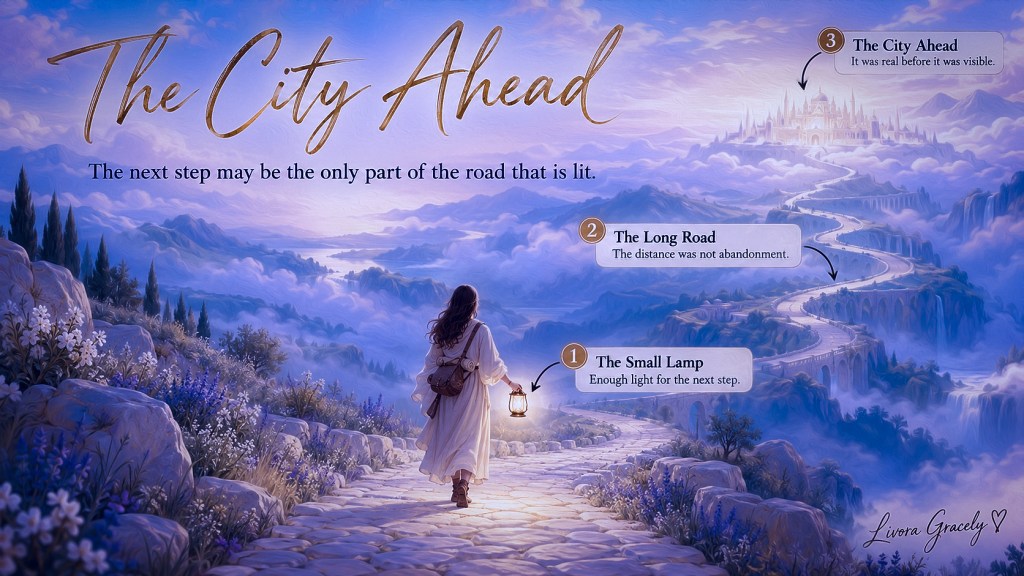
The next step may be the only part of the road that is lit.
The traveller had been walking long enough to stop asking when the city would appear.
At first, every rise in the road had seemed promising. He would climb, shield his eyes, and expect to see towers beyond the next line of hills. Instead, there would be another valley, another bend, another stretch of ground turning blue in the evening.
Now he carried only a small lamp, a rolled piece of cloth, and a promise he could not unfold into a map.
The lamp gave him enough light to see the stones near his feet. It did not illuminate the city. That would have been useful, but apparently the lamp had been assigned a more modest task.
He lifted it, took the next step, and kept walking.
Hebrews 11 begins with people like this. Not people who possessed a complete picture of the future, but people who acted because they trusted the One who had spoken about it. Their faith was not an escape from history. It was a way of moving through history when the destination remained beyond sight.
The People Before
Hebrews does not introduce its witnesses as a parade of people who found faith easy. Abel, Noah, Abraham, Sarah, Moses, and the others appear as men and women whose lives were shaped by a promise that had not yet become fully visible.
The chapter is often remembered as a list of heroes. The writer seems to remember something more human: these people had to make decisions before they could see how the decisions would end.
Abel offered what he believed was acceptable before anyone could measure the outcome. Noah prepared for a judgment that had not yet arrived. Abraham left his country without carrying a complete address for the place he would receive. Sarah trusted a promise that had become physically unreasonable.
Their lives did not unfold inside a well-lit room.
The road contained uncertainty, delay, disappointment, and the ordinary difficulty of continuing after the first excitement had passed. A promise can sound bright when it is first given. It becomes heavier when the years begin adding their weight to it.
Hebrews does not hide that weight. It says that some of these people died in faith without receiving the things promised, though they saw them and welcomed them from a distance. They confessed that they were strangers and exiles on the earth.
That is not the language of people who had mistaken optimism for faith. It is the language of people who had learned to live with a future they could not yet hold.
They carried the promise as one might carry a letter through a long journey. The letter does not become less real because the destination is far away. But the traveller must still walk through weather, hunger, unfamiliar roads, and nights when the writing cannot be read.
The people before us are not important because they never felt uncertainty. They are important because uncertainty did not become the final authority over their next action.
Faith Without Proof
Hebrews defines faith as confidence in what is hoped for and assurance about what is not seen. The sentence has often been made to sound like an instruction to stop thinking. In the letter, it means something more demanding.
Faith is not the ability to feel positive while facts remain inconvenient. It is the way a person orders life when the promise is trusted before the result can be displayed.
Noah builds before the rain. Abraham leaves before the map is complete. Moses chooses identification with an oppressed people rather than the temporary advantages of the royal household. These actions are not proofs that the future has already arrived. They are responses to a word that has become more trustworthy than the comfort of staying where one is.
This is where the old wilderness returns.
In the wilderness, the shorter road looked persuasive because the destination was good. Bread was good. Protection was good. Kingdom was good. The pressure came from trying to possess the good thing without receiving the road that belonged to it.
Hebrews does not present the long road as evidence that God has forgotten the traveller. Sometimes the length of the road becomes the place where trust changes from an idea into a habit.
Anyone can promise to be patient while the answer is still nearby. Patience becomes visible when the answer remains absent and the person still tells the truth, keeps the promise, returns to the work, or refuses to exchange faithfulness for a faster reward.
This kind of faith rarely looks impressive from the outside. A person goes to work. A person keeps caring for someone who cannot repay the effort. A person tells the truth without knowing whether honesty will protect the future. A person opens the door again after disappointment, though the hinges have not become more cooperative.
There may be no dramatic proof.
There is simply another step taken in the direction of the promise.
The lamp does not need to prove the existence of the city. It only needs to give enough light for the foot that is about to move.
The Better City
The people in Hebrews 11 were not merely waiting for a safer house, a better harvest, or a piece of land they could finally call their own. The letter says that they were longing for a better country, a heavenly one. Therefore God is not ashamed to be called their God, for He has prepared a city for them.
This is where the horizon expands.
The promise is not reduced to private escape. The people of faith are being gathered toward a home prepared by God, a city that gives shape to their wandering and meaning to their endurance.
A city is different from a hiding place. It has streets, gates, neighbours, memory, work, worship, and a shared life. The image suggests not only arrival but belonging. The traveller is not being rescued into emptiness. He is being led toward a place where the scattered pieces of life can be gathered into a community.
Hebrews later speaks of Mount Zion, the city of the living God, the heavenly Jerusalem, and the assembly of the firstborn. The letter does not need to describe every street in order to make the direction clear. Its readers are already being taught to see themselves as people whose true home is not exhausted by the present arrangement of the world.
The language quietly opens toward the final biblical vision of a city where God dwells with His people. Hebrews does not unfold the whole scene from Revelation here, and it does not need to. A horizon can be real without being fully drawn.
What matters is that the city ahead is better than the security the traveller could build alone. It is designed by God, and it gathers people who have learned to walk by faith rather than by possession.
This gives the road a different meaning. The traveller is not wandering because there is no destination. He is walking because the destination is larger than anything he could have invented from the roadside.
The city remains ahead.
That is not a failure of the promise. It is the reason the promise continues to pull the traveller forward.
Outside the Camp
By the time Hebrews reaches chapter 13, the language of pilgrimage becomes more physical. The readers are told to go to Jesus outside the camp, bearing the disgrace He bore, because here we do not have an enduring city but we are looking for the city that is to come.
The sentence does not sound like a travel advertisement.
There is no promise of a comfortable route, a flattering reception, or a clean pair of sandals at the end of the day. To go outside the camp means leaving the place where respectability is most easily maintained. It means accepting that loyalty to Christ may place a person beyond the boundaries of safety, approval, and familiar religious arrangement.
Yet Hebrews does not turn this into a contest for dramatic suffering. The call is not to perform hardship so that God will be impressed. It is to remain with Jesus where faithfulness has taken Him, even when the place is inconvenient and the city is not yet visible.
This is where the great language of Hebrews returns to the body.
The pilgrim has feet that become tired. The lamp needs oil. A companion may fall behind. Someone must share food. Someone must remember the prisoner, welcome the stranger, honour marriage, resist the love of money, and keep doing good when applause has gone elsewhere.
The future city is not an excuse to neglect the present road. It is the reason the present road can be walked with courage.
The people before us did not receive a complete map. The readers of Hebrews do not receive one either. They receive a better Priest, an open way, a living promise, and enough light to obey the next instruction.
The traveller reaches the top of another hill. The lamp has grown dim. Below him, the road bends through the dark, and beyond the darkness there is still no city to be seen.
He could sit down and call the unseen destination unrealistic. He could turn back and announce that the road had been misleading. Or he could protect the small flame, listen for the footsteps of the others, and take the next step.
The city is still ahead.
So is the road.
And for tonight, the lamp is enough.


Leave a comment