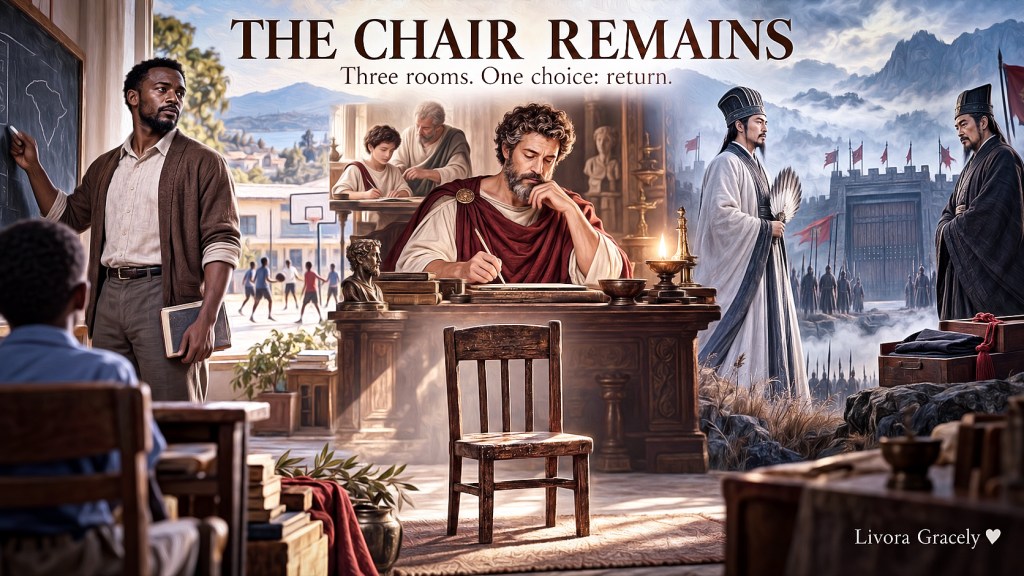
Three rooms had been left behind.
A classroom after the lesson.
A palace after the lamp had burned low.
A military camp after the drums had stopped.
In each room, something remained.
A chair.
A piece of chalk.
A writing tablet.
A closed gate.
Nobody had promised that the next day would be easier.
The rooms simply waited.
A Waiting Chair
Koffi had once entered a classroom as a student carrying the weight of school fees.
Later, he stood at the front of another classroom with chalk in his hand.
The students did not know how many difficulties had brought him there.
They only knew that the equation on the board had stopped making sense.
One student raised a hand.
Koffi turned around.
He did not erase the problem.
He wrote one step beneath it.
Then another.
The chair behind him remained empty.
It had belonged to the teacher before him.
Now it was waiting for the next student who would discover that understanding sometimes arrived after the third attempt.
At the end of the day, Koffi left the classroom and went to the gym he had built from his savings.
Different room.
Different equipment.
The same returning bodies.
Someone lifted a weight and placed it down too quickly.
Someone else watched.
Koffi adjusted the equipment.
“Again,” he said.
The person tried once more.
The room did not applaud.
It simply made space for another attempt.
The Second Answer
Marcus Aurelius had been surrounded by people who expected answers.
They came to the palace carrying disputes, requests, and reports.
He gave them an answer.
Then he returned to his books.
Sometimes the first answer remained.
Sometimes it did not.
A sentence was read once.
Then twice.
A stylus rested above the tablet.
The emperor looked at the words again.
Outside, a messenger waited.
Inside, Marcus crossed out what he had written.
The correction made the tablet less beautiful.
It also made the decision safer.
He had teachers who corrected his speech.
Teachers who corrected his habits.
Teachers who reminded him that a person could wear authority and still misunderstand a difficult thought.
So he kept returning to the work.
Not to produce a perfect answer.
To make the next one less careless.
The lamp burned down.
The messenger waited.
The emperor read again.
The Closed Gate
At Wuzhang Plains, Zhuge Liang sent a gift that was meant to provoke Sima Yi.
The garments were placed before him.
The officers wanted the gate opened.
They wanted horses.
They wanted the enemy to pay for the insult immediately.
Sima Yi looked at the clothes.
Then he looked at the map.
The order from the emperor was still clear.
Hold the position.
Do not attack.
The gate stayed closed.
Beyond it, Zhuge Liang’s army waited.
Inside, Sima Yi asked about his rival’s sleep, food, and workload.
The questions sounded smaller than the war.
They were not.
A commander could be invited to fight by a message.
He could be forced to fight by an order.
He could also refuse to let another man choose the moment for him.
Days passed.
The soldiers grew tired of waiting.
The gate remained where it was.
After Zhuge Liang died, the Shu army withdrew.
Its banners turned.
Its drums sounded.
Sima Yi stopped his pursuit.
The dead commander had left one final uncertainty behind him.
Sima Yi did not rush toward it.
He let the road empty.
Still Standing
Koffi returned to the board.
Marcus returned to the tablet.
Sima Yi returned to the closed gate.
None of them received a final announcement.
No voice entered the room to say that the difficult part had ended.
Koffi still had students who did not understand.
Marcus still had judgments that required a second look.
Sima Yi still had enemies who knew how to make waiting feel like defeat.
The work continued because the room continued.
A chair was pulled back.
A piece of chalk broke.
A hand reached for another.
The tablet received one more correction.
The gate held through another night.
There were no guarantees attached to any of these actions.
The student might fail again.
The emperor might still choose badly.
The army beyond the gate might find another way in.
Koffi placed the chalk on the desk.
Marcus closed the tablet.
Sima Yi listened to the silence outside.
Then each returned to the place where the work had stopped.
The chair remained.
Not as a monument.
As an invitation.
Someone would sit there tomorrow.
The lesson would begin again.


Leave a comment