Genesis 6:1
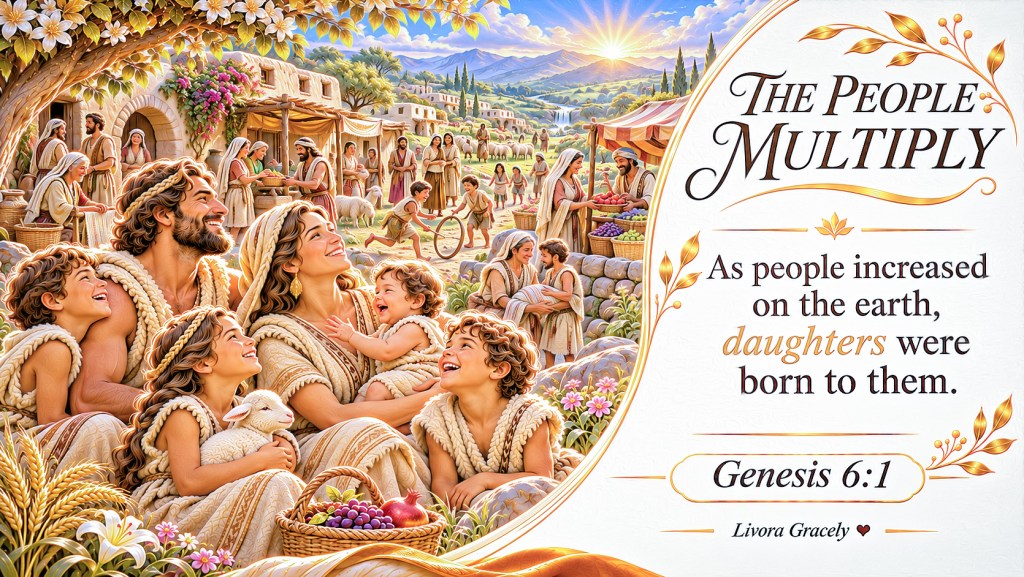
As people increased on the earth, daughters were born to them.
A Family in the Foreground
A baby reaches toward her mother. Beside them, children lean close, and a small lamb rests in a girl’s arms. Behind the family, another child rolls a hoop along a path while people gather among houses and baskets of fruit.
The poster imagines a world becoming busier. It gives faces to a sentence that tells us very little about individual faces: people were increasing on the earth, and daughters were born to them.
Genesis does not describe this particular family, their lamb, or the village behind them. The picture offers a way to pause over the verse and notice how much life can be held in a few words.
Beyond the Names
In the previous chapter, Genesis followed a line from Adam to Noah. Each generation brought another name: Seth, Enosh, Kenan, Mahalalel, and those who came after them. Alongside the named sons, the account repeatedly mentioned other sons and daughters.
A family record can guide the eye along one branch while a much larger tree continues to grow around it. Genesis 5 follows a particular line, but its brief references to other children remind us that the named figures were not the only people in the story.
At the beginning of chapter 6, the view widens. Instead of giving the age of one father when his son was born, the account speaks of people increasing across the earth.
The daughters mentioned here lead into the next verse. Genesis does not give them names or describe their childhoods. It tells us they were born as the human family grew.
A Blessing at the Beginning
The language of increase takes the story back to creation. In Genesis 1:28, God blesses the man and the woman and tells them to be fruitful, increase in number, and fill the earth.
That earlier blessing matters when reading Genesis 6. The growth of the human family is not presented in verse 1 as a problem by itself. The difficult events and the account of human wickedness follow; they should not be confused with the arrival of children. NIV Bible – Bible App
On the poster, the little girl holds her lamb close while the adults look toward the light. Beyond them are neighbours, children, and homes. The scene is imagined, but its widening circle helps us picture the movement from a family to a larger community.
Later, in Athens, Paul speaks of God as the maker of the world and says that from one man He made the nations to inhabit the earth. His words belong to a different setting, yet they too look across a world of people and remember their shared origin in God’s creative work. Bible Gateway
A World of Stories
A list of generations can fit neatly down a page. Life beyond it would be harder to arrange in a single column.
There would have been more sons and daughters than the family line names, more lives than Genesis pauses to describe. The opening of chapter 6 does not tell their individual stories, but it does turn our attention toward a growing human world.
The following verses will bring difficult questions and a darker view of that world. For this moment, the sentence begins with people increasing and daughters being born.
One chapter carried the story from name to name. The next begins by looking across the earth.
Livora Gracely ♥
Sources


Leave a Reply