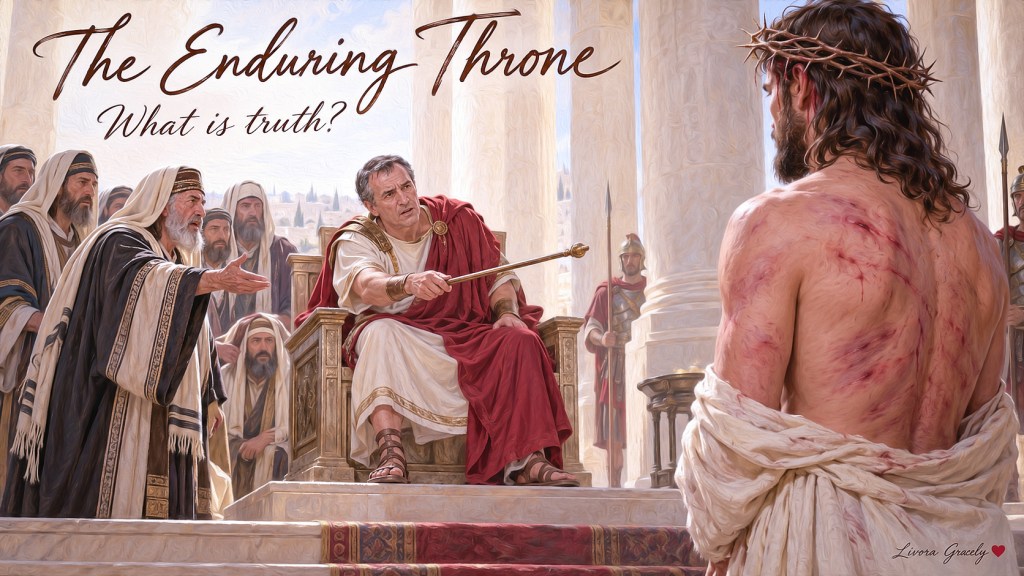
Pilate questioned His kingship. The Father declared His throne.
“Are you the king of the Jews?”
Pilate had summoned Jesus inside the governor’s palace. The question concerned kingship, but the Man before him had been brought there under arrest.
Jesus spoke of a kingdom whose source was beyond this world. If His kingdom came from this world, His servants would have fought to prevent His arrest. He had come to bear witness to the truth.
Pilate asked another question: “What is truth?” Then he went outside and announced that he found no basis for a charge against Jesus.¹
Hebrews brings a different declaration about this King. God speaks about His Son:
“Your throne, O God, will last for ever and ever;
a scepter of justice will be the scepter of your kingdom.”²
About the Son
The turn toward the Son continues everything the letter has been building.
God has spoken through Him, appointed Him heir of all things, and made the universe through Him. The Son reveals God’s glory and being, sustains all things, and sits at His right hand after providing purification for sins.
The following verses make His distinction from the angels increasingly clear. God affirms the relationship of Father and Son. He commands the angels to worship Him. He describes those angels as powerful servants.³
Now the letter turns from their service to the Son’s throne.
The contrast concerns their place and authority. Angels carry out God’s purposes with strength and obedience. The Son possesses the enduring royal authority described in this verse. Their splendour makes His distinction all the more striking.
This also gives the earlier account of His suffering its full weight. The One who accepted arrest in the garden is the One whom heaven worships. His willingness to suffer belongs to the mission of the Son who reigns.
Pilate’s question arose within an earthly court. Hebrews lets us hear what God has already declared about the Man being questioned.
The Divine King
The declaration comes from Psalm 45, a royal wedding song. Its original setting celebrates a king and the ideals of his rule: truth, humility, and justice. Hebrews takes its words and explicitly applies them to the Son.⁴
That setting matters. The letter is reading Israel’s royal hope in the light of Jesus. The King now before us is the Son through whom God made the universe and who perfectly expresses His being.
In the wording followed here, He is addressed as “O God.” This is a direct recognition of His divine identity, fitting the description already given at the beginning of the letter.
The Father’s address also preserves their relationship. The Father speaks; the Son receives the declaration. Hebrews holds His divine dignity together with His identity as the Father’s Son.
His closeness to the Father reaches those who hear Him. Jesus told His disciples that He called them friends because He had made known what He had learned from His Father. He also spoke of the Father’s love and of the works the Father showed Him.⁵ The Son makes the Father known with a closeness that gives substance to the opening of Hebrews: God has spoken through Him.
An Enduring Throne
The throne expresses His kingship. Its permanence tells us what kind of reign belongs to Him.
Earthly rulers hold office for a time. Their seats pass to others, their influence changes, and their kingdoms can fall. The declaration about the Son places no such ending upon His rule.
This brings the letter’s earlier words about inheritance into clearer view. The heir of all things has a kingdom that endures. His place at God’s right hand after cleansing sins is royal authority with lasting significance.
Before His birth, Mary was told that her Son would receive David’s throne and that His kingdom would have no end.⁶ The promise spoken to her and the declaration quoted in Hebrews belong to the same royal hope, fulfilled in the same Person.
His arrest did not erase that promise. His suffering carried forward the saving work whose completion Hebrews has already announced. The Son who provided purification for sins is now enthroned.
The courtroom could neither confer His divine identity nor remove it.
The Just Scepter
The final line tells us how this enduring King rules.
A scepter is a sign of royal authority. Here it is marked by justice. The word carries the sense of uprightness: the King’s rule is straight and right. His authority has a moral character as well as an enduring reach.
That gives precision to the word truth in this discussion. Pilate asked about truth after Jesus spoke of bearing witness to it. Hebrews describes the justice of His government. These concerns belong together, while each passage retains its emphasis: Jesus bears witness to truth, and His reign exercises what is right.
The promise of an everlasting throne gains further depth through that righteous rule. The authority that endures is trustworthy. Justice belongs to the way the Son exercises His kingship.
The opening of Hebrews has already placed His saving work beside His exaltation. The King on this throne is the One who provided cleansing for sinners. His justice and His mercy meet within the account of His own costly work.
At Jesus’ trial, Pilate faced pressure from people who appealed to his loyalty to Caesar. He brought Jesus out and took his place on the judgment seat. Eventually, he handed Him over to be crucified.⁷
The seat was visible. The proceedings were public. The Father’s declaration about His Son remained true through them all.
Pilate sat on the judgment seat.
Before him stood the King.
Scripture References
- John 18:33–38, NIV; opening quotations from verses 33 and 38.
- Hebrews 1:8, NIV.
- Hebrews 1:1–7.
- Psalm 45:1–7.
- John 15:14–15; John 5:19–23.
- Luke 1:32–33.
- John 19:12–16.


Leave a Reply