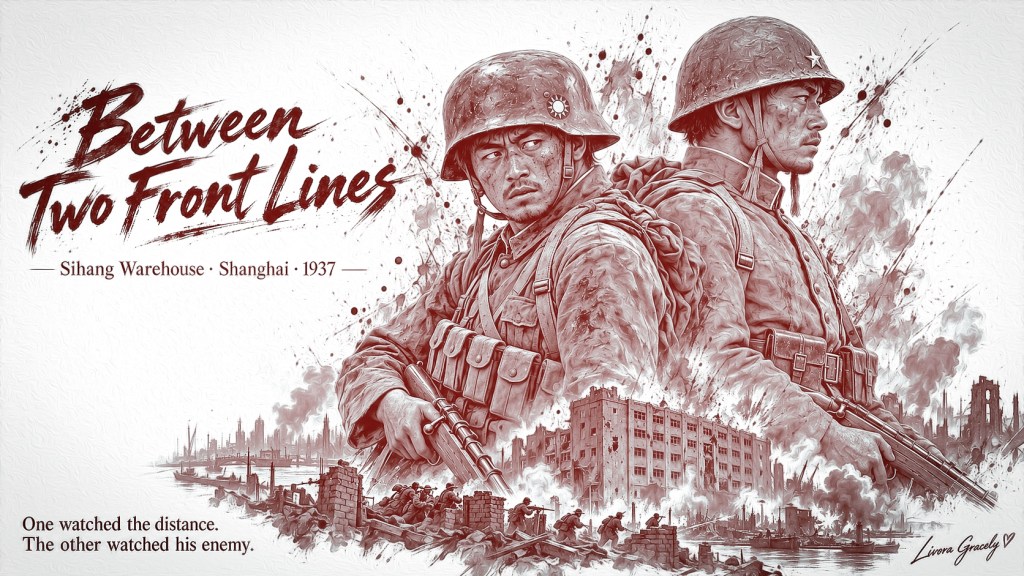
One watched the distance. The other watched his enemy.
A Small Message
The message was small enough to fit inside a cigarette packet.
In her later account of the fighting at Sihang Warehouse, Yang Huimin remembered writing to the Chinese soldiers inside, identifying herself as a Girl Guide and asking what they needed. She put the note into the packet and asked a British soldier to throw it across to them. When no answer came, she tried to draw their attention to what was inside.
The reply named food, ammunition, and gun oil.
Shanghai was under Japanese attack. By late October 1937, several hundred Chinese soldiers under Xie Jinyuan were holding the warehouse beside Suzhou Creek. Across the water lay the International Settlement, where people could watch the fighting from a distance that offered some protection without making the destruction disappear.
Yang had found men behind a wall. She had asked them a question they could answer.
Across the Water
Her recollection describes further efforts to connect the defenders with the Shanghai Chamber of Commerce and help bring supplies to them. Other volunteers worked on deliveries too. Food, clothing, and medicine were gathered in the city and carried towards the warehouse; the work belonged to more people than a single portrait could contain.
A parcel had to pass through several hands before anyone inside could use it. Someone collected what was needed. Someone arranged transport. Someone brought it close enough for a defender to receive it. The danger did not end when a donation left its owner’s house.
From across the creek, the warehouse could look like one large, stubborn building. A request for food made its occupants harder to keep at that distance. They had to eat between attacks, clean their weapons, and attend to the wounded while the walls continued taking fire.
Above the Roof
Yang became widely remembered for delivering a Republic of China flag to the defenders. Accounts differ over the route she took and the details of the delivery. A photograph dated 29 October records a large Chinese flag flying above the warehouse.
The flag could be seen from outside. Much of the work supporting the men could not. A coat carried into the building disappeared among other coats. Food was unpacked and eaten. Medicine passed out of sight towards someone who needed it.
These deliveries did not stop the attack or remove the defenders from danger. The soldiers remained at their positions, and civilians remained in a city being torn apart. Yet a request had travelled out of the warehouse, and people beyond it had begun sending things back.
Behind the Wall
In a sheltered corner, a soldier works at the knot of a food parcel. Dust has settled in the fold of his sleeve. His first pull tightens the cord, so he steadies the bundle between his knees and tries the smaller loop instead.
Beside him, another man keeps watching the opening in the wall. He turns briefly at the sound of paper, then looks outside again. The parcel lies open now, but his companion does not start eating. He breaks a piece of bread and waits until the watching man has one hand free.
The man takes it without lowering his rifle. Crumbs catch on his cuff. He brushes them away, takes a bite, and shifts aside so his companion can sit against the wall.
The paper between them has picked up brick dust. Inside it, there is enough for another piece.
Historical note: Yang Huimin’s message and supply efforts follow her later account. Details of the flag delivery vary between accounts. The anonymous soldiers and actions in Behind the Wall are fictional scenes written for this article.


Leave a Reply