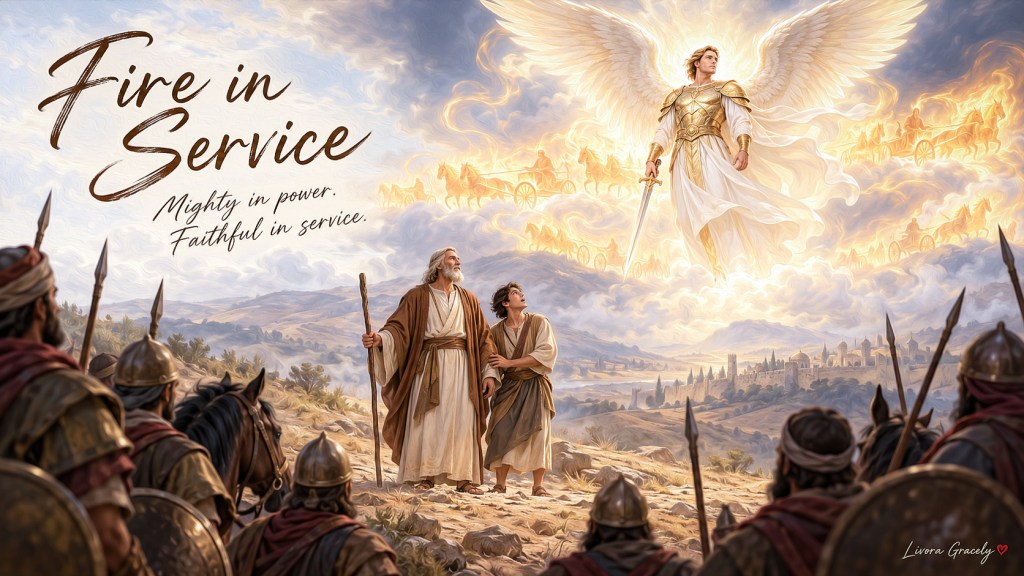
The hills held chariots of fire.
The captives were given a meal.
The first army was easy to see.
Elisha’s servant went outside early that morning and found the city surrounded by horses and chariots. He turned to his master in alarm. What were they going to do?
Elisha prayed for the young man’s eyes to be opened. Then the servant saw the hills filled with horses and chariots of fire around the prophet. The help had been there before he could see it.¹
Hebrews gives us a sentence through which to consider the strength of heaven:
“In speaking of the angels he says, ‘He makes his angels spirits, and his servants flames of fire.’”²
The fire is striking. So is the word servants.
Under His Command
God is the One acting in this sentence. The angels belong to Him, and their service takes its direction from Him.
Calling them servants does nothing to diminish their strength. Another psalm describes mighty angels who obey God’s word and heavenly hosts who carry out His will. Their power and their obedience appear together.³
That helps us hear the movement of Hebrews. The previous verse calls all God’s angels to worship the Son. Now the letter describes their service. Their splendour belongs within an order in which God speaks and they respond.
The Son’s place is already established at the Father’s right hand. The angels have their own honoured work within His purposes. Their greatness gives weight to the comparison: beings of such power serve the God whose Son they worship.
Around Elisha, the fiery chariots did not become an invitation for the servant to direct a battle. The prophet prayed to God. What happened next remained in His hands.
Wind and Flame
The words in Hebrews come from a psalm celebrating God’s majesty over creation. Light, clouds, wind, and fire belong within its picture of the Lord’s greatness. Hebrews draws from that passage to speak about His angels.⁴
Some translations use spirits here; others use winds. The underlying word can carry either sense. Both renderings belong to a passage in which God directs His servants and commands the powers of creation.
The emphasis remains on God’s command over His servants. Wind and flame bring force and movement into the sentence. The imagery gives their service a strength that a pale, decorative picture of angels would miss.
It also leaves room for restraint. The verse does not give a description of every angel’s body or explain every appearance an angel may take. It places powerful servants under the authority of their Maker.
The account of Elisha likewise describes what the young man saw: horses and chariots of fire. The scene reveals help beyond his sight. Its details can remain as Scripture gives them, while Hebrews supplies the clear statement about angelic service.
Serving the Son
That service becomes particularly tender in the wilderness.
Jesus had fasted and faced the devil’s temptations. He refused to turn stones into bread at the tempter’s demand, to test His Father by throwing Himself down, or to gain kingdoms through worshiping the devil. When the devil left, angels came and attended Him.⁵
Matthew gives that quiet action its place after the testing. The Son had endured hunger and temptation; heavenly servants came to His help. The Gospel allows their ministry to stand without explaining everything they did.
The One whom they served had entered real human weakness. His hunger belonged to the life He had taken among us. Their attendance honours the Son within that life.
Jesus Himself would describe His mission through service: He came to serve and give His life as a ransom for many.⁶ In Him, service reaches the cost of self-giving. His willingness to serve belongs alongside the heavenly honour already described in Hebrews.
The angels attend Him. He gives the life through which sinners are saved.
Looking Into Salvation
Peter opens another small window onto heaven’s attention.
Writing about the salvation announced through the gospel, he recalls the prophets’ search concerning the Messiah’s sufferings and the glory that would follow. Then he says that angels long to look into these things.⁷
Their eagerness adds wonder to their service. These mighty beings attend closely to the saving work unfolding through Christ. Peter leaves them looking into the gospel with an interest that has not been exhausted.
The Son stands at the centre of that work. The hunger, the suffering, the giving of His life, and the glory that follows belong to His saving mission. Heaven’s servants have their part around Him; the salvation they contemplate is accomplished through Him.
Back in Elisha’s story, the enemy soldiers were led into Samaria. Israel’s king wanted to kill them. Elisha instructed him to give them food and water instead.
A great feast was prepared. After the soldiers had eaten and drunk, they were sent back to their master.
The morning had revealed chariots of fire.
The captives were sent home fed.
Scripture References
- 2 Kings 6:15–23.
- Hebrews 1:7, NIV; see also the worship commanded in verse 6.
- Psalm 103:20–21.
- Psalm 104:1–4.
- Matthew 4:1–11.
- Mark 10:42–45.
- 1 Peter 1:10–12.


Leave a Reply