Genesis 11:1–4
With one language and a shared plan, the people began building a city and a tower.
A Plan on the Table
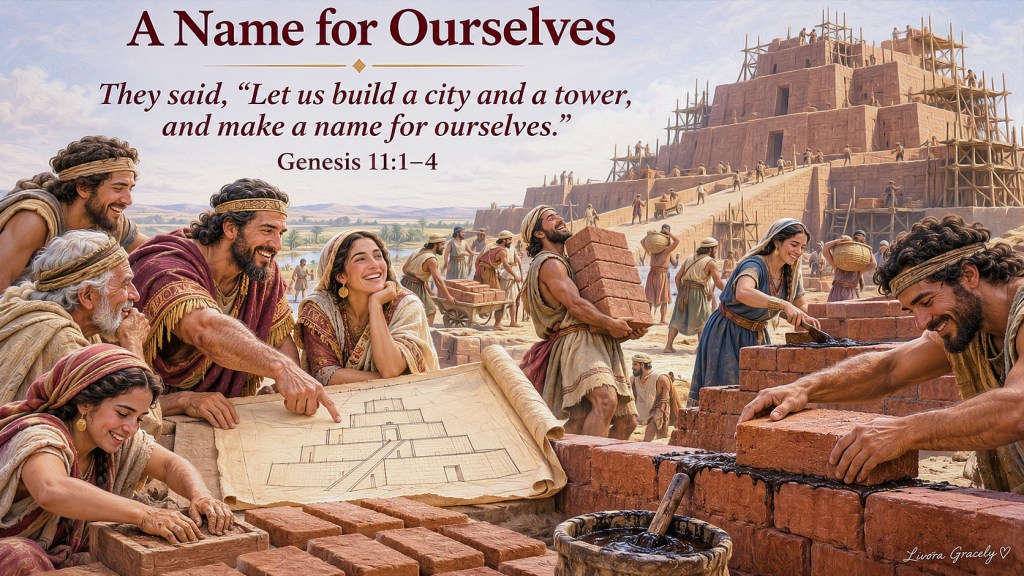
A hand rests on a drawing of a tower. Around the table, faces turn toward the plan while workers carry bricks across the ground behind them.
At one side, a woman presses clay into a mold. At the other, a man sets a brick in place, dark mortar beneath his hands. Farther back, the tower rises above the busy building site.
The poster imagines the builders and their work. Genesis does not describe this drawing or tell us who stood around it. It does give the materials, the place, and the words that brought the people together.
One Language, One Place
The story begins when the whole earth had one language and common words. As people traveled eastward, they found a plain in Shinar and settled there.
There they spoke to one another about what they would make. They formed bricks and burned them thoroughly, using brick for stone and bitumen for mortar.
The account lets the words of their plan be heard: they would build a city and a tower with its top reaching toward the heavens. They would make a name for themselves, so that they would not be scattered over the whole earth.
In the poster, many hands take part. A brick is shaped, another is carried, and another is placed on the growing wall. Their shared work gives a visible form to the common purpose recorded in the passage.
A Name for Themselves
The builders wanted more than a tower. They named a city, a reputation, and a future in which they would remain together.
Their words follow an earlier blessing in Genesis. After the flood, God blessed Noah and his sons and told them to be fruitful, multiply, and fill the earth. At Shinar, the people spoke of building so they would not be scattered.
The passage does not say that the builders discussed the earlier blessing or tell us everything they felt. It records what they said to one another and the purpose they gave for their work.
A Name in Another Story
Later in Genesis, God called Abram to leave his country and go to a land He would show him. God promised to bless him, make his name great, and make him a blessing.
The two passages belong to different moments. At Babel, the people speak of making a name for themselves. In Abram’s story, God speaks the promise of a great name and a blessing that reaches beyond Abram’s household.
The repeated word invites a pause without making the stories identical. One begins with a city and a tower planned on a plain; the other begins with a call to leave and a promise for the journey.
Before the Work Stops
The drawing remains open on the table. Around it, bricks are lifted, mortar is spread, and the unfinished tower stands against the sky.
Much later, Jesus spoke of a person planning a tower and considering its cost. His illustration addressed the cost of discipleship, not the builders at Babel.
The next part of Genesis will tell what happened to the builders and their city. For now, the passage leaves their words beside their work: a city, a tower, and a name they hoped would keep them together.
Livora Gracely ♥
Sources
- Genesis 11:1–4 — The people settle in Shinar and plan a city and a tower.
- Genesis 9:1, 7 — God blesses Noah and his sons and tells them to multiply and fill the earth.
- Genesis 12:1–2 — God calls Abram and promises to make his name great.
- Luke 14:28–30 — Jesus uses the example of building a tower while speaking about the cost of discipleship.


Leave a Reply