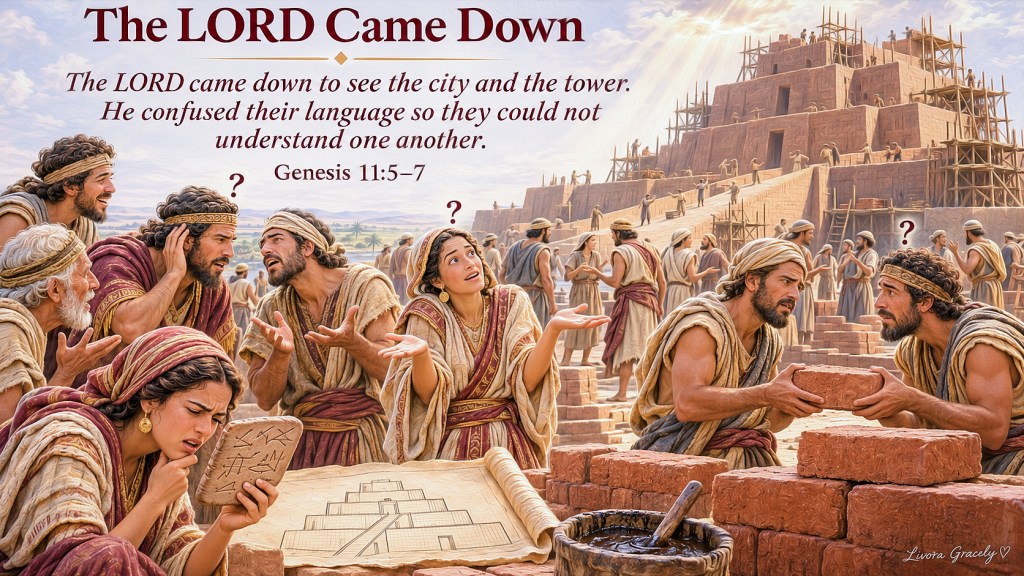
Genesis 11:5–7
The LORD came down to see the city and the tower, and the builders could no longer understand one another.
A Brick between Two Hands
Two workers hold the same brick. One appears to be speaking, while the other looks back at him with a puzzled expression.
Nearby, a man cups his hand around his ear. A woman raises her hands, and another studies marks on a small tablet. Behind them, the tower still rises above the building site.
The poster imagines the builders’ expressions and gestures. Genesis does not describe these particular people or the words they tried to exchange. It does say that their language was confused so that they could no longer understand one another.
The LORD Came Down
The people had planned a city and a tower with its top reaching toward the heavens. They wanted to make a name for themselves and remain together rather than be scattered across the earth.
Then the account changes direction. The LORD came down to see the city and the tower the people were building.
The contrast is striking. The builders had spoken of a tower reaching toward the heavens; Genesis now speaks of the LORD coming down to see their work. The words draw attention to God’s response to their undertaking.
The passage does not say that God had been unaware of the project. It tells the story in a way that places His seeing beside the people’s ambitious plan.
One People, One Language
The LORD spoke of the people as one, with a single language, and of this project as the beginning of what they would do. He said that nothing they planned would be impossible for them.
Their common language had allowed them to speak and work together. The passage has already given the purpose they expressed: to make a name for themselves and avoid being scattered.
Genesis does not describe every thought in their minds or name a particular disaster that the tower would cause. It records their words, the LORD’s words, and what He did next.
Words No Longer Understood
The LORD said, “Let us go down,” and spoke of confusing their language so that they would not understand one another.
In the poster, a brick remains between two pairs of hands. A tablet is examined; a listener leans closer. These details are imagined, but they bring the difficulty of understanding into a scene of shared work.
Much later, at Pentecost, people from many places heard the disciples speak about God’s works in their own languages. That gathering in Jerusalem was a different event: the people did not all return to one language. Yet their surprise at hearing familiar words offers another moment in the biblical story to consider language and understanding.
The One Who Sees
A psalm speaks of the LORD looking down from heaven and seeing humanity. Its setting is a song of praise, not the building site in Shinar, but it too gives attention to the God who sees.
In the poster, the two workers still hold the brick. Between them is a task they once could have discussed; around them are voices they are struggling to understand.
The tower has not disappeared. The words that brought the builders together have changed.
Livora Gracely ♥
Sources
- Genesis 11:1–7 — The builders’ shared purpose and the LORD’s response to their city and tower.
- Psalm 33:13–15 — The LORD looks from heaven and observes humanity.
- Acts 2:5–11 — People from many places hear about God’s works in their own languages at Pentecost.


Leave a Reply