Genesis 11:8–9
The building stopped, and from Babel the people were scattered across the earth.
The Road beyond the Bricks
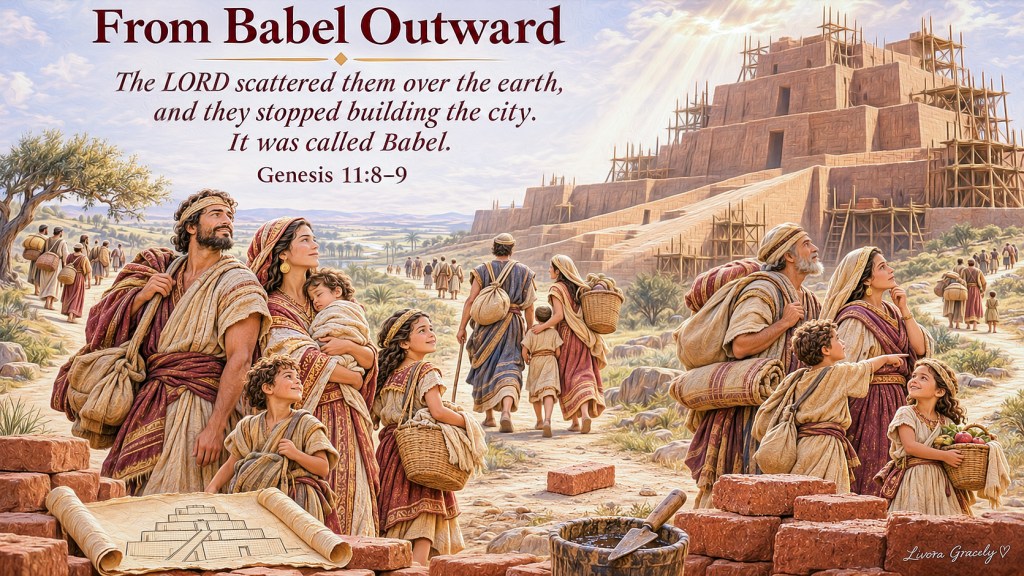
A drawing lies unrolled among the bricks. Nearby, a trowel rests in a dark pot, and the tower rises behind the families who have begun to move away.
A mother carries a sleeping child. An older man has a bundle over his shoulder, while children walk beside the adults. Farther along the road, other figures travel through the open land.
The poster imagines what the people might have carried and the paths they might have taken. Genesis does not describe these families or their departures in such detail. It tells that the LORD scattered the people from the city over the earth and that they stopped building it.
A City Left Unfinished
The people had spoken of building a city and a tower. They wanted to make a name for themselves, so that they would not be scattered across the earth.
Their plan began in a place where they shared one language. Then the LORD confused their language, and they could no longer understand one another as before.
The ending returns to the very thing they had hoped to avoid: the LORD scattered them. The work on the city stopped.
In the poster, scaffolding still surrounds the tower. Bricks lie on the ground, and the plan remains open. These details give a shape to a building project interrupted. The passage says the people stopped building the city; it does not say that the tower fell or that the city was destroyed.
A Name Remembered
The builders had wanted to make a name for themselves. At the close of the account, the city has a name: Babel.
Genesis connects that name with what happened there. In the Hebrew telling, Babel echoes the word for confusing: there the LORD confused the language of the whole earth, and from there He scattered the people.
The name remains, but the story attached to it is larger than the one the builders had planned. Their own words and the account’s closing words stand near each other: they wanted to stay together; they were scattered from that place.
Families across the Earth
The chapter before Babel describes the families descended from Noah’s sons, organized by their lands, languages, clans, and nations. It ends by saying that the nations spread across the earth after the flood.
Genesis 11 turns to the story of a city and its builders. Together, the chapters move between a wide view of families across the earth and the account of what happened at Babel.
The roads in the poster help bring that movement into view. They are not a map of the routes the people took, but an imagined glimpse of families traveling beyond one building site.
Beyond Babel
Much later, Paul spoke in Athens of God making the nations to inhabit the earth. He spoke, too, of people seeking God, who is not far from any one of them.
Paul’s words belong to a different time and setting. They offer another view of the nations living across the earth.
At Babel, a drawing remains among the bricks. Beyond it, the road stretches into the distance, and the story continues beyond the unfinished city.
Livora Gracely ♥
Sources
- Genesis 11:1–9 — The building of Babel, the confusion of language, and the scattering of the people.
- Genesis 10:1–5, 20, 31–32 — The families and nations descended from Noah’s sons, according to their lands and languages.
- Acts 17:26–27 — Paul speaks in Athens about the nations inhabiting the earth and seeking God.


Leave a Reply