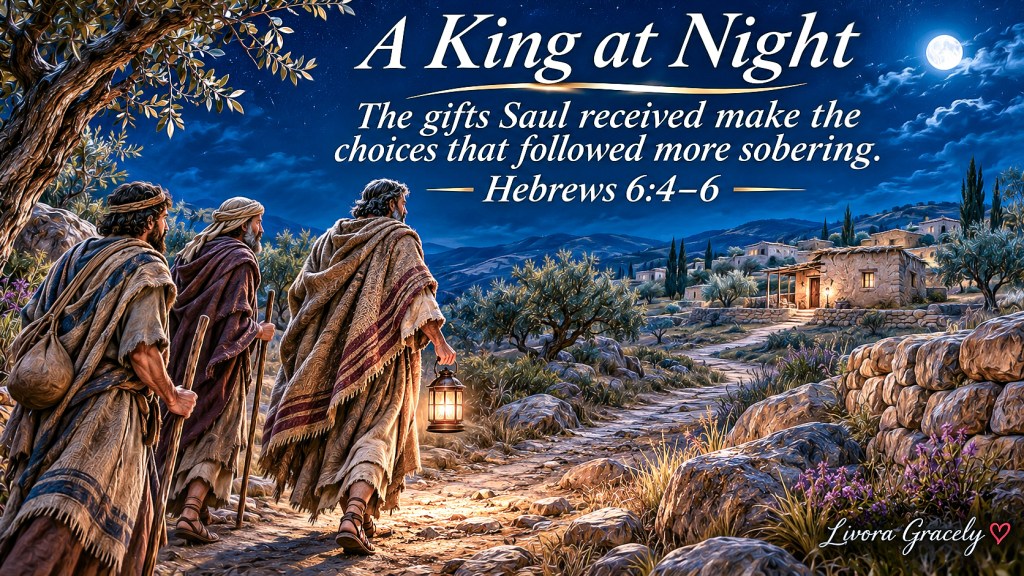
Hebrews 6:4–6
The gifts Saul received make the choices that followed more sobering.
Saul put on different clothes and went out into the night. Two men accompanied him to the woman at Endor.¹
The king had once removed mediums and spiritists from the land. Now, afraid of the Philistine army, he had asked his servants to find a medium for him. Samuel was dead. Saul had inquired of the Lord, but the Lord had not answered him by dreams, Urim, or prophets.¹
The woman did not recognize the king beneath his disguise. Saul asked her to call up Samuel. The message he received would not be the answer he had hoped for.
Before that night, there had been another journey: a young man searching for his father’s lost donkeys.²
A Promising Beginning
Saul came from Benjamin, a small tribe of Israel. When Samuel spoke to him of what was desired in Israel, Saul questioned why such words should be addressed to him. Samuel anointed him, and later the Spirit of God came powerfully upon Saul as he met a company of prophets.²
His beginning held more than Saul had imagined when he set out to search for the animals. In time, he led Israel in the rescue of Jabesh Gilead, and the people celebrated before the Lord.³
The story does not remain there. Under pressure at Gilgal, Saul offered the burnt offering before Samuel arrived. Samuel told him that his kingdom would not endure. Later, after Saul failed to carry out the Lord’s command concerning Amalek, Samuel told him that the Lord had rejected him as king.⁴
Saul’s life had begun with gifts and a calling. Those beginnings did not make his later choices unimportant. The young man who had once wondered why Samuel spoke to him became a king responsible for listening to the word Samuel brought. Each scene deserves attention; together, they show a life more complicated than either its promise or its last night.
The Weight of a Choice
On another day, Saul placed his troops under an oath not to eat until evening. His son Jonathan, who had not heard the oath, dipped the end of his staff into honey and ate. His eyes brightened.⁵
When Saul learned what had happened, he said Jonathan must die. But the people intervened and saved him. The son who had helped bring deliverance to Israel did not die that day.⁵
The sweetness on the end of a staff and the weariness of a hungry army belong to the same story. A king’s words had consequences for people around him.
Later still, Saul ordered the deaths of the Lord’s priests at Nob. His own officials refused to strike them, but Doeg carried out the king’s command.⁶
These scenes do not give us the right to pronounce a verdict on Saul’s eternal destiny. They do show choices, their consequences, and the grief that runs through his story. Samuel mourned for Saul, even after telling him that he had been rejected as king.⁴
A Serious Warning
Hebrews speaks of people who have once been enlightened, tasted the heavenly gift, shared in the Holy Spirit, and tasted the goodness of God’s word and the powers of the coming age. It then describes their falling away and says that it is impossible to bring them back to repentance.⁷
The word impossible is difficult to hear. It is also the word the writer uses. The passage does not ask us to make the warning smaller so that it feels easier. Nor is it a sentence for us to place over another person whenever their journey becomes difficult. The writer addresses a community, calling its members to hear and to continue together.
It speaks of those who, in falling away, crucify the Son of God again to their own loss and hold Him up to public disgrace. This is not a second physical crucifixion. The language conveys the gravity of the rejection being described.⁷
Christians have understood the details of this passage differently: who these people are, how their falling away should be understood, and how the warning relates to salvation. We should listen carefully to the text without pretending that every question has been settled.
Saul is not named in Hebrews 6. His story unfolds before Christ’s death and resurrection, and it cannot be placed over the warning as if every detail were the same. Yet his life gives us a separate picture of gifts received, decisions made, and consequences that reach beyond one person.
Come Near Again
Such a warning may trouble someone who remembers a season of doubt, a painful failure, or a long distance from God. Hebrews gives us reason to take turning away seriously; it does not ask us to declare that every struggle is the falling away described in these verses.
Peter denied Jesus and wept. Later, the risen Lord met him and entrusted His sheep to his care.⁸ Peter’s story does not answer every question in Hebrews 6, but it keeps us from calling every failure final.
The same letter that gives this warning has already urged its hearers to hold firmly to their confession and approach the throne of grace, where they may receive mercy and find help in time of need.⁹ After its warning, the writer addresses them as dear friends and remembers the love they have shown in serving God’s people.¹⁰
Saul walked into the night seeking an answer. Hebrews calls its hearers to keep listening to the Son and to encourage one another today.¹¹ The warning remains; so does the invitation to come near through the One who understands weakness and gives help.
Livora Gracely ♥
Scripture References


Leave a Reply