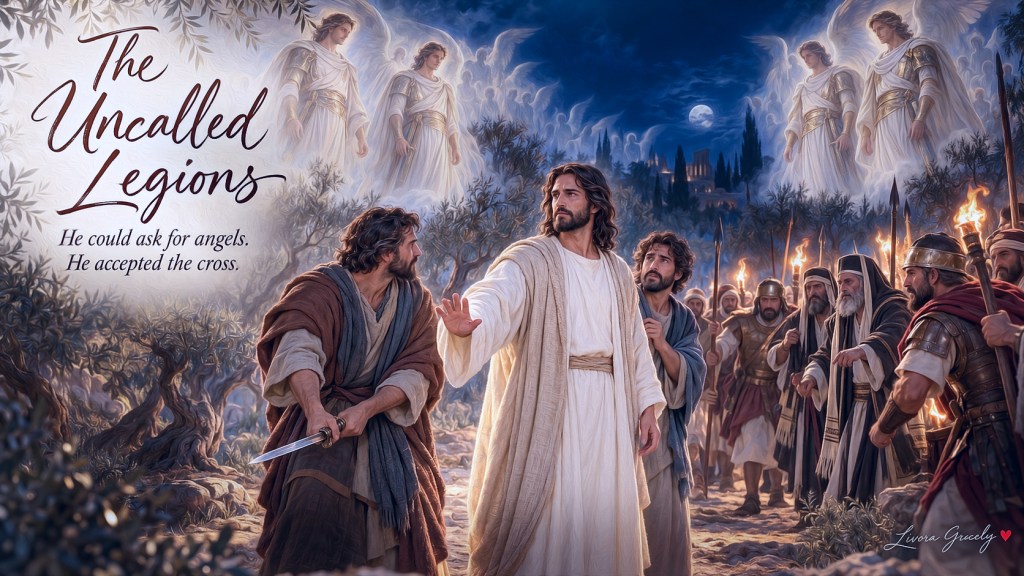
He could ask for angels.
He accepted the cross.
“Put your sword back in its place.”
The men had come to arrest Jesus. One of His companions drew a sword and struck the high priest’s servant. Jesus stopped him, then spoke of help far beyond the weapon in his hand.
He could appeal to His Father, who would provide more than twelve legions of angels. A legion was a great body of troops. The help He described would overwhelm the crowd before Him.
Yet He accepted the path through which the Scriptures would be fulfilled.¹
Hebrews tells us who this arrested Jesus is:
“And again, when God brings his firstborn into the world, he says, ‘Let all God’s angels worship him.’”²
The Son who could receive angelic help is the One whom the angels are commanded to worship.
The Father Presents
God is the One who brings His Firstborn into the world and declares the honour due to Him. The command comes from the Father. Through Scripture, He directs the angels’ attention to His Son.
This continues the movement of the previous verse. The Father has identified the Son and affirmed their relationship. Now He speaks about the response the Son is to receive.
Readers have understood this entrance into the world as His birth among us, His entrance into heavenly glory, or His coming again. The wording has led to different readings of the occasion. The central declaration remains clear: God presents His Son as the One all His angels must worship.
The beginning of Hebrews has already described Him as the heir of all things, the One through whom the universe was made, and the One who sustains it. After providing purification for sins, He sits at God’s right hand.³ The Father’s command belongs within that account of His identity and work.
At His arrest, Jesus spoke of the Father as the One He could ask for help. The relationship affirmed in Hebrews remained His relationship in the garden.
The Firstborn
The title Firstborn adds something important to this picture.
In a household, the firstborn held a place of particular responsibility and inheritance. Scripture also uses the title to express royal standing. God promises to make His chosen king the firstborn, the highest of the kings of the earth. The meaning is explained through the position God gives him.⁴
In Hebrews, this title fits the Son already named as heir of all things. It expresses His supreme standing. The letter has placed Him within the making of the universe; calling Him Firstborn does not turn Him into the first creature made.
His highest position also belongs alongside a remarkable closeness to those He saves. Elsewhere, He is called the firstborn among many brothers and sisters. Hebrews says that He is not ashamed to call them His family. He shares their flesh and blood and comes to their help in suffering.⁵
These are the people He brings into salvation. Their place in His family is a gift of His saving work. His unique Sonship and their welcome belong together.
The One with the foremost place has entered the lives of His brothers and sisters. In the garden, He remains among them as the danger closes in.
The Angels Worship
Now the verse reaches its command: all God’s angels are to worship Him.
Their greatness makes that command weighty. These are heavenly beings whose presence can overwhelm a human witness. Yet God directs their worship toward His Son. The distinction between the Son and the angels becomes visible in what they are commanded to do.
When John falls down to worship an angel, the angel stops him. He identifies himself as a fellow servant and tells John to worship God. In another vision, John hears countless angels praising the Lamb who was slain. Honour rises to the One seated on the throne and to the Lamb.⁶
The Lamb’s suffering remains part of His identity within that heavenly praise. The One who gave His life receives the honour of heaven.
Hebrews brings that same Person before us. He has provided purification for sins; now the Father commands the angels to worship Him. His nearness to human pain belongs within the story of the Son whose dignity exceeds theirs.
No angel’s splendour places it beside Him as an equal. The whole company addressed by God is called to acknowledge His Son.
The Son Accepts
The scene in the garden now carries greater weight.
Jesus had prayed in anguish, asking whether the cup before Him could be taken away. He placed that request within His surrender to the Father’s will. When the armed crowd arrived, His acceptance continued into action.
The Father could provide angelic help. Jesus accepted the suffering through which His saving mission would be accomplished.
Hebrews has already shown its outcome: purification for sins and a seat at the right hand of the Majesty. The Son’s suffering and His heavenly honour belong to the same account. The One worshiped by angels is the One who gave Himself for sinners.
His brothers and sisters depend upon that self-giving. He shared their flesh and blood and provided the cleansing they needed. Their salvation rests upon the work of the Son who now reigns.
In the garden, He told His companion to put the sword away. He did not ask the Father for the legions that would prevent His arrest.
The men took hold of the Son whom heaven was commanded to worship.
He went with them.
Scripture References
- Matthew 26:36–56; opening quotation from verse 52, NIV.
- Hebrews 1:6, NIV.
- Hebrews 1:1–5.
- Psalm 89:26–27.
- Romans 8:29; Hebrews 2:11–18.
- Revelation 22:8–9; Revelation 5:11–14.


Leave a comment