Genesis 10:6–20
Among Ham’s descendants, one name leads from a mighty hunter to the cities of Shinar and Assyria.
A Hunter beside the Cities
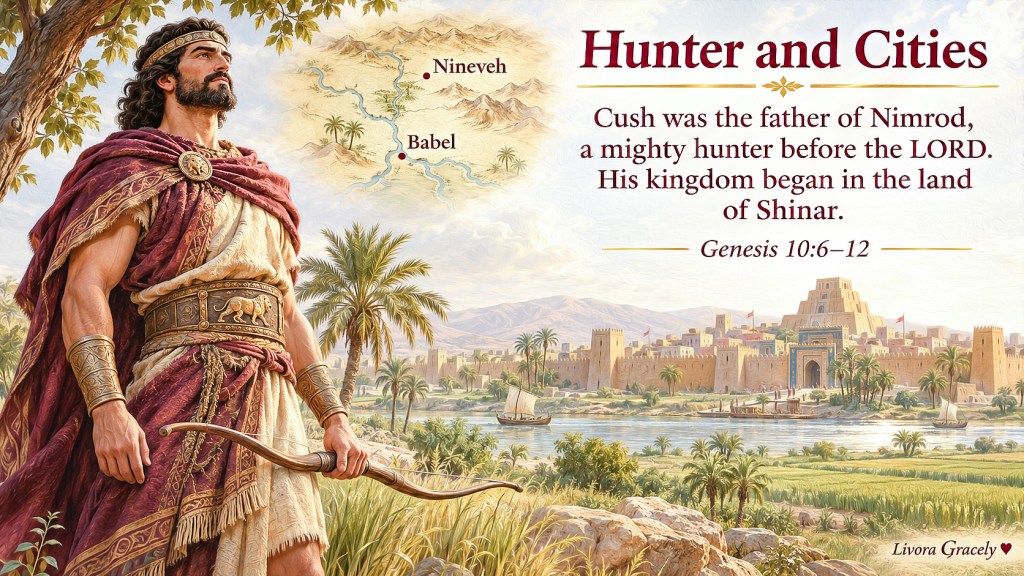
A bow rests in Nimrod’s hand. Across the water, a city rises beyond fields and palm trees, while boats move along the river.
Above him, a small map names Babel and Nineveh. The poster places a hunter and two cities within the same landscape, inviting a journey through a family line that reaches beyond one person.
Genesis does not describe Nimrod’s clothing or show him standing beside a river with a bow. The picture imagines the man named in the passage as a mighty hunter and connects him with the cities in his story.
The Son of Cush
The account of Ham’s descendants begins with Cush, Egypt, Put, and Canaan. Among Cush’s descendants, Genesis names Nimrod, who became a mighty man on the earth.
The passage calls him a mighty hunter before the LORD. His name became part of a saying: someone might be compared to Nimrod, the mighty hunter.
The account leaves much unsaid about him. It gives no description of the hunt in the poster and does not explain every detail of his character. It remembers his strength, the saying associated with him, and the places connected with his kingdom.
Cities on the Map
The first centers of Nimrod’s kingdom included Babel, Erech, and Akkad in the land of Shinar. The account continues toward Assyria and names Nineveh among its cities.
These places will appear again in the biblical story. Babel becomes the setting for the account that follows the list of nations in Genesis 11. Nineveh will later become the city to which the LORD sends Jonah.
In the poster, the names of Babel and Nineveh sit beside the lines of a river. The map is an artist’s way of bringing places together; the biblical account gives their names within the movement of the story.
Nineveh Heard Again
Much later, Jonah entered Nineveh with a message from God. The people believed God and turned from their evil ways.
Jesus later recalled their response when He spoke to the people of His own generation. He said that the people of Nineveh had repented at Jonah’s preaching, and that something greater than Jonah was present.
The people in Jonah’s story lived long after the city was named in Genesis. Their response belongs to a later moment, yet the familiar place carries the reader from one part of the Bible to another.
Beyond One Name
Nimrod is not the only name in Ham’s family record. The passage continues through the descendants of Egypt and Canaan, naming peoples and places that will reappear in later accounts. Among them are Sidon and the Amorites; the Philistines are also mentioned in the line associated with Egypt.
The earlier words of Noah named Canaan. They did not pronounce a curse on all of Ham’s descendants, and they offer no basis for a curse against a race.
The poster brings the story close to one hunter and the cities on his map. The chapter then widens the view: beyond Nimrod are other families, languages, territories, and nations, each carrying the account further across the earth.
Livora Gracely ♥
Sources
- Genesis 10:6–20 — The descendants of Ham, including Nimrod and the cities associated with him.
- Genesis 9:24–27 — Noah’s words concerning Canaan, Shem, and Japheth.
- Genesis 11:1–9 — The account of Babel.
- Jonah 3:1–10 — Jonah’s message to Nineveh and the people’s response.
- Matthew 12:41 — Jesus recalls the repentance of the people of Nineveh.


Leave a Reply