Genesis 10:21–32
From Shem’s family came names that would lead the story toward generations still to come.
The Names on the Scroll
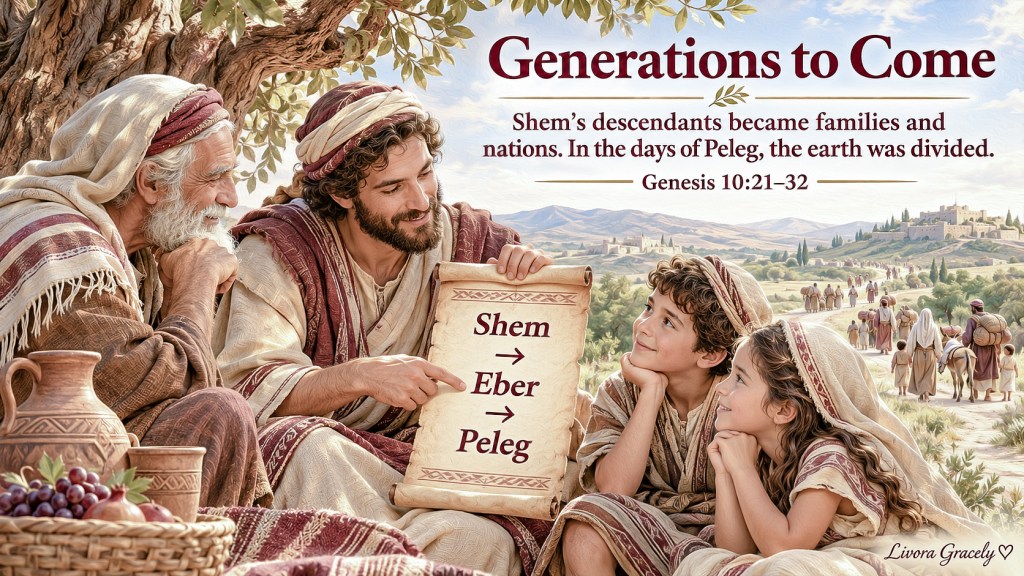
A father points to a name on a scroll. Beside him, an older man leans forward, while two children follow the words beneath his hand.
Shem. Eber. Peleg.
Beyond the family, people travel along a road through the hills. Their figures grow smaller in the distance, passing fields and settlements beneath a broad sky.
The poster imagines a family reading these names together. Genesis does not describe this conversation or a scroll like theirs. Its list, however, gives each name a place in a story that continues across generations.
From Shem to Eber
Shem was one of Noah’s three sons who came out of the ark. Genesis 10 turns to his descendants after recording the family lines of Japheth and Ham.
Among Shem’s sons, the passage names Arphaxad. Arphaxad became the father of Shelah, and Shelah the father of Eber. Two sons are then named for Eber: Peleg and Joktan.
The scroll in the picture moves from Shem to Eber to Peleg. It presents a shortened line: Arphaxad and Shelah stand between Shem and Eber in the biblical account.
Joktan’s family is also given space in the chapter. Genesis names his descendants and speaks of the region where they lived. The list follows more than one branch, allowing the family to grow beyond the three names on the pictured scroll.
In the Days of Peleg
When Peleg is introduced, Genesis adds a brief explanation: in his days the earth was divided.
The sentence invites questions, but the verse does not describe exactly how that division took place. Some readers connect it with the scattering of peoples told in the following chapter. That is a possible way to understand the words, rather than a detail the verse itself explains.
Genesis 10 closes by speaking of the families of Noah’s sons and the nations that spread across the earth after the flood. The travelers in the poster bring that larger movement into view, although their particular journey is imagined.
Names Further Along
After the account of Babel, Genesis returns to Shem’s family line. It follows generations through Eber and Peleg toward Terah and his son Abram.
Much later, Luke’s account includes Peleg, Eber, and Shem in the genealogy of Jesus. The names appear in a different setting, within a family line that reaches back through Abraham and beyond.
These passages do not tell the same part of the story. Together, they show how names first encountered in a list can be found again as the biblical account moves from one generation to another.
Families across the Earth
At the end of Genesis 10, attention widens beyond Shem’s family. The chapter gathers the families of all three sons of Noah, according to their generations and nations, and speaks of their spread across the earth.
In the picture, the children remain close to the scroll while the road winds away behind them. A finger rests beside a name; farther off, families continue along the path.
The scroll holds only a few names. The chapter opens onto many more.
Livora Gracely ♥
Sources
- Genesis 10:21–32 — The descendants of Shem and the families of Noah’s sons.
- Genesis 11:1–9 — The account of Babel and the scattering of the people.
- Genesis 11:10–26 — Shem’s family line through Eber and Peleg toward Abram.
- Luke 3:34–36 — The names of Peleg, Eber, and Shem in the genealogy of Jesus.


Leave a Reply