Genesis 10:1–5
From Japheth’s descendants, families spread toward distant lands and coastlands.
At the Water’s Edge
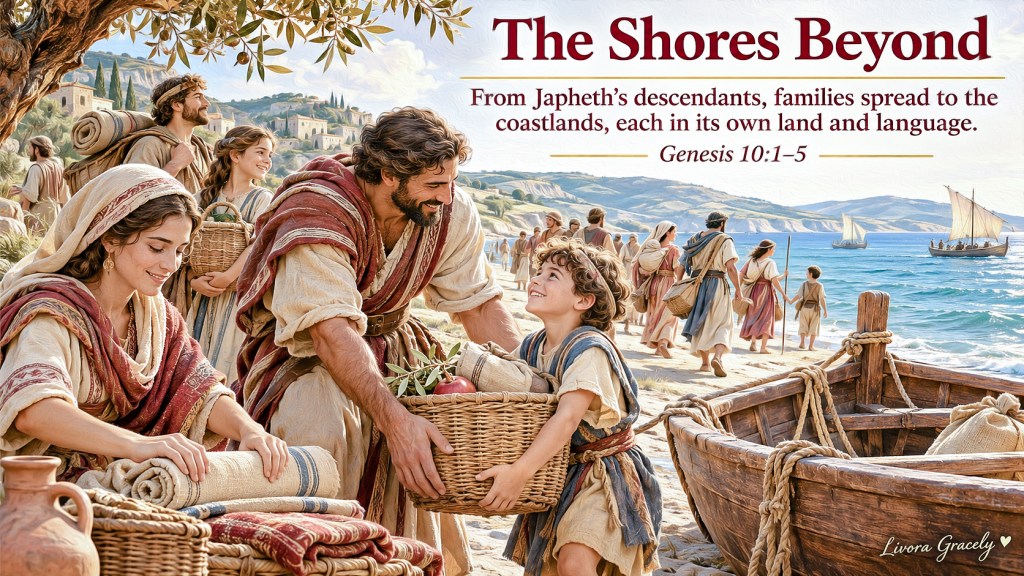
A father and child carry a basket together. Inside are folded cloth and fruit, gathered for the journey ahead.
Beside them, a woman rolls a blanket. Farther along the shore, families walk toward the water while sails rise against the blue horizon.
The poster imagines a moment of departure. Genesis does not describe this family, their belongings, or a voyage in these boats. The picture offers a way into the account of Japheth’s descendants, whose families are described in relation to their lands, languages, and coastlands.
The First Names on the List
Genesis 10 begins by naming Noah’s sons: Shem, Ham, and Japheth. Their sons were born after the flood, and the chapter follows the families that came from them.
When the list begins in detail, Japheth comes first. His sons are named as Gomer, Magog, Madai, Javan, Tubal, Meshech, and Tiras. The passage then follows some of the children of Gomer and Javan.
The change in order invites a closer look. Shem is named first in the opening verse, but his descendants are listed last. After the account of Babel, Genesis returns to Shem’s family line and follows it toward Abram.
That later movement may help explain the arrangement, although Genesis does not state why the names are ordered this way. The chapter opens with three sons, then gives each family line its own place.
A Name Heard Again
Among Japheth’s sons is Magog. The name appears again much later, though in a different setting.
In Ezekiel, Gog is addressed in connection with the land of Magog. In Revelation, Gog and Magog appear in John’s vision among the nations gathered for battle.
The passages use the name in different contexts. Genesis introduces Magog in a family list; the later books speak in prophetic and visionary language. The shared name invites attention, but it does not by itself settle every question about the people or places involved.
Another name in the list is Kittim, among the descendants of Javan. It stands within the passage that leads toward the coastlands, where the account speaks of families spread across their territories.
Lands and Languages
Genesis describes these descendants according to their clans, nations, lands, and languages. The list of names opens outward toward communities living in different places.
The following chapter will turn to Babel and tell of a time when the whole earth had one language before the people were scattered. Genesis 10 looks across the resulting spread of families and languages; Genesis 11 turns to a story about their scattering.
The poster gathers this wide movement into one imagined shoreline. A blanket is rolled, a basket is lifted, and children walk beside the adults. The passage does not tell us what any particular family carried, but it leaves a record of families and lands beyond the ark.
On the shore, the father still holds one side of the basket while the child holds the other. Beyond them, the water reaches toward places the picture cannot show.
Livora Gracely ♥
Sources
- Genesis 10:1–5 — The descendants of Japheth and the families associated with the coastlands.
- Genesis 11:1–9 — The account of Babel and the scattering of the people.
- Genesis 11:10–26 — Shem’s family line leading toward Abram.
- Ezekiel 38:2 — Gog and the land of Magog in Ezekiel’s prophecy.
- Revelation 20:8 — Gog and Magog in John’s vision.


Leave a Reply