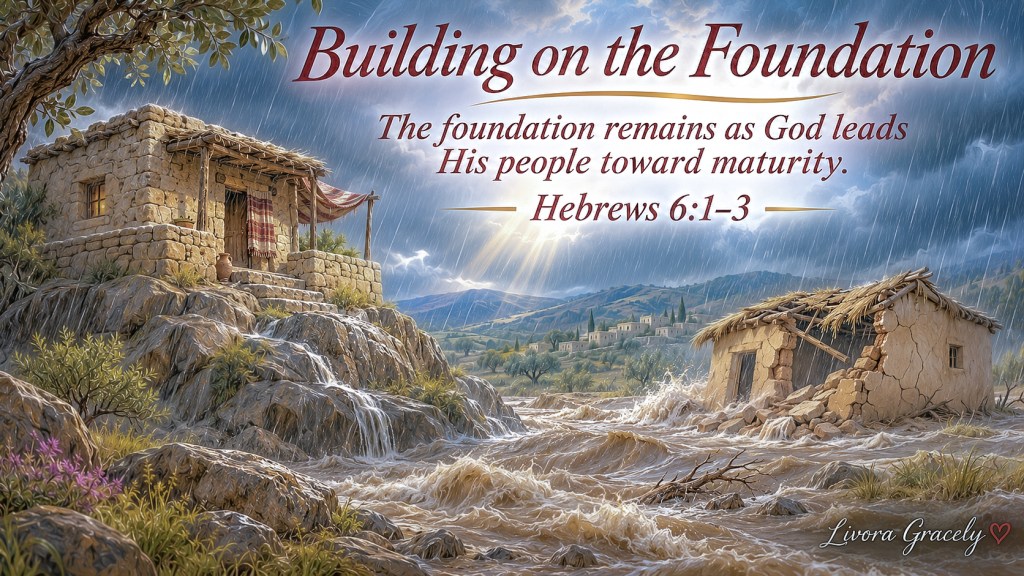
Hebrews 6:1–3
The foundation remains as God leads His people toward maturity.
A man dug deep until he reached rock. There he laid the foundation for his house.¹
Another man built without a foundation, on the sand. Then rain fell, streams rose, and winds struck the houses. The house founded on rock stood firm. The other fell with a great crash.¹
Jesus used the two builders to speak about hearing His words. The wise person hears and puts them into practice. The foolish person hears but does not. Both hear; the difference appears in their response.¹
Hebrews also speaks about a foundation. After urging its hearers to grow in discernment, the letter calls them to move toward maturity without laying the same foundation again.²
The foundation matters. And, once laid, it is meant to support what comes next.
Not Laying It Again
Hebrews names matters that belong to the beginning of the community’s instruction: repentance from acts that lead to death, faith in God, teaching about washings and the laying on of hands, the resurrection of the dead, and eternal judgment.²
The writer calls them to move beyond this elementary teaching about Christ. He does not tell them that repentance and faith have ceased to matter. He uses the picture of a foundation: it need not be laid again and again when it is time to build upon it.
Christians have understood some details of the list differently, including the precise washings the writer has in mind. But the direction of the appeal is clear: let us go on toward maturity.²
A foundation does not disappear when walls are raised. It remains beneath the building. In the same way, growth does not require us to leave Christ behind or imagine that we have outgrown the need to trust God and turn toward Him.
Hearing and Doing
In Jesus’ story, the wise builder did more than choose a place to build. He pictured the person who hears Jesus’ words and acts on them.¹
Hearing is a beginning. We may listen to a familiar passage and be able to repeat it. Then a moment comes when we must consider what it asks of us: how to speak truthfully, how to seek forgiveness, or how to care for someone in need.
James tells his readers not only to listen to the word, but to do what it says.³ Understanding and practice belong together. We learn, we act, and we continue to receive correction.
The rain and wind reached both houses in Jesus’ story. A firm foundation was not a promise that no storm would come. The picture asks what it means to hear Jesus and build a life in response to Him.
The letter to the Hebrews gives that call to a community. Its readers are urged to encourage one another, so that no one is left to face the journey alone.⁴ Growing in maturity can include asking for help, listening to a friend, and patiently helping someone else learn.
Take Care How We Build
Paul also used the image of a building when he wrote to the Corinthians. He described his work among them as laying a foundation and said that another was building on it. The foundation, he wrote, is Jesus Christ.⁵
Paul urged each builder to take care how they built. He spoke of different materials and of a fire that would test the quality of each person’s work. In his picture, someone whose work is burned suffers loss, though that person is saved.⁵
Paul was speaking about the work of those building up the Christian community. Jesus’ story of the houses has its own emphasis: hearing and doing His words. The two pictures do not need to mean the same thing in every detail. Together, they invite us to consider both our foundation in Christ and the care with which we live and serve.
Building on Christ is not a contest to appear more knowledgeable than others. Love, truth, and patience matter in the life of His people. Hebrews will soon remind its readers that God has not forgotten the love they have shown in serving others.⁶
If God Permits
After the call to go on toward maturity, the writer adds, “And God permitting, we will do so.”²
The words hold intention and dependence together. The community is called to move forward; it does not do so as though it no longer needs God.
A psalm says that unless the Lord builds the house, the builders labour in vain.⁷ The builders are still at work, but their work rests on the Lord’s care.
We may read, pray, practise, serve, and learn from others. We can do these things without treating growth as a task we must accomplish apart from God. Paul urges believers to offer their lives to God and to be transformed by the renewing of their minds.⁸
Some seasons are tiring. Weariness is not proof that a person has forgotten God or has failed to trust Him. In such seasons, receiving help and taking the next step with others can be part of the journey.
Continue on the Foundation
The house on the rock stood when the rain came. Jesus used that picture to call His hearers to put His words into practice.¹
Hebrews invites its community to go on toward maturity without laying its foundation again.² The beginning remains important; it is not the whole of the journey.
Christ is the foundation.⁵ Let us continue to listen to Him, respond to His words, and build one another up. And as we grow, let us remember the writer’s quiet words of dependence: if God permits, we will go on.
Scripture References
- Matthew 7:24–27; Luke 6:47–49.
- Hebrews 6:1–3 — main passage.
- James 1:22–25.
- Hebrews 3:12–14.
- 1 Corinthians 3:10–15.
- Hebrews 6:9–12.
- Psalm 127:1.
- Romans 12:1–2.


Leave a Reply