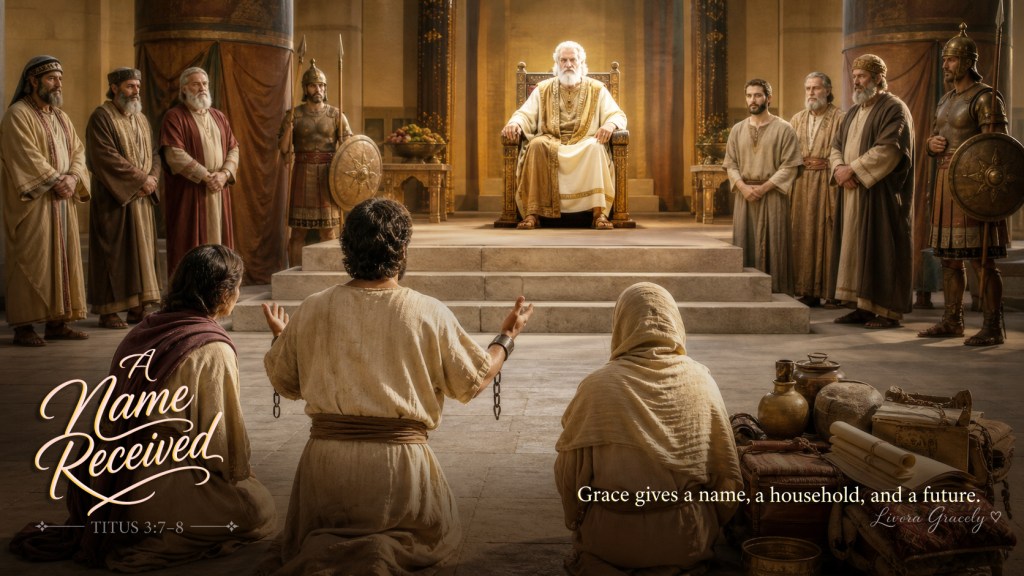
Titus 3:7–8
The Open Ledger
A servant once stood before his king with a debt too large to repay.
The amount had passed beyond his ability. His money was gone. His possessions could not cover it. His future stood under the threat of judgment.
He fell before the king and begged for patience. He promised to pay everything back, although he had no way to do so.
The king saw his helplessness and took pity on him.
He cancelled the debt.
The story can stop there.
The servant did not discover a hidden payment. He did not earn a reduction through improved behavior. The debt disappeared because the king chose mercy.
That image helps us approach the record that stood against us. Paul describes sin as a debt that cannot simply be ignored. James explains that whoever stumbles at one point becomes accountable for the whole demand.
Imagine owing one hundred connected bills. Paying one would not settle the other ninety-nine. If the total amount remains beyond your ability, you still need someone to deal with the whole debt.
At the cross, God dealt with what we could not complete.
The cross was not an ornament placed beside salvation. It was where the impossible burden was answered through Christ. What human beings could not carry, He carried. What we could not finish, He finished.
Grace begins where human ability ends.
The Unseen Verdict
Paul writes that believers have been justified by grace.
The word justified, δικαιωθέντες, means declared right before God through His gracious act.
This does not mean that sin was unimportant. It means that the guilt of those who trust Christ has been answered through Christ’s work.
Human beings often imagine that God weighs their lives on a scale. They hope their kindness will outweigh their dishonesty, their prayers will outweigh their pride, or their service will outweigh their hidden failures.
But salvation does not begin with a successful calculation.
It begins with surrender.
Paul knew this personally. He possessed religious knowledge, discipline, courage, and conviction. Yet his conviction had been directed against Jesus and His people. His confidence could not make the wrong direction right.
Then Christ met him.
Paul did not become useful because his past had been harmless. He became useful because grace gave him a new standing and a new direction.
The law still revealed the seriousness of sin, but it was never a ladder by which human beings could climb into God’s acceptance. When the apostles met to discuss Gentile believers, Peter acknowledged that neither they nor their ancestors had been able to carry the full burden of the law.
The church did not make complete obedience the entrance fee for salvation.
Grace came first.
Good works would follow, but they could never become the foundation.
The record was not hidden at the cross.
It was answered there.
The Inherited Door
Paul continues by saying that those who have been justified may become heirs, having the hope of eternal life.
The word heirs, κληρονόμοι, describes those who receive an inheritance through a family relationship.
An heir does not create the inheritance by working for it. The inheritance comes from the one who possesses it and chooses to give it. It is received because of belonging, not because the heir has produced the wealth alone.
This helps us understand why the death of Christ matters. In ordinary human experience, an inheritance becomes available through the death of the one who makes the will. In the gospel, Christ’s death is not a defeat. Through His death, the promised inheritance reaches those who trust Him.
The justified person is not merely released from a courtroom.
He is welcomed into a household.
The old record no longer defines his name. A new future has begun.
That inheritance has a present shape. It gives believers forgiveness, direction, strength, and the ability to live differently now. It also has a future shape.
The word eternal life, ζωῆς αἰωνίου, means life belonging to God’s unending future with Christ.
This hope is not an escape from responsibility. It changes the way responsibility is carried. A person whose future is held by God does not need to force every moment to prove his worth.
Yairus learned this through a crisis he could not control.
He was a ruler of the synagogue, but his twelve-year-old daughter was dying. His position could not heal her. His religious standing could not hold death back.
So he came to Jesus.
Yairus fell at Jesus’ feet and pleaded for Him to come to his house. He arrived with a title, but he approached as a father with empty hands.
Before Jesus reached the house, news came that the girl had died. Jesus answered, “Do not be afraid; just believe.” He then entered the house, took the girl by the hand, and gave her life.
Yairus received what his position could not provide.
Grace does not merely remove a name from a debt record. It gives a name, a household, and a future.
The Tested Sentence
Paul calls this message a trustworthy saying.
The word trustworthy, πιστὸς ὁ λόγος, means a word reliable enough to govern the believer’s life.
Paul is not giving Titus a slogan for comfortable moments. He is giving him a foundation for people who may feel weak, uncertain, or ashamed.
The message can be trusted because its source can be trusted.
God justifies by grace. He gives an inheritance. He grants the hope of eternal life. These promises do not depend on the changing strength of the person who receives them. They depend on the faithfulness of God revealed through Jesus Christ.
The rich ruler shows the danger of wanting the promise while resisting the Person who gives it.
He came to Jesus with a serious question: What must I do to inherit eternal life? He was not careless about religion. He had tried to live a moral life and possessed wealth, discipline, and public respect.
Yet Jesus exposed the place where his confidence truly rested.
He told the man to sell what he had, give to the poor, and follow Him.
The man went away sad.
His wealth was not merely something he owned. It had become the security he trusted. He desired eternal life, but he could not release the present guarantee he believed was sufficient.
The warning is not that every possession is evil. The warning is that possessions can become a substitute for trust. A person can speak about the future while refusing to surrender what controls the present.
The trustworthy saying demands more than verbal agreement.
It asks where a person will stand when Christ’s word and his old security point in different directions.
Paul trusted Christ and received a new direction.
The rich ruler heard the invitation but protected the old foundation.
After the Gift
Paul wants Titus to stress these things so that believers will devote themselves to doing what is good.
The word profitable, ὠφέλιμα, means beneficial for people and their shared life.
The gospel does not save people because they have become useful. It saves them so that their lives may become useful.
This distinction must remain clear.
Good works are not payment for grace. They are the result of grace. A person released from an impossible debt no longer needs to spend every day proving that he deserves mercy. He can begin to use his life for the good of someone else.
Paul became such a person. The man who once opposed the followers of Jesus later carried Christ’s name across cities, boundaries, prisons, and hostile streets. His usefulness came from a life redirected by mercy.
Yairus learned that trust begins when human control ends. The rich ruler showed that a person may desire the promise while refusing to release the substitute he trusts more than Christ.
Titus does not lead believers toward self-congratulation. He leads them toward the God who justifies, gives an inheritance, promises eternal life, speaks what is trustworthy, and produces what is profitable through grace.
The debt is not ours to repay.
The inheritance is not ours to manufacture.
The future is not ours to secure.
But the life we receive can be placed in God’s hands and used for the good of others.
Grace does not make us useful so that God may accept us.
God accepts us by grace, and then teaches us to become useful because we have received it.
Scripture Notes
Matthew 18:23–27 — Jesus tells of a servant whose enormous debt is cancelled by the king’s mercy. The story illustrates forgiveness that cannot be earned or repaid.
Colossians 2:13–14 — Paul describes the record of debt standing against humanity and explains that it was cancelled and nailed to the cross through Christ.
James 2:10 — James teaches that breaking one part of the law makes a person accountable to the whole demand, showing why human merit cannot provide complete righteousness.
Titus 3:7–8 — Paul explains that believers are justified by grace, become heirs with the hope of eternal life, and are called to devote themselves to good works.
Acts 15:5–29 — The apostles acknowledge that the full burden of the law could not be carried by their ancestors or by Gentile believers. Salvation is not received through complete law-keeping.
Acts 9:1–19 — Paul encounters the risen Jesus while opposing His followers. Christ gives him a new direction and later uses him to carry the gospel to the nations.
Hebrews 9:15–17 — The death of Christ establishes the promised inheritance for those who are called. His death opens the way for the inheritance to be received.
Luke 8:40–56 — Jairus, a ruler of the synagogue, comes humbly to Jesus because his twelve-year-old daughter is dying. Jesus tells him not to fear and restores the girl’s life.
Matthew 19:16–26 — The rich ruler desires eternal life but cannot release the security provided by his possessions. Jesus exposes the danger of trusting wealth instead of following Him.
Titus 3:1–8 — Paul connects salvation by grace with a life that becomes ready for good works. Good works are not the cause of salvation, but the result of grace received.


Leave a Reply