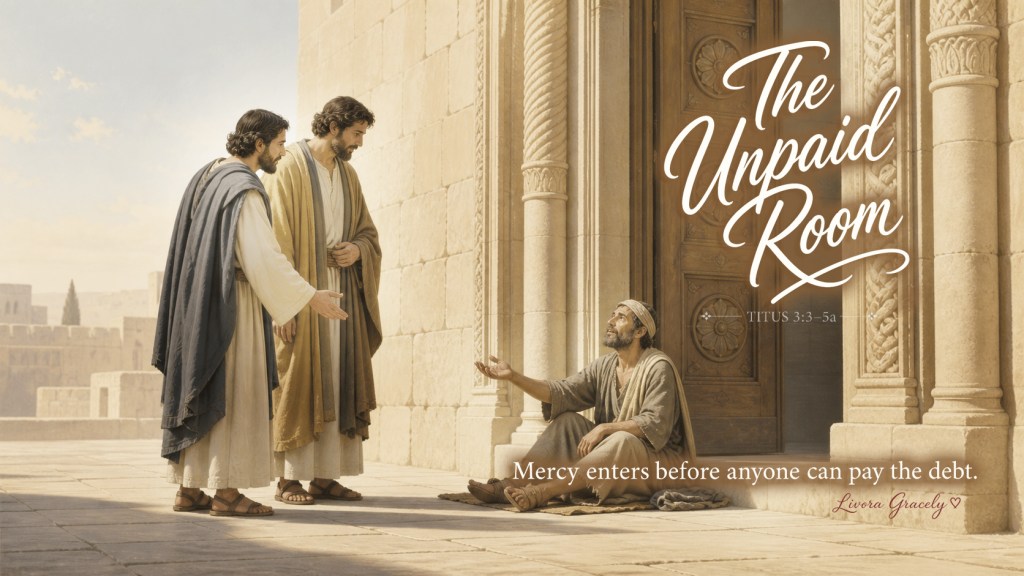
Titus 3:3-5a
Clever Shadows
A man was carried every day to the Beautiful Gate.
He knew the sound of worshipers entering the temple. He knew the movement of feet around him. But his own legs could not carry him across the threshold.
So he extended his hands.
He waited for coins.
That day, he received something he had not requested. In the name of Jesus, strength came into his feet. He stood. He walked. He entered the temple, praising God.
The people saw the change.
But not everyone welcomed its meaning.
Some saw a man restored. Others saw a threat to their authority.
The scene opens a deeper question: what if a person can live close to religious activity and still fail to recognize the truth? What if the mind can appear wise while moving farther from God?
Paul says, “At one time we too were foolish.”
The Greek word anoētoi means “unable to understand rightly, even while appearing wise.”
This kind of foolishness is not a lack of intelligence. It is the inability to see life as it truly is. A person may believe he is defending God while resisting God. He may call stubbornness conviction and pride wisdom.
The old life often hides beneath respectable reasons. It does not always appear as open rebellion. Sometimes it speaks with religious language, moral confidence, or impressive knowledge.
A person can stand near the temple and still fail to see the One who gives life.
The first step toward restoration is not proving that we are wise.
It is allowing the light of God to expose the shadows we have mistaken for wisdom.
Beautiful Trouble
The healed man stood where everyone could see him.
His body became a public testimony to the power of Jesus. Yet the religious leaders did not celebrate. They questioned the apostles, demanded explanations, and threatened them because the healing had happened in Jesus’ name.
The miracle was visible.
The resistance was visible too.
This is how the old life can operate. It may recognize that something good has happened and still refuse to honor its source. It may defend order while resisting restoration. It may protect tradition while rejecting truth. It may guard reputation while silencing the name of Jesus.
Paul describes this condition with the word kakia.
The Greek word kakia means “inward evil that seeks or permits another’s harm.”
Malice is not merely an angry moment. It is a settled desire for another person’s harm. It can hide inside a demand for justice, a concern for purity, or a need to protect one’s position.
The leaders were not troubled because the man remained broken. They were troubled because his restoration pointed beyond them.
His healed body made the authority of Jesus impossible to ignore.
The old life keeps wounds alive by turning them into permission to retaliate. It calls resentment discernment. It calls cruelty courage. It calls silence wisdom when the truth threatens its position.
That is why Paul’s words in 1 Corinthians 6:7 are so searching:
“Why not rather be wronged?”
He is not calling evil good. He is asking believers whether they would rather protect their rights or preserve the work of love.
The new life receives mercy and refuses to pass the wound forward.
High Above
Nebuchadnezzar stood high above everyone else.
He possessed a kingdom, a name, and the ability to make the world notice him. He looked at Babylon and spoke as though its greatness had come entirely from his own strength.
The higher he stood, the less he could see.
His position became a window turned inward. Every view led back to himself. Every achievement confirmed his importance. Every warning sounded like an interruption.
God warned him, but pride rarely listens to a warning that threatens its throne.
Nebuchadnezzar continued to admire himself until his greatness collapsed. Daniel describes him as being driven away from people and living like an animal, his body exposed to the elements, his former confidence stripped away.
The image is severe, but its point is not to mock mental illness or human weakness. It reveals what happens when a person forgets that life is received, not possessed.
Paul says that the old life was enslaved to passions and pleasures. A person may appear powerful while being controlled by what he cannot resist. He may command others but remain unable to command his own appetite, envy, anger, or desire for recognition.
A crown is not required for pride.
A person can sit in an ordinary room and still make himself the highest authority in it.
Nebuchadnezzar’s turning begins when he looks upward again. He acknowledges that the Most High rules over human kingdoms. His words do not erase the damage caused by his pride, but they show that pride is not beyond exposure.
The man who had looked only at himself finally lifted his eyes.
The one who had stood high above others learned that he was still beneath God.
Sometimes mercy begins by bringing down the height from which we have judged everyone else.
Other Light
Rahab lived outside Israel’s covenant community.
Her history did not give her a respectable place among the people of God. Yet when she heard what God had done, she recognized that Israel’s God was the true God.
Her faith became visible through a dangerous decision.
She hid the spies. She misdirected the authorities. She placed her own safety at risk.
She could have remained silent.
She could have protected herself.
Instead, she acted on what she had come to believe.
Rahab did not begin with a clean record. She began with recognition. The light reached her before her life was rearranged.
Jesus says, “I am the light of the world.”
But another person also stood close to religious knowledge while remaining trapped in an old life.
At a well in Samaria, a woman met Jesus.
She knew the dispute about worship. She knew that Jews and Samaritans did not agree about the proper place to worship God. She knew that the Messiah was expected to come and explain all things.
She had knowledge.
She had questions.
But knowledge had not freed her.
Her past had become part of the way people saw her. She came to the well at an hour when she could avoid the crowd. She carried the weight of a life she could not easily explain.
Jesus did not begin by giving her a religious lecture. He spoke to her thirst.
He offered living water—not merely relief for one afternoon, but a spring rising within the person who receives it.
Then he revealed that he knew her life. He did not flatter her, and he did not crush her. He brought the truth into the light and remained near enough for her to receive mercy.
When she recognized that Jesus was the Messiah, something changed.
She left her water jar.
She returned to the city.
She invited the people she had avoided to come and see the man who had told her everything she had ever done.
The light had not merely exposed her.
It had given her a new direction.
Jesus also calls himself the bread of life. Manna sustained Israel for a time, but those who ate it eventually died. Christ gives a life that ordinary nourishment cannot produce.
The light, the bread, and the water all lead to the same person.
Jesus does not merely improve an already sufficient life.
He becomes its source.
Mercy’s Echo
Paul does not leave the reader staring at the darkness.
He turns the sentence with a greater reality:
“But when the kindness and love of God our Savior appeared, he saved us, not because of righteous things we had done, but because of his mercy.”
The old life was foolish, disobedient, deceived, enslaved, malicious, envious, hateful, and hated.
Paul does not soften the diagnosis.
He includes himself in it:
“We too.”
There is no room here for spiritual pride. No one can build a platform from a past that has been rescued by grace. No one can claim that salvation began with personal goodness.
The word esōsen means “rescued decisively by God from helplessness and ruin.”
The man at the Beautiful Gate could not make his legs strong. Rahab could not erase her history. The Samaritan woman could not rewrite the years behind her. Nebuchadnezzar could not preserve himself at the height of his pride.
None of them could rescue themselves.
The Greek term behind mercy, eleos, describes compassionate action toward those unable to save themselves.
That is the ground beneath the entire passage.
God does not wait for people to become worthy before he acts. He comes to people who are foolish, bound, resentful, proud, and unable to repair what they have broken.
Yet mercy does not leave people unchanged.
The man who once waited for coins walked into the temple.
Rahab risked herself for the people of God.
Nebuchadnezzar lifted his eyes toward heaven.
The Samaritan woman left her jar and went back to the people she had avoided.
Those who receive mercy do not boast as if they rescued themselves. They begin to live as people who have been rescued.
The old room was dark, crowded, and unpaid.
But the light entered before anyone could pay the debt.
And once it entered, the room was no longer the final truth about the people inside it.
Scripture Notes
Acts 3:1–10 — A man unable to walk is carried to the Beautiful Gate and receives strength in the name of Jesus. His restoration becomes visible before the religious leaders begin resisting its meaning.
Titus 3:3 — Paul includes himself and other believers in the description of the former life: foolish, disobedient, deceived, enslaved by desires, malicious, envious, hateful, and hated.
Acts 4:5–22 — The religious leaders investigate the healing of the lame man and threaten the apostles because the restoration is connected publicly with the name of Jesus.
Daniel 4:28–37 — Nebuchadnezzar’s pride collapses after he attributes Babylon’s greatness to himself. When he lifts his eyes toward heaven, his understanding returns and he acknowledges the authority of God.
Joshua 2:1–21 — Rahab recognizes the works of Israel’s God and protects the spies at personal risk. Her faith becomes visible through a costly decision.
John 4:4–30 — Jesus meets the Samaritan woman, exposes the truth about her life without crushing her, and offers living water. After recognizing Him, she leaves her jar and returns to the city.
John 6:32–35 — Jesus identifies Himself as the bread of life, showing that the manna given in the wilderness could sustain physical life temporarily but could not provide the lasting life found in Him.
John 8:12 — Jesus declares Himself the light of the world and promises that those who follow Him will not walk in darkness but will have the light of life.
Titus 3:4–5a — The turning point comes when God’s kindness and love appear. Salvation is attributed not to human righteousness but to God’s mercy, expressed through His saving action.


Leave a Reply