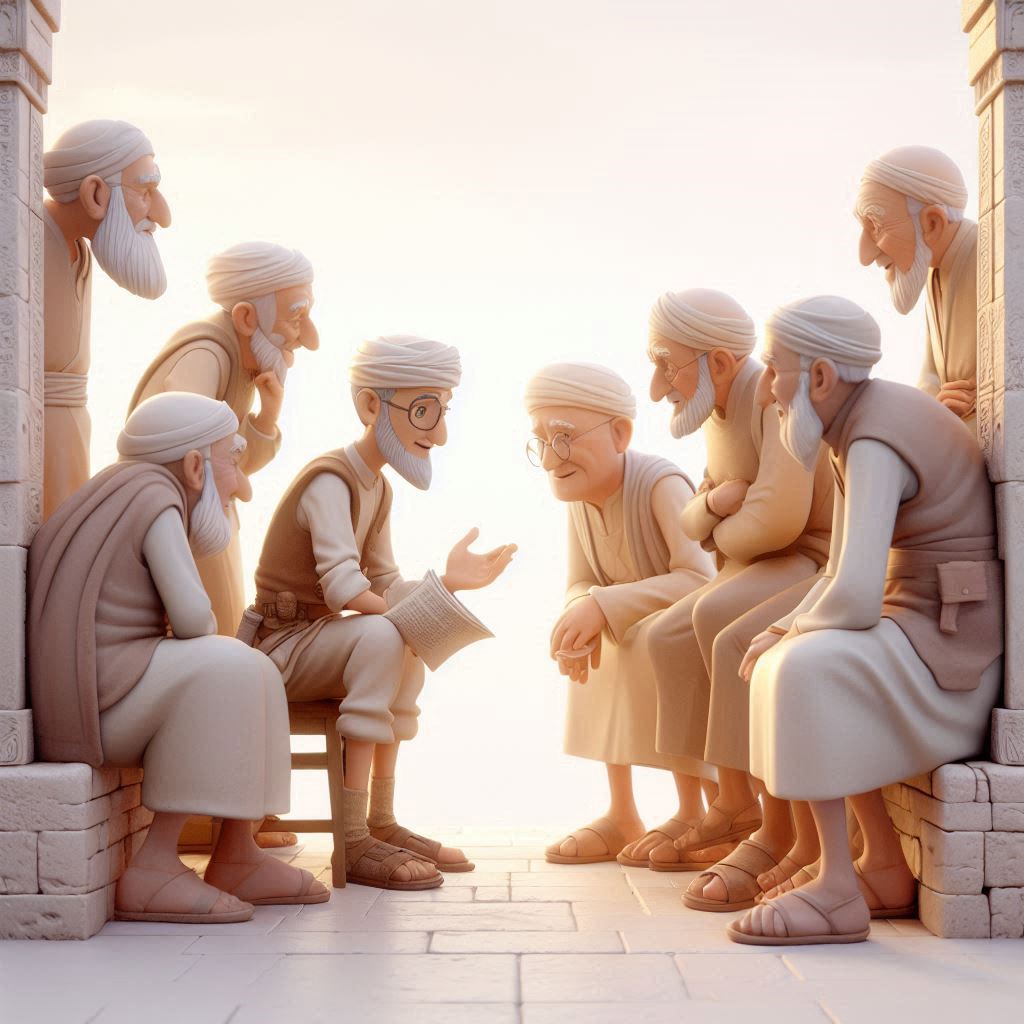
The City Gate: Place of Decision
In ancient Israel, the city gate was not only an entrance but also a place of judgment, negotiation, and public witness. Here elders sat to settle disputes and confirm covenants. It was, in a sense, the courtroom and marketplace combined.
Boaz rises early and sits at the gate, waiting for the nearer kinsman-redeemer.
When the man arrives, Boaz invites him to sit, and gathers ten elders as witnesses.
What follows is a scene of both legal precision and divine orchestration.
The Offer and the Shift
Boaz begins with land. “Naomi, who has come back from the country of Moab, is selling the parcel of land that belonged to our relative Elimelech” (Ruth 4:3).
The nearer kinsman is eager: land is wealth, inheritance, and legacy. He says, “I will redeem it.”
But Boaz then reveals the fuller cost:
“The day you buy the field from Naomi, you also acquire Ruth the Moabite, the widow of the dead, in order to perpetuate the name of the dead in his inheritance” (Ruth 4:5).
Suddenly, the man hesitates. He answers, “I cannot redeem it for myself, lest I impair my own inheritance. Take my right of redemption yourself” (Ruth 4:6).
The nearer redeemer, though willing to take the land, refuses the responsibility of raising up offspring for Ruth’s late husband. His concern is self-preservation, not covenant faithfulness.
The Symbolic Transfer
To seal the transaction, the nearer redeemer removes his sandal, handing it to Boaz—a symbolic act affirming the transfer of redemption rights.
Before the elders and all the people, Boaz declares:
“You are witnesses this day that I have bought from the hand of Naomi all that belonged to Elimelech and to Chilion and to Mahlon. Also Ruth the Moabite… I have bought to be my wife, to perpetuate the name of the dead in his inheritance” (Ruth 4:9–10).
Here lies a powerful picture of the Gospel.
The nearer redeemer represents the law, which can show us our need but cannot save us.
The law claims the field but cannot redeem the heart.
Christ, our true Redeemer, does what the law cannot—He takes us as His own, not only restoring inheritance but giving us life through His covenant love.
Just as Ruth was joined to Boaz in the sight of many witnesses, so the Church is joined to Christ before the eyes of heaven and earth. Our redemption is not secret, but public and celebrated.
Blessing from the People
The elders and townspeople bless the union: “May the Lord make the woman, who is coming into your house, like Rachel and Leah, who together built up the house of Israel… and may your house be like the house of Perez” (Ruth 4:11–12).
What began with famine and loss now swells into blessing and legacy.
Application for Believers Today
At the city gate of your heart, who holds the right of redemption?
The law may expose your debt, but only Christ can pay it.
Like Boaz, He steps forward at the gate, takes upon Himself the cost, and declares before heaven’s witnesses: “You are Mine.”
Our Redeemer does not shrink back when the cost is high—He pays it in full.


Leave a Reply