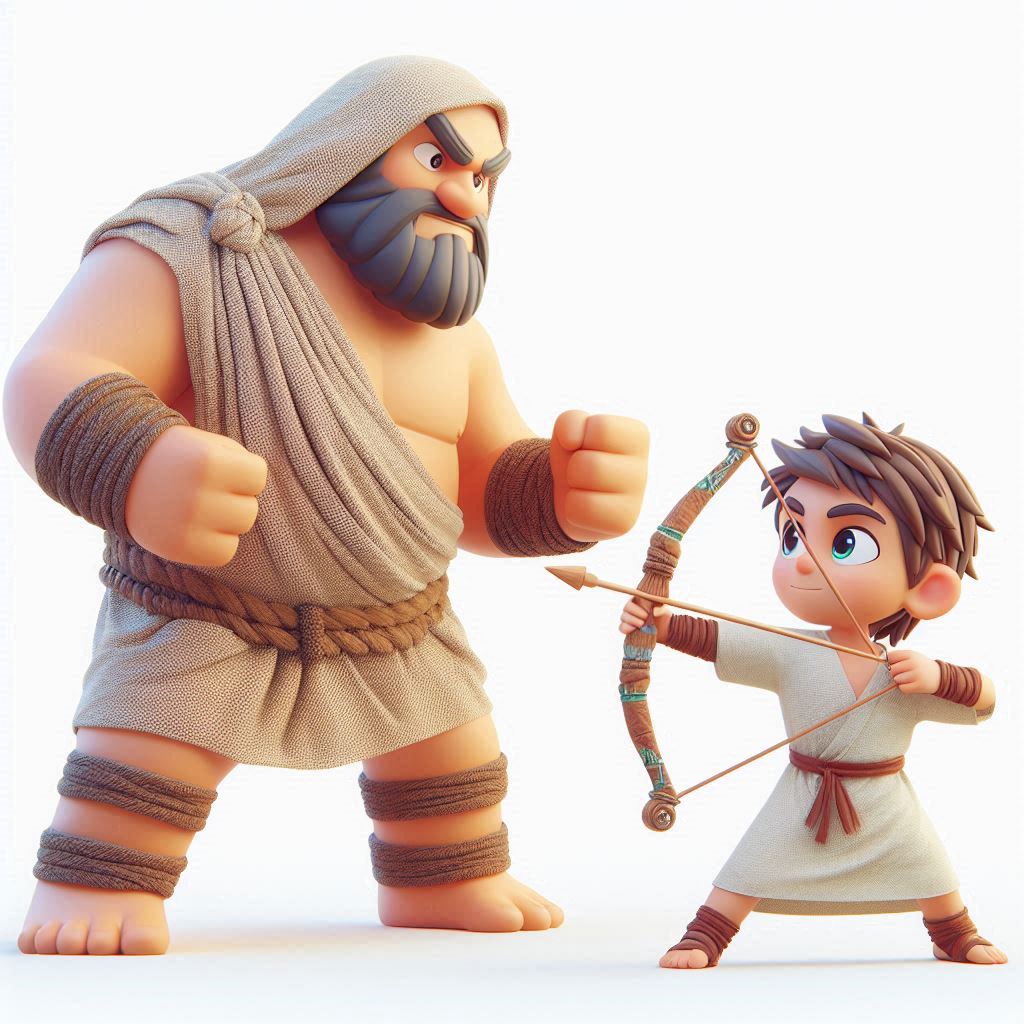
Goliath’s Pride Fallen
The turning point in David’s life comes when his private faith and hidden skill are suddenly placed on a national stage.
Israel stood paralyzed before the Philistine giant, Goliath of Gath (1 Samuel 17). For forty days, this towering warrior mocked Israel’s armies and defied the living God. Even King Saul, who was chosen for his stature and leadership, shrank back in fear.
Into this crisis walked David—not as a soldier, but as a young shepherd sent merely to deliver bread to his brothers.
Divine Empowerment
David’s response reveals more than courage; it unveils his theology. He declared, “Who is this uncircumcised Philistine, that he should defy the armies of the living God?” (1 Samuel 17:26). The keyword here is emunah (אֱמוּנָה, Hebrew: “faith, firmness”). David’s faith was not in himself, nor in weapons, but in the covenant God who had delivered him before. “The Lord who rescued me from the paw of the lion and the paw of the bear will rescue me from the hand of this Philistine” (v. 37).
This confrontation is not merely a tale of underdog triumph, as many reduce it, but a theological declaration: Israel’s God reigns supreme over every earthly power. The stone from David’s sling, guided by the Lord, silenced the giant and reminded Israel that victory comes “not by sword or spear, for the battle is the Lord’s” (v. 47).
Historically, Josephus recounts this moment as a demonstration of divine intervention, emphasizing that David’s trust in God, not his stature, determined the outcome. Ancient audiences would have understood Goliath’s armor and size as invincible by human standards. Yet the young shepherd, armed with faith, overturned worldly expectations. This was a living commentary on Zechariah 4:6: “Not by might, nor by power, but by my Spirit, says the Lord.”
Facing Today’s Giants
For us today, David’s encounter with Goliath represents the believer’s confrontation with overwhelming challenges—whether personal, communal, or cultural. Giants still stand against the people of God: injustice, unbelief, fear, sin itself. Yet in Christ, the true Son of David, the ultimate Goliath—death—was defeated (1 Corinthians 15:55–57). The cross appeared like weakness, yet it became the greatest victory.
Thus, David’s victory was more than national deliverance. It was a signpost to the Messiah, who would one day conquer the true enemy. The young shepherd’s faith in God was vindicated, and his act echoed through Israel’s history as the moment when trust in the Lord proved stronger than all human might.


Leave a Reply