Livora Gracely is a pen name.
This little corner gathers whimsical stories, gentle reflections, and Scripture-inspired writing for readers who still enjoy noticing small things.
Some stories begin with questions.
Others begin with a quiet morning, a cup of tea, an old bench, or a verse that refuses to be forgotten.
The person behind the name simply prefers the words to arrive before the writer.
Writing to remember.
Sharing to inspire.
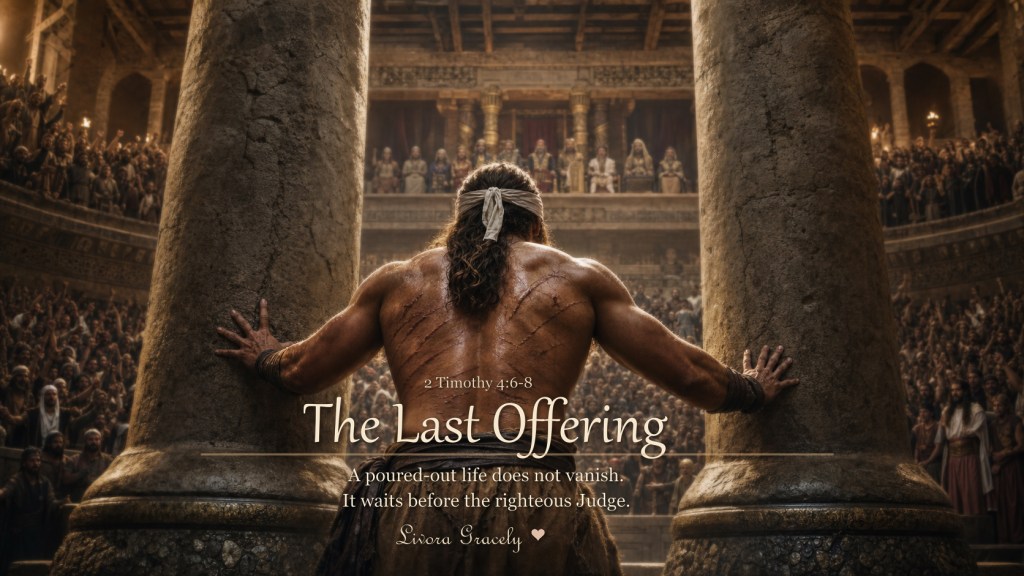
Princes sat where everyone could see them. The people crowded above. Laughter moved through the house like smoke. The enemy had turned victory into entertainment, and in the middle of the room stood a blind man with hair growing again upon his head.
Samson could no longer see the faces that mocked him.
A child held his hand.
That may be the most painful part of the scene. The man who once tore gates from a city now needed a boy to guide him between two pillars. His strength had frightened nations, but now his body had become a spectacle. His eyes were gone. His freedom was gone. His enemies had gathered around the ruins of his life.
Yet one prayer still rose from him.
One last request for strength.
Scripture does not erase Samson from the story of faith. Hebrews remembers his name among those who acted through faith. That matters. His ending should not be handled as though tragedy cancelled grace.
Still, the picture remains heavy.
Samson’s end was an act of faith in a broken life. Paul’s end carries another witness: faith kept through a completed race.
He is also near death. He is also surrounded by the power of men. His body, too, is being offered up. But he does not speak like a man trying to recover one last act of strength.
He speaks like a man whose race has reached its appointed line.
Spilled Wine
Paul did not describe his death as an accident.
He did not speak as though Rome had finally taken what belonged to him. He did not make Nero the owner of his ending. His blood may soon be shed by human hands, but Paul saw something deeper than execution. He saw offering.
“I am already being poured out.”
That picture changes the room.
A life poured out for Christ is not the same as a life wasted by men. The world may see the servant becoming weak, old, chained, and disposable. It may count his remaining days and conclude that his usefulness is almost over. But heaven does not measure offering by how much remains in the vessel. Heaven sees where the life has been given.
Paul had not waited until death to become an offering. His life had already been spent in the service of Christ. His journeys, wounds, prayers, tears, imprisonments, letters, corrections, and sufferings had all belonged to the same altar. Now the final drops were not being stolen from him. They were joining the offering that had been his life.
This must not become a transaction.
Paul was not buying a crown with blood. He was not calculating pain into reward. The grace that called him had also carried him, strengthened him, corrected him, and kept him. If his life was an offering, it was because Christ had first claimed it by mercy.
Jesus knew the cup before Him.
In Gethsemane, He did not pretend the cup was light. He prayed in agony. Yet He did not walk away from the Father’s will. The true Offering went first. Every faithful pouring after Him is only an echo of the Son who gave Himself completely.
Loosened Doors
Peter once slept between soldiers.
Herod had already killed James, and Peter seemed to be next. Chains held him. Guards surrounded him. The church prayed, but the prison doors remained closed until the night before he was to be brought out.
Then an angel entered.
The chains fell. The doors opened. Peter walked out into the street and thought he was seeing a vision.
Sometimes God opens the prison before the sword falls.
That witness matters, because it keeps the heart from thinking death has the final authority. Herod could plan. Soldiers could guard. Iron could lock. But if the servant’s work was not finished, even chains had to loosen in the night.
Yet Paul’s words show the other side of the same Lord.
Paul does not seem to expect an angel at the door. He does not write as a man waiting for one more escape. He says the time of his departure has come. Peter was released because his race was not finished. Paul is ready because his race is reaching its end.
Peter walked through an opened prison door; Paul was nearing another door, one no angel needed to prevent.
Paul had already learned to speak of the body as a tent, something temporary enough to be taken down without taking hope with it. The body may be “sown in dishonor,” yet it is “raised in glory.”
That is not denial.
It is direction.
The tent may be loosened. The body may be humbled. The departure may come near. But the servant of Christ does not belong finally to the prison, the sword, or the grave.
Paul’s peace does not come from control over the outcome.
It comes from belonging to the One who controls the time.
Finished Dust
Paul gathers his life into three quiet lines.
He has fought the good fight. He has finished the race. He has kept the faith.
There is no boasting in it. There is weight, but not pride. He is not standing over younger servants as a hero demanding admiration. He is looking back over the course entrusted to him and seeing grace that did not let him go.
The fight was good, but it was still a fight.
The race was appointed, but it still required endurance.
The faith was kept, but only because many other things had not been allowed to become lord.
This is the deeper beauty of Paul’s ending. Not a servant inventing meaning at the edge of death, but a servant recognizing that the Lord had carried him through the whole road.
And Timothy must hear this.
Paul is not only remembering. He is handing something forward. The work of the evangelist, the endurance of hardship, the ministry entrusted by God, the Scriptures able to make the servant complete for every good work: these do not disappear because Paul’s departure is near.
The older servant is almost finished.
The younger servant must remain faithful.
Stephen also knew something of this. He stood before violent men and bore witness to the Righteous One. The stones came. His body fell. Yet his last words did not belong to revenge. He saw Jesus standing, entrusted his spirit to Him, and prayed that their sin would not be held against them.
That is a finished faith.
Not loud.
Not safe.
But kept.
Waiting Crown
Now a crown is waiting.
But Paul does not speak of it like a wage owed to a worker who has successfully bargained with God. The crown of righteousness is given by the Lord, the righteous Judge. That changes everything.
Human courts had judged Paul poorly. Human power had chained him. Human opinion had often misunderstood him. Some abandoned him. Some resisted him. Some listened only long enough to decide he was dangerous. If men were the final judges, Paul’s life could look like defeat.
But they are not the final judges.
Christ is.
The righteous Judge sees truly. He sees the servant in prison and the faith that still burns. He sees the bruised body and the race that has been completed. He sees the offering that men call loss. He sees the hidden obedience no crowd applauded, the tears no church recorded, the wounds no enemy understood.
The crown is not only for Paul.
That is the mercy in the final turn. Paul does not close the door behind himself. He opens the hope to all who have loved Christ’s appearing. Not only apostles. Not only martyrs. Not only those whose names are remembered by history. All who wait for Him, long for Him, and keep faith because His coming is more real than the world’s verdict.
What we love at the end shapes how we live before the end.
If we love ease most, every hardship will feel like betrayal. If we love recognition most, every hidden obedience will feel wasted. If we love survival most, every threat will rule us.
But if we love His appearing, even a poured-out life has direction.
One house fell.
One tent loosened.
And the life kept for Christ did not end where men stopped seeing it.
Witness Notes
Judges 16:23-31 – Samson stands blind between the pillars, mocked by his enemies, and asks God for one final strength.
Hebrews 11:32 – Samson is remembered among those who acted through faith, keeping his tragic ending from being treated as faithless.
2 Timothy 4:6-8 – Paul sees his approaching death as a life being poured out, a race completed, faith kept, and a crown waiting from the righteous Judge.
Matthew 26:36-46 – Jesus faces the cup in Gethsemane and submits to the Father’s will before the cross.
Acts 12:1-11 – Peter sleeps in prison before possible execution, but God opens the prison doors because his race is not yet finished.
2 Corinthians 5:1-4 – Paul speaks of the body as a tent, temporary enough to be taken down without taking hope with it.
1 Corinthians 15:43 – Paul describes the resurrection body as sown in dishonor and raised in glory.
2 Timothy 4:5 – Paul’s nearing departure becomes a handoff to Timothy to endure hardship and fulfill his ministry.
2 Timothy 3:16-17 – Scripture equips the servant of God for every good work.
Acts 7:54-60 – Stephen bears witness to Christ before death, entrusts his spirit to Jesus, and forgives those who stone him.
Some days are too fun to slow down. The hill took this personally.
The hill behind the bakery had never been officially dangerous.
It was too small for that.
Still, every winter, sensible adults looked at it with narrowed eyes.
The hill looked back with snow on its shoulders and said nothing.
That was how it avoided responsibility.
At the bottom stood a haystack, three laundry baskets, and Mr. Bell from the bakery holding a tray of cinnamon rolls.
Nobody knew why the tray was there.
Mr. Bell said it helped morale.
At the top of the hill, two children and one monkey sat on a rolled newspaper as though this were a perfectly normal transportation choice.
The newspaper had once contained yesterday’s village news.
By Saturday morning, it had become a sled.
This was considered a promotion.
The monkey sat in front.
It wore a scarf, held the curled edge with both hands, and looked extremely employed.
“Braking department ready,” it announced.
The girl behind it laughed.
“There are brakes?”
“There is confidence.”
The boy raised both arms into the cold air.
“That sounds faster!”
A small crowd had gathered near the bakery window.
Grandma Lottie held a notebook.
Mr. Bell held the cinnamon rolls higher.
The hill waited.
It had the patient expression of something that knew exactly what gravity was about to do.
“Proceed carefully!” called someone.
The monkey nodded.
Then the newspaper slid.
For one bright second, everything looked organized.
Then the snow sprayed sideways.
The monkey leaned left.
The newspaper went right.
The girl laughed so hard her hat turned around.
The boy shouted, “Excellent weather!”
Halfway down, the newspaper spun once.
Then twice.
The monkey pulled the curled edge with great professional commitment.
“I am applying brakes!”
“You are applying enthusiasm!” the girl shouted.
The monkey considered this.
“That may be the same lever!”
At the bottom, the newspaper bounced over a snow bump, skimmed past the laundry baskets, and landed directly in the haystack.
Three mittens flew into the air.
No one admitted owning the third.
For a moment, the village was silent.
Then the haystack sneezed.
The boy’s head appeared first.
The girl’s hat appeared next.
The monkey climbed out last, still holding the newspaper edge.
“Good news,” it said. “The brakes are very imaginative.”
Grandma Lottie wrote that down.
By the following Saturday, a small wooden sign had appeared at the top of the hill.
It read:
No Brakes Policy
Underneath, someone had added:
Morale rolls available below.
Sensible adults objected for nearly seven minutes.
Then Mr. Bell opened the bakery window.
That helped.
After that, the village stopped asking whether the newspaper could be controlled.
It asked whether the haystack was ready.
And every winter Saturday, just before the first joyful scream came flying down the hill, Grandma Lottie sharpened her pencil, Mr. Bell lifted the cinnamon rolls, and the hill quietly pretended it had nothing to do with any of it.
A bowl was moved. Bread was being prepared. Feet crossed the room with purpose. Someone had noticed the work before anyone else had to mention it. Hospitality has its own kind of gravity. It pulls the hands toward what must be done, and Martha had answered that pull.
Nothing in her service looked evil.
The room needed care. The guests needed welcome. The body, too, has its hunger, and love often begins by noticing such things before they become complaints. Martha was not serving an idol. She was serving the Lord who had entered her house.
Yet in the same room, another kind of hunger had already found its place.
Mary sat at the feet of Jesus and listened.
She did not appear to be carrying the room. She did not look efficient. She was not proving her love by movement. She was near enough to hear Him, and that nearness had become her work.
Christ was speaking.
That was the difference. Not love against love, or service against devotion, but one need rising above every other need because the Voice in the room was not ordinary.
Jesus did not despise Martha’s hands.
He protected Mary’s listening.
There is mercy in that protection. The soul can be active and unfed. A house can look faithful while the inner ear grows thin. The table can be full, the hands occupied, the schedule crowded, and still the deepest hunger may remain unanswered because Christ has become present but not primary.
The ear has a place before it has a task.
It was made to sit where His word can reach it.
Second Chair
Paul warned Timothy that a time would come when people would no longer endure sound doctrine.
The strange thing is that they would not stop listening. Their problem would not be emptiness of sound, but abundance of chosen sound. They would gather teachers according to their own desires. They would turn their ears away from the truth and turn aside to myths.
It is a quiet tragedy.
The ear does not always rebel by closing itself. Sometimes it rebels by becoming selective. It remains open, but only to voices that know how to comfort desire without correcting it. It wants teaching, but not surrender. It wants warmth, but not repentance. It wants spiritual language, but not the living word that searches the heart.
Before many teachers are gathered, desire has already begun arranging the chairs.
One chair is kept for Christ, perhaps in memory, perhaps in language, perhaps in habit. But another chair is placed nearby for a voice that will make obedience feel less necessary. Another chair is prepared for a voice that can put sugar on the edge of disobedience until it no longer tastes dangerous.
This is how truth can be near and still unwanted.
It is not always thrown out of the house. Sometimes it is simply moved from the center. It becomes one sound among many, one option among other explanations, one voice to be weighed against the ache of what the heart would rather keep.
Paul does not treat this as a small matter. The ear that turns from truth does not remain neutral. It turns somewhere. It does not become empty. It becomes available.
And once the ear is available, even a myth can begin to sound nourishing.
Green Question
The garden was quiet when the first strange voice came.
There was no crowd around the tree. No public debate. No great confusion of opinions. Only one question entered the stillness, and the question knew where to press.
The serpent did not begin by tearing fruit from the branch. He began by touching the way Eve heard God. The command that had guarded life began to sound like withholding. The boundary that had carried love began to feel like loss. What had been forbidden began to appear as the missing door to fullness.
The hand reached after the ear had moved.
This is still the old pattern. A false voice rarely needs to create desire from nothing. It only needs to name desire in a way that makes disobedience seem like discovery. It offers a larger life than the one God has given, though it can only lead the soul out of life.
But Christ stood in another wilderness.
He was hungry. The need was real. The tempter spoke to the body, to the future, to the possibility of a crown without a cross. Yet the Son did not let hunger become His teacher. He did not let desire explain the Father.
“It is written.”
The words were not a religious decoration. They were obedience breathing under pressure. Where the first garden listened away from God, Christ listened under God. Where the first hand reached for forbidden food, the Son let His hunger kneel before the Father’s word.
Not every hunger is meant to lead.
In the Son, hunger remains real without becoming lord.
Royal Choir
Ahab’s room was louder than Eden.
By then, one whisper had become a chorus. Four hundred prophets stood ready with the answer the king wanted. Their agreement sounded impressive, but agreement is not the same as truth. A crowd can make desire feel safe without making it clean.
Ahab did not lack access to warning.
He knew of Micaiah. He knew enough to dislike him before the prophet spoke. That is a frightening kind of knowledge: to recognize where an unwelcome truth may come from, and to resent it in advance because it will not serve the plan already chosen.
The king wanted confirmation dressed as prophecy.
Micaiah gave him truth.
For a moment, the whole room revealed the illness Paul later named. The king had gathered voices according to desire. He had surrounded himself with sound that would not trouble him. One true word stood against many pleasing ones, and the pleasing ones felt easier to believe because they asked less of the heart.
They were sweet enough to follow.
The arrow that found Ahab in disguise may have looked accidental from the field.
But heaven was not confused by costume.
No borrowed armor could hide a king from the truth he refused. No chorus could turn a lie into shelter. No number of agreeable mouths could save the soul from the God it would not hear.
Yet Christ shows the deeper mercy by refusing to flatter the crowd.
After He fed the five thousand, He did not deny their bodily hunger. He had compassion on it. Bread multiplied in His hands, and the fragments left behind testified that His mercy was not thin.
But He would not let bread become the center.
He spoke of Himself as the Bread of Life.
Many turned back when the saying became hard. They had eaten from His hands, but could not endure the life offered by His words. Then Jesus turned to the Twelve and asked whether they also wanted to go away.
Peter did not answer like a man who understood everything.
He answered like a man who had seen that every other road was empty.
“Lord, to whom shall we go?”
Needed Seat
There is another blindness that speaks with confidence.
Jesus said that when the blind lead the blind, both fall into a pit. That is frightening enough. But the heavier word is what He said before that: leave them.
There are moments when judgment sounds like release. A person can love chosen darkness so deeply that correction is no longer chased after him. The guide keeps speaking. The followers keep following. The movement continues. But Christ has already named the road.
Still, another blind man gives the better witness.
Bartimaeus did not pretend to see. He did not gather teachers to rename darkness as light. When Jesus passed by, he cried for mercy. Others told him to be quiet, but need had made him honest.
The safest blind man is the one who knows he needs Christ.
That is why Paul’s charge to Timothy is not frantic. He does not tell him to become another voice competing for restless ears. He does not ask him to make truth more pleasant than myth. He does not ask him to chase every desire until the gospel sounds harmless enough to be welcomed.
“But you,” he says.
Keep your head.
Endure hardship.
Do the work of an evangelist.
Fulfill your ministry.
Faithfulness in such a time must be sober. It must speak without bitterness. It must suffer without becoming hard. It must keep Christ at the center when people prefer teachers who leave desire untouched.
Mary’s place in the house now seems less quiet than it first appeared.
She is not escaping life. She is beginning where life must begin. There will be service after listening. There will be work after receiving. There will be obedience after sitting. But if the ear forgets this first place, every other place becomes dangerous.
The world will keep offering another chair.
Some chairs will be crowded. Some will be comfortable. Some will sound wise. Some will sound kind. Some will even sound spiritual.
But the ear was made for the feet of the Lord.
Before it gathers many voices, it must remember where it was meant to sit.
Witness Notes
Luke 10:38-42 – Mary sits at the Lord’s feet while Martha is distracted by much serving.
2 Timothy 4:3-5 – Paul warns Timothy that people will gather teachers according to their own desires, turn from truth to myths, and charges Timothy to remain sober and faithful.
2 Timothy 3:6-9 – Paul describes false voices entering homes, always learning but never arriving at truth, opposing truth, and not getting very far.
Genesis 3:1-7 – The serpent’s voice enters the quiet garden and disturbs the way Eve hears God’s command.
Matthew 4:1-11 – Christ resists the tempter by remaining under the written Word.
1 Kings 22:1-38 – Ahab gathers many pleasing prophetic voices but rejects Micaiah’s unwelcome warning.
John 6:1-15, 35, 60-69 – Jesus feeds the crowd, reveals Himself as the Bread of Life, and Peter remains because Christ has the words of eternal life.
Matthew 15:14 – Jesus warns that blind guides and those who follow them will fall together.
Mark 10:46-52 – Bartimaeus, though blind, cries to Christ for mercy and receives sight.
Agrippa sat with the careful dignity of a king. Bernice was there beside him, carrying the quiet weight of honor, beauty, and public attention. Festus, the governor, had already admitted that the case before him was difficult to write down. It was not a simple crime. It was not a clean charge. It was, somehow, about questions of religion, and about a man named Jesus who had died, but whom Paul insisted was alive.
Then Paul stood.
He did not stand like the others in the room. His body carried another testimony. Somewhere near his hands, or close enough for the room to remember, iron had its place.
A prisoner was being heard by rulers.
Yet when Paul opened his mouth, the room slowly changed shape.
He did not sound like a man whose first desire was to escape. He spoke of light on the road to Damascus. He spoke of a voice from heaven. He spoke of repentance, forgiveness, resurrection, and the Christ who had suffered and risen from the dead.
The human court had gathered to examine Paul.
But the word of God was quietly examining the court.
Not with panic.
Not with bitterness.
With mercy.
When Agrippa felt the message coming near enough to touch him, Paul did not ask that all who heard him become prisoners. He wished that they might become as he was, except for those chains.
It was a strange prayer to rise from a man in custody.
He stood before people who could discuss his fate, yet his heart reached for theirs. He was the accused man in the room, but he knew another hearing was coming, one before which kings, governors, guests, soldiers, servants, prisoners, and apostles would all stand.
So before that day arrived, Paul spoke.
Mercy had found a voice in a difficult room.
Higher Presence
When Paul charged Timothy, he did not begin with Timothy’s fear.
He began with the presence of God.
“In the presence of God and of Christ Jesus,” he wrote.
That first line lifts the whole command out of ordinary urgency. Timothy was not being asked to manage a religious schedule, maintain a public role, or keep a tradition alive by habit. He was being summoned to serve before the face of God.
This changes the weight of every word.
A sermon is not merely delivered before listeners. A correction is not merely spoken into a disagreement. An encouragement is not merely offered to someone tired. Every act of faithful witness happens under the gaze of the One who sees the messenger, the hearer, the hidden motive, the trembling hand, and the soul that may not yet know how near mercy has come.
Paul knew this.
He had spoken in synagogues, streets, homes, prisons, and courts. He had spoken when some believed and when others resisted. He had spoken when doors opened and when doors closed around him. If he had measured his calling only by the kindness of the season, he would have stopped long before this letter.
But the charge did not come from the season.
It came from God.
That presence does not make the servant proud. It makes him low. No one can truly speak before God and treat people as enemies to defeat. No one can truly speak before God and use truth as a weapon for self-display.
The presence of God gives courage, but it also cleans the courage. Timothy must preach the word as one who stands under that gaze, where fear loses its right to decide whether mercy may speak.
Coming King
Paul names Christ Jesus as the One who will judge the living and the dead.
The sentence is serious, but it is not cold.
Christ is not only the message Timothy must proclaim. He is the coming Judge, the appearing King, the One before whom every life will finally be seen in truth. The living will not be too busy for Him. The dead will not be too far from Him. History will not hide anyone. Power will not protect anyone. Forgetfulness will not erase anyone.
Yet this is where mercy shines with a quiet strength.
Before Christ appears as Judge, His word is still being sent.
Before the final throne, there is still a road.
Before the verdict, there is still a call.
Jesus once told people to settle matters while they were still on the way, before they reached the judge. The picture is simple enough to understand: do not wait until the road is over to seek peace. But beneath that human image lies a deeper mercy. Humanity itself is on the way. Sin has broken peace with God. All have sinned and fallen short of His glory. The wound is not shallow enough to be healed by excuses, effort, or delayed regret.
Peace must be made through the Son.
The Judge is also the Savior who came first in humility. He entered the weakness of human life. He was opposed, wounded, crucified, buried, and raised. His blood became the road of peace for those who had no clean road left to build.
This is why Paul’s urgency is not the urgency of terror first. It is the urgency of mercy still being offered. Christ will appear. His kingdom will come. The living and the dead will stand before Him. And for that very reason, the word is still sent now, while the road remains beneath human feet.
Narrow Season
“Preach the word,” Paul says. “Be prepared in season and out of season.”
Some seasons seem ready for truth.
A room grows quiet. A heart softens. A listener recognizes the wound before the word finishes naming it. There are moments when the servant feels as if the ground itself has been waiting for rain.
But Paul does not build Timothy’s calling on those moments.
There are other seasons.
A word comes, and the heart turns aside. Correction is treated as cruelty. Rebuke is heard as hatred. Encouragement is desired only if it does not disturb what must be changed. People may want learning without surrender, comfort without repentance, and teachers who will not trouble the room.
Paul will speak of that more plainly after this.
There will be a time when people will not endure sound teaching.
But here, before that sentence opens tomorrow’s sorrow, Paul tells Timothy what must be done today.
Preach the word.
Not because the season is easy.
Because mercy is still speaking.
Noah’s days carried the same quiet warning.
The ark did not appear in a finished storm. It rose while the world still had mornings, meals, fields, marriages, ordinary conversations, and the long patience of God stretching across days that looked deceptively normal. Wood was cut. The structure grew. The door remained open while mercy gave time and witness stood in plain sight.
The flood was not the first word.
Mercy was.
But mercy was not endless postponement. At last, the Lord shut the door. The rain came. The water rose. What had been offered could no longer be entered. The patience of God had been real, and so was the hour when the open door became a closed one.
Jesus would later let the same warning pass through another closed door: when the bridegroom came, those who had delayed too long found that the late cry could not reopen what readiness had neglected.
This is not meant to make mercy smaller.
It makes mercy precious.
The present call is not background noise. The open road is not an ordinary delay. The word that corrects, rebukes, and encourages is not an interruption of life, but the sound of God’s patience before the season changes.
So Timothy must be ready.
The word must be near his mouth, near his heart, and near the people entrusted to his care. It must be spoken when welcome makes the speaking gentle, and when resistance makes the speaking costly.
A silent servant may look harmless for a moment.
But if peace with God is still being offered, silence can become a terrible kind of neglect.
Patient Fire
Paul does not leave the command without its holy restraint.
“With great patience and careful instruction.”
This keeps the servant from becoming the danger he is trying to resist. Truth spoken without patience may still use the right words, but it can carry the wrong spirit. Rebuke without love can bruise what it was sent to heal. Encouragement without instruction can comfort a person without helping him stand.
Paul does not ask Timothy to become loud.
He asks him to become faithful.
Correction needs clean hands.
Rebuke needs tears.
Encouragement needs truth.
Great patience means the servant remembers how long mercy has waited for him. Careful instruction means he does not throw Scripture carelessly at human souls. He teaches as one who knows that Christ is near, that judgment is real, and that reconciliation is still being offered.
This patience is not a second theme beside mercy. It is the way mercy walks when people are slow to hear. It is the steady warmth of a word that refuses to disappear simply because the room is difficult. It is the love of God taking time with people who may resist before they receive, argue before they bow, and wander before they understand that the voice calling them is not trying to rob them of life.
Paul’s own body had become a living picture of that mercy.
In the court before Agrippa, Bernice, and Festus, he could have made the room only about his defense. He could have measured every sentence by its usefulness to his release. But his heart had been seized by something larger than his own chains.
He wanted the hearers to receive Christ.
He wanted peace to reach the room before the final court arrived.
The hearing ended. The important people rose. They withdrew to speak among themselves. Paul remained bound, and Rome still had its procedures.
But the word had already done what chains could not prevent.
It had stood in the room.
It had named Christ.
It had offered mercy while there was still road.
And somewhere beyond the iron, beyond the royal seats, beyond the careful language of governors, the coming King had not yet appeared.
So mercy still spoke.
Witness Notes
Acts 25:13-27 – Paul is brought before Agrippa, Bernice, and Festus in a human court.
Acts 26:1-29 – Paul uses his defense to proclaim Christ and desire salvation for his hearers.
2 Timothy 4:1-2 – Paul charges Timothy before God and Christ to preach the word with patience and instruction.
Matthew 5:25-26 – Jesus urges reconciliation while still on the way before reaching the judge.
Romans 3:23-25 – All have sinned, and peace with God comes through Christ’s blood.
Genesis 6:13-22; 7:16 – Noah’s ark witnesses to God’s patience before the door is shut.
Matthew 25:1-13 – Jesus warns that delayed readiness cannot reopen the closed door.
2 Peter 3:9 – God’s patience gives time for repentance before judgment.
Dust still hung around the wheels. The driver remained beside the horses, waiting in the quiet heat. Trees stood on both sides of the road, holding patches of shade over the ground. The sky was clear above them, wide and bright, as if nothing unusual had happened.
But two men were standing in the water.
One was a servant of God who had run toward a stranger’s chariot because the Spirit had sent him there. The other was a man from Ethiopia, a traveler of rank, far from home, with a scroll that had been lying in his hands like a locked room.
A few moments earlier, he had been reading Isaiah and not knowing whom the prophet meant.
He had the words.
He had the page.
He had the desire to understand.
Still, the road had carried him only so far.
Then Philip climbed into the chariot and began from that Scripture to tell him the good news about Jesus. The page did not disappear. The scroll was not pushed aside. It became a lamp in the hands of a faithful guide.
Now the water reached the Ethiopian’s body.
Philip stood before him, one hand near his chest, his face lifted toward heaven in prayer. The man who had been reading now stood ready to be buried and raised in the name of Christ.
Scripture had found its way to salvation.
Crooked Descent
Paul does not begin this movement with a soft picture.
Evildoers and impostors will go from bad to worse. They deceive, and they are deceived. Their danger is not only that they mislead others. Their danger is that the lie becomes a place they live.
A person can move without growing.
A life can be busy, persuasive, religious, impressive, and still be descending. The steps may not look steep at first. One compromise learns the shape of another. One hidden appetite finds a teacher willing to bless it. One refusal of truth becomes easier the second time. The heart grows trained by what it will not surrender.
Paul is not trying to make Timothy afraid of every voice. He is teaching him to read direction.
There is a kind of life that worsens because it will not be corrected. It keeps speaking, keeps influencing, keeps gathering confidence, yet its movement is downward. It deceives others because it has already learned to deceive itself.
The sun falls on every field.
Jesus once spoke of seed scattered on different soils. The path, the rocky ground, the thorns, and the good soil all lived beneath the same sky. None of them escaped the heat. The difference was not the presence of pressure. The difference was what the soil could receive, keep, and bring to fruit.
So Timothy must not imagine that suffering means something has gone wrong with faith. Paul has just told him that a godly life in Christ will meet persecution. Heat is not the strange part. The question is what the heat reveals.
Some lives harden.
Some wither.
Some are choked by desires that grew quietly beside the seed.
But there is soil where the word remains, where roots go down, where fruit comes slowly and truly. That is the direction Paul now sets before Timothy.
But as for you.
Tested Gift
Paul gives Timothy a different road of growth.
Continue in what you have learned and have become convinced of, because you know those from whom you learned it.
Timothy’s faith was not floating in the air. It had come to him through voices, faces, homes, prayers, tears, and a life he had watched closely. Paul’s teaching was not a loose set of sentences. Timothy had seen the teaching walk. He had seen its purpose, patience, love, endurance, and suffering. He had seen truth with a body.
To continue is not a small command.
It means Timothy must resist the restless hunger for something newer than faithfulness. He must not abandon tested truth simply because impostors are loud, clever, or confident. He must remain in what has already become conviction, not because he is afraid to think, but because he has seen the fruit of the truth he received.
The Bereans give this picture a quiet strength.
When Paul came to them, they received the message with eagerness. They did not receive it carelessly. They searched the Scriptures daily to see whether these things were so. Their openness was not gullibility. Their testing was not cold suspicion.
They had a beautiful kind of readiness.
A true teacher did not make Scripture smaller in their hands. He made the room brighter. The Scriptures did not silence their minds. They trained their discernment. The result was not endless delay, as if certainty could never arrive. Many believed.
This is the shape of healthy learning.
A heart receives.
The word tests.
Truth becomes conviction.
Then conviction becomes a place to stand.
Timothy is called to that same steadiness. He is not asked to become a collector of spiritual impressions. He is asked to remain in the truth that has already been taught, tested, believed, and embodied before him.
Living Breath
Before Timothy knew Paul, he had known the Holy Scriptures.
From infancy, Paul says, those writings had been near him. Before the prison letter, before the missionary journeys, before the suffering cities, there had been earlier light. A child hearing sacred words before he could measure their depth. A home where Scripture was not a decoration. A memory forming quietly before the calling became visible.
That early light mattered.
Scripture is able to make one wise for salvation through faith in Christ Jesus. It does not merely make the mind busy. It does not merely fill the shelf of the soul with religious material. It gives wisdom that leads to salvation, and that salvation is through faith in Christ Jesus.
The Ethiopian had already felt this on the road. Isaiah was in his hands, but the page had not yet become clear. He did not handle the scroll as a private mirror for his own guesses. He asked Philip, “How can I understand unless someone guides me?” The question did not insult the scroll. It honored it. Philip began with that Scripture and announced Jesus. The scroll was not replaced. It was opened toward the Christ it had been carrying.
There is a terrible opposite of this. Jesus once spoke to people who searched the Scriptures yet refused to come to Him for life. The page was near, but surrender stayed far away.
Paul will not let Timothy live there.
All Scripture is God-breathed.
The words carry the breath of God. They teach. They rebuke. They correct. They train in righteousness. This breath does not only comfort the room. It changes the air. It reaches corners that have grown stale. It moves what has been left crooked. It does not flatter the old self and call that kindness.
A person may want Scripture only as warmth.
God gives it also as light.
A person may want Scripture only as encouragement.
God gives it also as correction.
This is not less mercy. It is deeper mercy. The breath of God keeps forming a life until the servant can stand, walk, and work in righteousness.
Ready Hands
The goal is not a person who merely knows more.
Paul says Scripture forms the servant of God to be thoroughly equipped for every good work. The breath of God prepares a life for use. Teaching gives shape. Rebuke removes what cannot remain. Correction turns the feet. Training strengthens the body of obedience.
Good work does not grow from moral ambition alone. It grows from a person brought to salvation through Christ, formed by the word of God, and kept in the truth long enough for the hands to become ready.
Timothy will need those hands.
He will serve in a world where impostors worsen, where deception teaches itself to sound wise, where suffering is not strange, where old lessons must be continued, not abandoned. He will need Scripture not as an ornament, but as breath.
Beside the road, the water settled again.
The chariot would move on. The driver would gather the reins. The trees would keep their shade. The scroll would return to the traveler’s hands, but it would no longer be only a question.
A man had gone down into the water because the God-breathed word had carried him to Christ.
And when he climbed back into the chariot, the road ahead was the same road.
By sunrise, the parachute shed had already opened its windows.
Mila fastened her beige suit first. Liora checked the straps twice, not because she was afraid, but because straps enjoyed being taken seriously.
They had jumped one thousand times.
Grandpa kept the number in a blue notebook titled Ordinary Departures, although everyone agreed that falling from the sky became ordinary only after the seventy-third time and a proper biscuit.
“Ready?” asked Mila.
Liora pulled her goggles down. “Since last Tuesday.”
The pilot looked over his shoulder. “Wind is gentle.”
“The wind has manners today,” said Mila.
The pilot nodded. In Livora, weather with manners was considered valid equipment.
They stepped into the bright morning sky hand in hand, as calmly as other people stepped into a bakery.
The parachute opened above them with a soft, round sigh.
Below, the village became small and polite. Roofs gathered themselves into red dots. The river curled like a ribbon someone had forgotten to tie. The bakery smoke rose carefully, as though it did not want to interrupt.
Mila and Liora floated.
Their boots pointed nowhere in particular.
Their fingers stayed linked.
They were not proving bravery anymore. Bravery had stopped being an announcement long ago. It had become part of breakfast, laundry, market day, and the quiet habit of checking the sky before tea.
Then the first stork appeared.
It flew beside them with excellent posture.
The second stork arrived three wingbeats later and immediately looked disappointed to have missed the paperwork.
“They came again,” said Liora.
“They are improving,” said Mila.
The storks stretched their wings toward each other.
For a moment, they wobbled.
Then wing touched wing.
Mila smiled behind her goggles.
The storks were now holding hands, or at least making a very serious bird attempt at it.
“They think this is required,” said Liora.
“It may be,” said Mila. “We never filed an objection.”
One stork gave a sharp encouraging call.
The other answered with a sound that suggested either courage or complaint. It was difficult to tell with storks. They carried both in the same voice.
Above them, the parachute drifted steadily.
Beside them, the birds kept formation.
Below them, someone in the village pointed upward, and several people stopped what they were doing. The baker lifted a floury hand. Grandma shaded her eyes. A child waved both arms as if helping them land from a great distance.
The storks shouted again.
“Encouragement?” asked Liora.
“Possibly instructions,” said Mila. “They have longer necks, so they assume better visibility.”
Mila squeezed Liora’s hand once.
The signal meant: left field today.
Liora squeezed back.
The signal meant: yes, and avoid Mrs. Poppy’s roses.
They descended slowly, with the storks circling like official witnesses who had not been invited but had excellent attendance.
The landing was soft.
The birds landed beside them and looked pleased with their own supervision.
Mila unbuckled her helmet.
Liora folded the parachute edge carefully.
“Same time tomorrow?” asked Mila.
The storks stepped closer.
Liora looked at them. “Apparently.”
By then, the sky had become less like a place to conquer and more like a doorway everyone knew how to open.
And courage, having been practiced so often, no longer made a speech.
It simply took someone’s hand and stepped out again.
The shade was thin, but it was enough for a pause. An Egyptian lay beneath the trees, too weak to be useful, too abandoned to be dangerous. One of David’s men knelt near him with a skin of water and let the drink come slowly, little by little, because a dying throat cannot receive mercy in a hurry. Someone placed bread in the man’s hand. His fingers held it as if even food had become heavy.
Behind them, the men were restless.
Ziklag was still burning in their memory. Their wives and children had been taken. They had already wept until there was no strength left to weep. Some had spoken of stoning David. Now the trail of the raiders was somewhere ahead, and their leader was sitting beside an enemy’s servant who had been left behind because he was sick.
It could have looked like delay.
But David had strengthened himself in the Lord his God, and strength from God did not make him less patient. It made him able to see the broken person in front of him. The rescue was hidden in a body nobody wanted to carry.
Paul knew another hard season.
When he wrote to Timothy, he did not begin with a theory about suffering. He pointed to a life Timothy had already followed.
Known Steps
“You, however, know all about my teaching,” Paul writes.
The sentence is not a display case. Paul is not polishing his own name before a younger servant. He is calling Timothy back to a life Timothy had seen closely enough for memory to become instruction.
Timothy knew the teaching. But he also knew the way of life.
That matters. Sound words can be repeated from a distance, but a way of life must be seen near the dust. Timothy had watched what Paul’s doctrine did when the room changed, when the city became hostile, when a journey grew long, when hunger, suspicion, pressure, and danger came near. He had seen that Paul’s purpose did not turn with every wind. He had seen faith that kept looking to Christ, patience that did not rush into panic, love that did not disappear under pain, and endurance that kept walking when the ground had no softness left.
Paul’s list is not ornamental. It is a trail.
Teaching. Way of life. Purpose. Faith. Patience. Love. Endurance.
Timothy could attach those words to footsteps, faces, prison rooms, hurried departures, and prayers spoken when no one had strength for a speech. The list had weight because it had walked in front of him.
These were not separate jewels kept in a box. They belonged together in one life. The teaching shaped the way of life. The purpose steadied the faith. The faith fed patience. Patience made room for love. Love kept endurance from becoming hard and proud.
So when Paul speaks of persecution, he is not handing Timothy a frightening idea from far away. He is naming something Timothy has already seen on Paul’s skin, in Paul’s pace, in Paul’s prayers, in the tired places where the apostle kept belonging to Christ.
The cost of godliness was not hidden from Timothy. It had walked in front of him.
Deep Roots
That is why Paul’s next words carry weight.
He does not only say that he suffered. He names the places: Antioch, Iconium, and Lystra. Cities can hold memories like stones in the ground. A street where the crowd turned. A gate where a servant of Christ was pushed out. A field beyond the city where a body lay as if the story had ended.
Timothy did not need to imagine this from a clean room.
Lystra was close to his own story. He knew the dust of that region. He knew what persecution could cost when the word of Christ entered real streets and met real resistance. Paul had not merely endured inconvenience. He had carried the mark of a life that could not preach Christ and remain untouched.
Nor did Paul pretend that endurance never trembled.
In another letter, he remembered trouble so heavy that he despaired even of life. Yet comfort met him there, not as decoration for pain, but as strength from the Father of mercies. The comfort that held him became comfort he could hand to others. His endurance was not a polished refusal to feel pain. It was a life held by God when its own strength had reached the edge.
That gives Timothy a different picture of maturity. The mature servant is not the one who never bends under weight. He is the one whose roots keep drinking when the visible branch looks tired. Grace does not only begin the life of faith. Grace keeps finding the hidden places where faith is nearly dry.
Jesus had already told a parable about shallow growth.
Some seed falls on rocky ground. It springs up quickly because the soil is thin. For a moment, everything looks alive. The green appears fast. Joy arrives fast. A person can receive the word with gladness and still have no depth beneath that gladness.
Then the sun rises.
Trouble comes. Persecution comes because of the word. What looked lively begins to wither because the root cannot find water.
This is not a cruel picture. It is a merciful warning.
Godliness needs roots deeper than first joy. A life in Christ cannot live only on the feeling of beginning. It must keep receiving grace where no one applauds, keep praying when fear has a louder voice, keep letting the word go below the surface until faith is not merely green above the ground, but held beneath it.
The Lord’s rescue often starts there, below sight.
Paul was not saying he never trembled.
He was saying the Lord held him.
“Yet the Lord rescued me from all of them.”
Standing Heaven
Rescue does not always wear the same face.
Paul could point to Antioch, Iconium, and Lystra and say that the Lord delivered him. He had walked out of places that might have swallowed him. He had continued after wounds that looked final because the Lord kept him.
Stephen shows the sentence from a different angle.
He stood before a council that could not withstand the wisdom and the Spirit with which he spoke. The argument did not defeat him, so false words were gathered against him. The room looked at him, and his face was like the face of an angel. The light on his face did not soften the room. Sometimes a holy witness makes hard hearts harder before it makes anything clear.
They dragged him outside the city.
The stones began to rise.
Stephen was not rescued from them in the way David’s family was recovered, or in the way Paul was delivered from the persecutions he named. No path cleared at the last moment. No army arrived.
But heaven was not shut.
Full of the Holy Spirit, Stephen looked up and saw the glory of God, and Jesus standing at the right hand of God. On earth, men covered their ears. In heaven, the Son of Man stood. On earth, the stones were falling. In heaven, Christ was not absent, not indifferent, not seated far away from the witness who bore His name.
Stephen prayed, “Lord Jesus, receive my spirit.”
Then he prayed for the people killing him.
That prayer sounded like his Master.
The Lord’s rescue did not keep Stephen’s body from death. It kept his witness from being owned by death. It kept his final words inside the mercy of Christ. It let him fall asleep beneath a sky that had already been filled with glory.
This is the cost Paul does not soften for Timothy: everyone who wants to live a godly life in Christ Jesus will be persecuted.
And near the coats of the men who killed Stephen stood a young man named Saul.
He did not know he was standing near a seed.
Quiet Seed
Paul would later remember Stephen’s blood.
The apostle who told Timothy about Antioch, Iconium, and Lystra had once stood on the wrong side of another servant’s suffering. He had approved. He had guarded the garments. He had watched the stones do their work.
Grace did not leave Saul beside the coats.
Christ met him on another way, and the persecutor became the apostle who would one day teach Timothy how to read persecution without despair. Hidden mercy had already been moving through a scene that looked only like loss.
It had moved under the trees, where David waited beside an abandoned man.
It had moved through Paul’s cities, where wounds did not get the final word.
It had moved outside Jerusalem, where heaven opened above falling stones.
None of those scenes looked easy while they were happening. The water beside the trees was slow. The cities were hard. The stones were real. But mercy was not waiting outside the suffering until the suffering ended. It was already there, quiet enough to be missed, faithful enough to remain.
The life is costly, but it is not empty.
Under the thin shade, a weak man receives water.
Outside the city, heaven is bright above falling stones.
And somewhere beside the garments, a seed is already in the ground.
Witness Notes
2 Tim. 3:10-12 – Paul shows godliness growing through visible endurance and rescue. 1 Sam. 30:11-19 – Hidden mercy restores what suffering seemed to have stolen. 2 Cor. 1:8-10 – God holds servants when endurance reaches its edge. Mark 4:16-17 – Shallow joy withers when persecution exposes rootless faith. Acts 6:10,15 – Spirit-given wisdom shines clearly even before hardened hearts. Acts 7:55-60 – Heaven opens while Christ receives a faithful witness. Acts 22:20 – Saul remembered Stephen’s blood from mercy’s far side.