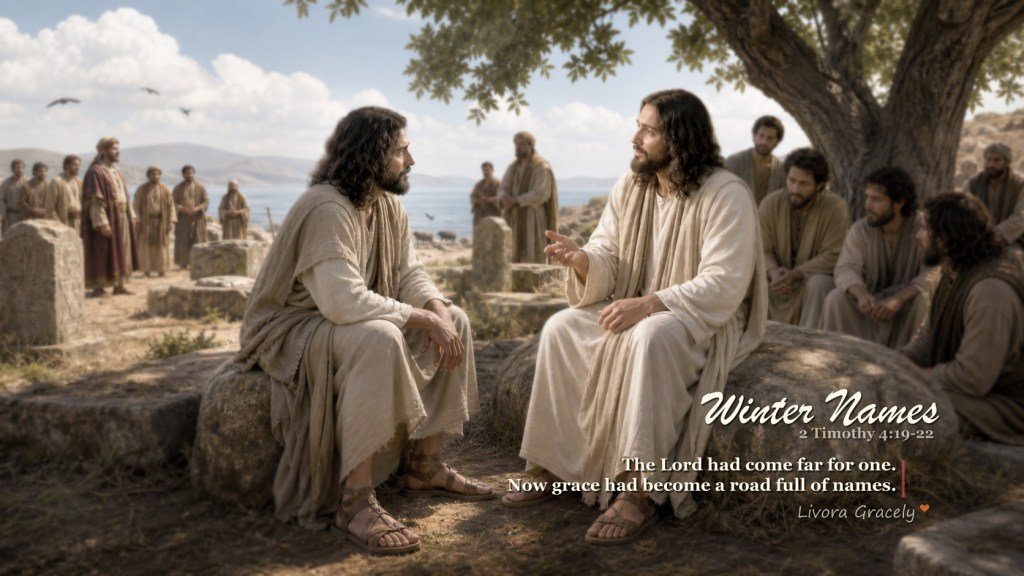
2 Timothy 4:19-22
Quietly Seated
The man was sitting down, and that alone was almost impossible.
People had known him by noise, wounds, broken chains, and the frightening geography of tombs and hillsides. He had lived near death before he died, moving through places where no one wanted to meet him after dark.
But now he was clothed, in his right mind, and sitting near Jesus.
The sea had been crossed for this. Wind and water had spent their strength against the boat, but Jesus still came. The region had not asked for Him. The tombs had not become gentle. The man had not walked toward help with a clear sentence in his mouth. Yet Christ arrived where mercy seemed least expected.
One man was found and restored. One man, whose name Scripture does not give us, sat like a living answer beside the Lord.
Then the people came. They saw what mercy had done. They saw the human being who had returned from the edge of himself. And they were afraid.
They asked Jesus to leave their region.
That is one of the strangest sorrows in the Gospels. A man had been given back to life, but the village could not bear the nearness of the One who had done it. Jesus did leave, but He did not leave the region empty.
The restored man wanted to go with Him. Jesus sent him home instead: “Tell them how much the Lord has done for you.” So the man went through the Decapolis and spoke. The Lord came far for one, and one carried the news far for many.
Paul knew that pattern in his bones. He too had once been met on a road he did not travel in order to be saved. Christ had come all the way to an enemy and made him a messenger.
So when Paul reaches the final lines of his final letter, he does not end with an idea floating above the earth. He ends with names.
Old Lanterns
“Greet Priscilla and Aquila and the household of Onesiphorus.”
After the lion’s mouth, the letter becomes warm with people. That matters because Paul has just remembered an hour when no one came to his support. The benches were empty. No familiar shoulder stood near him. No human voice rose beside his own defense.
But one lonely hour did not erase all faithful names.
Now he says, greet Priscilla and Aquila.
They are not decorations at the edge of the page. They are old lanterns. They had stood in the long weather of the work. They had opened their lives, their labor, their home, and their courage. Some friendships are not loud in the final sentence because they have already been loud in the years.
Then comes the household of Onesiphorus. A household can become a shelter for the gospel, not only a building or family name, but a living place where a servant of Christ is refreshed instead of forgotten. Onesiphorus had not been ashamed of Paul’s chains. He had searched for him, found him, and brought mercy close enough for a prisoner to feel it.
So Paul remembers the house. He had been alone in one room, yes, but his life had not been empty of rooms where grace had burned.
There is a kind of pain that tries to rewrite the whole past. It says, “No one was there.” It wants one cold courtroom to become the final truth about every face. Paul refuses that lie. He still knows who stood, who refreshed, and where the lamps were kept burning.
And Timothy must know it too.
The gospel had always found room inside ordinary houses and remembered names.
Scattered Roads
“Erastus stayed in Corinth, and I left Trophimus sick in Miletus.”
The sentence feels almost too ordinary. After Alexander, after the first defense, after the Lord standing at Paul’s side, we are given travel notes: Erastus stayed in Corinth, and Trophimus was left sick in Miletus.
The work of God still moves through unfinished arrangements. Paul does not pretend that everyone is strong, available, and gathered neatly around him. One man remains in Corinth. Another is left in Miletus with a body that cannot continue. The map of mission has gaps in it.
Paul himself is not in an easy condition. He has asked for a cloak, books, and parchments. He has warned Timothy about harm, remembered abandonment, and spoken of winter. This is not a world where faith removes the body from weather, distance, illness, and need.
Trophimus is sick, and that detail should stay as heavy as Scripture leaves it. Paul had seen healing. Paul had preached Christ with power. Paul had been delivered from the lion’s mouth. Yet he still writes that he left Trophimus sick in Miletus. The presence of God does not turn every servant into an untired instrument; sometimes the work continues while one body must stop.
Erastus stayed in Corinth, and not every absence is desertion. Some people are not beside Paul because they are still holding a place somewhere else. The gospel can scatter the faithful without making them unfaithful.
The message moves through human bodies, local assignments, delayed companions, and names spread across cities. A servant remains in Corinth, a friend lies sick in Miletus, and an old apostle writes from need.
Hurry Warmly
“Do your best to get here before winter.”
There is tenderness in that sentence, and urgency. Paul does not say, come when life becomes convenient or visit if the road feels easy. He says, do your best. Get here. Before winter.
Winter is not only a season on the calendar. It is what happens when the road becomes harder than it was. Ships wait. Travel slows. Cold enters the body. A cloak becomes more than a belonging.
Some presence must not be postponed until the heart is ready to feel noble about it. Some visits need to happen while the road is still open. Some words need to arrive while ears can still hear them. Some hands need to reach another life before weather, weakness, or death changes the shape of the possible.
Paul had spent his life moving toward people. In Athens, he did not sit still with private certainty while a city worshiped what it did not know. He observed, reasoned, and spoke among the people until the message divided the room: mockery in some, delay in others, faith in a few.
That is the weather of witness. Not every hearer opens, and not every city receives. But Paul kept moving because Christ had first moved toward him. The risen Lord had not waited for Paul to become gentle before calling his name. He met him on the road while he was still breathing threats.
Now Paul asks Timothy to move, not as a tourist or a polite visitor, but as a son in the faith who understands that presence can become obedience. “Before winter” is a small phrase with a large ache inside it. A good intention can freeze into regret because it never became a journey.
Paul does not accuse Timothy. He calls him.
Come before winter.
Shared Grace
“Eubulus greets you, and so do Pudens, Linus, Claudia and all the brothers and sisters.”
More names come, newer names, Gentile names. The message that Paul had proclaimed among the nations is no longer only a mission statement. It has faces now: Eubulus, Pudens, Linus, Claudia, and brothers and sisters gathered near the end of a letter that began with charge, suffering, endurance, and warning.
This is how the gospel leaves evidence, not only in arguments won, journeys completed, or enemies answered, but in names. Old friends, faithful houses, workers in other cities, sick companions, and newer believers near Paul’s side form a quiet map of the moving Christ.
At another well, one Samaritan woman’s conversation became a town’s footsteps toward Christ. Grace has always known how to widen from one life into many.
Christ stopped Saul on a road. Paul carried the name of Christ before nations. Now, near the end, Paul writes names that sound like the nations have begun to answer back.
The room is not as empty as it once seemed, and the work is not as fragile as winter makes it feel. Paul is still in need. Timothy still must come. Trophimus is still sick. Erastus is still away. The season is still turning. But grace has gathered people around the message, and the message has entered more lives than one servant could hold in his hands.
Then Paul gives the final blessing: “The Lord be with your spirit. Grace be with you all.”
One line reaches Timothy personally, and the other opens over the whole community. Paul does not end by clutching grace to himself. He gives Timothy the nearness of the Lord for the work ahead, and he leaves everyone under the covering of grace.
That is enough, not because every problem has disappeared, every friend has arrived, or winter has been canceled, but because the Lord is still with the spirit of His servant, and grace is still wide enough for all.
Paul once stood stopped and claimed on the Damascus road. Timothy is now called to come before winter. And around the last lines of the letter, Priscilla, Aquila, the household of Onesiphorus, Erastus, Trophimus, Eubulus, Pudens, Linus, Claudia, and all the brothers and sisters gather like small lights before the cold.
The Lord had come far for one.
Now grace had become a road full of names.
Witness Notes
Mark 5:1-20 – Jesus crosses into the region of the Gerasenes, restores one tormented man, and leaves him as a witness to many.
Luke 8:26-39 – The healed man is sent home to declare how much God has done for him.
John 4:4-42 – One Samaritan woman’s conversation with Jesus becomes a doorway for many in her town to come toward Him.
Acts 9:1-19 – Christ meets Saul on the Damascus road and turns an enemy into a messenger.
Acts 17:16-34 – Paul observes Athens, reasons with its people, and watches the message divide hearers into mockery, delay, and faith.
Acts 18:1-3, 18-26 – Priscilla and Aquila stand as faithful co-workers whose home and labor serve the gospel.
2 Tim. 1:16-18 – Onesiphorus refreshes Paul and is not ashamed of his chains.
2 Tim. 4:19-22 – Paul closes with names, need, urgency before winter, and grace for Timothy and all.


Leave a comment