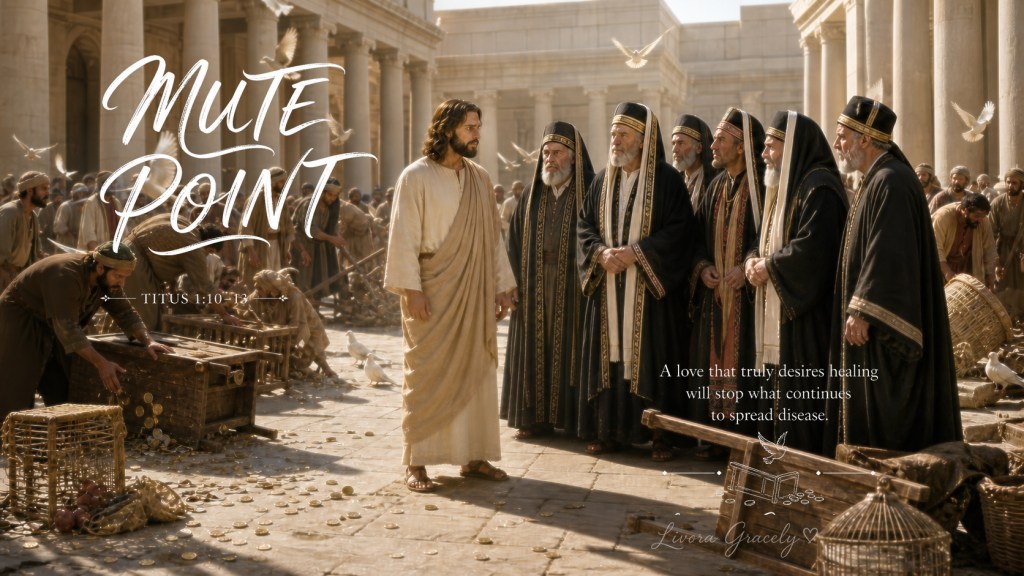
Titus 1:10–13
Closing Time
The tables were already down.
Coins lay across the temple pavement. A bench used by men selling doves had been pushed aside. Traders gathered what they could while others moved towards the exits.
Jesus stood in the middle of the disturbance.
People had seen Him receive children, touch lepers, and stop for voices everyone else ignored. Compassion seemed to follow Him from town to town.
That day, compassion had overturned the furniture.
He had driven out those buying and selling. He had stopped the money changers. He had refused to let another transaction continue.
Then He spoke.
“My house will be called a house of prayer.”
The words named what the place had been given to be.
“But you are making it a den of robbers.”
The words exposed what it had become.
Yet the clearing of the courts did not leave the temple empty. The blind and the lame came to Jesus there. He healed them. A space occupied by commerce began receiving people who had brought nothing to sell.
Later, when Jesus returned to the temple courts and began teaching, the chief priests and elders approached Him.
“By what authority are You doing these things?”
They possessed recognized positions within the temple. Jesus did not.
At least, not one they were prepared to recognize.
The question would remain in the air: who had given Him the right to interrupt what they had permitted?
Years later, Paul left Titus on Crete with unfinished work. He too would face voices that had found room inside a religious community. They carried recognized marks. They knew religious language. They had entered households.
Paul did not tell Titus to admire their confidence.
“For there are many rebellious people, full of meaningless talk and deception, especially those of the circumcision group.”
Some conversations had already gone too far.
House Rules
The trouble did not begin with outsiders who knew nothing of Scripture.
Paul placed special attention on those of the circumcision group. They carried the sign of an old covenant in their bodies, yet their conduct resisted the truth that sign was meant to serve. Religious identity had not made their words trustworthy.
They were rebellious.
Their talk was empty.
Their influence was deceptive.
Meaningless talk can appear harmless because it leaves no bruise on the person listening. Deception can sound impressive while it is still arranging its arguments. But Paul measured the teaching by what happened after it entered a home.
“They must be silenced, because they are disrupting whole households by teaching things they ought not to teach—and that for the sake of dishonest gain.”
Whole households were being overturned.
People who shared meals, work, worship, and responsibility were being disturbed by teachings that should never have been given a place among them. The teachers were not merely mistaken. Shameful profit gave their error a reason to continue. Every household confused by their words became another room in which their influence could operate.
Paul’s instruction was therefore direct.
They must be silenced.
He did not mean that Titus should answer every difficult question by forbidding it. Honest questions do not need to be strangled. A person searching for truth is not the same as a person using religious speech to gain access, control, or money.
These teachers had already shown their purpose.
More discussion would not necessarily produce more light. It might only give deception another evening at the table.
Paul then quoted a voice from Crete itself.
“One of Crete’s own prophets has said it: ‘Cretans are always liars, evil brutes, lazy gluttons.’”
The sentence was not permission to despise an entire people. Paul was not teaching Titus to cure deception with contempt. He used a severe local verdict to expose traits already visible among the rebellious teachers: falsehood, destructive appetite, and an unwillingness to submit their lives to truth.
Titus was not sent to insult Crete.
He was sent to keep its churches from becoming healthy-looking rooms filled with diseased speech.
The distinction mattered. A quick-tempered man could enjoy Paul’s command for the wrong reason. He might silence people because they challenged him. He might call personal irritation discernment and turn correction into revenge.
But Paul had just said that an overseer must not be quick-tempered or violent. The man able to give a sharp rebuke must first be a man whose anger does not rule him.
Titus needed strength without appetite for domination.
The houses needed protection.
The teachers still needed health.
Right Behind
Paul did not hide the edge of his instruction.
“This saying is true. Therefore rebuke them sharply, so that they will be sound in the faith.”
The sharpness had a destination.
Health.
Jesus once used words sharp enough to stop one of His closest disciples.
Near Caesarea Philippi, He had asked His disciples who they believed He was. Peter answered with a confession no ordinary observation could have produced.
“You are the Messiah, the Son of the living God.”
Jesus called him blessed. What Peter had confessed had not been revealed by flesh and blood, but by the Father in heaven.
Then Jesus began explaining where the road would lead.
He must go to Jerusalem.
He must suffer.
He must be killed.
He would be raised on the third day.
Peter had accepted the identity of the Messiah but not the road of the Messiah. He took Jesus aside and began to rebuke Him.
“Never, Lord! This shall never happen to You!”
The concern may have sounded loyal. Peter loved Jesus. He did not want suffering to reach Him. Yet his kindness offered Jesus a kingdom without a cross and a victory without the obedience He had come to fulfil.
Jesus turned.
“Get behind Me, Satan!”
The disciple who had just spoken by the Father’s revelation was now speaking from merely human concerns. Peter had moved from following Jesus to standing in front of Him, trying to redirect the road.
Jesus put him back where a disciple belonged.
Behind Me.
The words did not end Peter’s discipleship. They defended it. Jesus would not permit even the devotion of a beloved friend to make the cross negotiable. Peter needed more than a gentle acknowledgement that his intentions were good. The error had reached the centre of Christ’s mission.
It had to be stopped there.
One day Peter would speak of Christ’s sufferings without trying to remove them. He would strengthen others with the truth he had once resisted. But first, the man who correctly named the Messiah had to let the Messiah correct him.
That is the mercy inside a sharp rebuke.
It does not flatter a wrong direction simply because the person walking it has been right before. It speaks while there is still a road to which the person can return.
At the Door
Long before Peter stood in front of Jesus, another man stood near a boundary he could not see.
Cain had brought an offering from the soil. Abel brought fat portions from the firstborn of his flock. The Lord looked with favour on Abel and his offering, but not on Cain and his.
Cain became very angry.
His face fell.
God came to him before the field, before the blood, and before the question about his missing brother.
“Why are you angry? Why is your face downcast?”
Then came the warning.
Sin was crouching at the door. It desired Cain, but Cain had to rule over it.
The words were firm, but the door had not yet been crossed. Cain was being shown what was gathering near him while another choice remained possible.
He did not receive the warning.
Cain spoke to Abel, and when they were in the field, he attacked his brother and killed him.
God questioned him again.
“Where is your brother Abel?”
Cain answered with another question.
“Am I my brother’s keeper?”
The man who had not mastered what waited at his own door now denied responsibility for the brother who would never walk through his door again.
Peter and Cain both heard words that interrupted them. Peter was trying to move the Messiah away from the cross. Cain was moving towards his brother with anger already at work within him.
Peter was placed behind Jesus.
Cain went into the field.
The difference did not lie in whether the correction felt severe. The difference appeared in what each man allowed the correction to do.
Paul wanted the teachers in Crete rebuked sharply, not because their destruction was desirable, but because their direction was already carrying others with them. Whole households stood beyond the door.
Titus had to speak before deception crossed another threshold.
The purpose remained:
“So that they will be sound in the faith.”
Proper Business
Back in Jerusalem, one coin continued across the pavement.
It struck the leg of an overturned table, changed direction, and rolled into the open court.
The business it belonged to had stopped.
When the chief priests and elders questioned Jesus’ authority, He asked whether John’s baptism had come from heaven or from human origin. They weighed belief against reputation and found neither answer safe.
“We don’t know.”
Behind them, the tables remained overturned.
The temple had not been cleansed because Jesus had lost control. It had been cleansed because the house had been losing its purpose. What occupied its courts had to be stopped. What had been displaced had to be welcomed again.
This was the road Paul placed before Titus.
“They must be silenced,” he had written, because their words were overturning whole households. Titus was not being permitted to become harsh. He was being entrusted with people whose faith had been made ill.
Christ had not stopped the business in the temple merely to produce silence. The emptied space made room for the house to become what it had been called to be. Titus too would have to stop what was spreading before those households could become sound in the faith.
The blind had come.
The lame had come.
Children had raised their voices.
The chief priests had heard them and become indignant.
Jesus remained in the house.
The last coin circled once on the stone, leaned towards the floor, and fell still.
Somewhere beyond the scattered tables, someone began to pray.
Witness Notes
Titus 1:7–9 — Paul requires an overseer who is blameless, not overbearing, quick-tempered, violent, or greedy for gain; he must hold firmly to the trustworthy message so that his encouragement and correction come from sound doctrine rather than personal anger.
Titus 1:10–13 — Paul warns Titus about rebellious and deceptive teachers, especially among the circumcision group, whose shameful pursuit of gain is disrupting whole households; they must be silenced and sharply rebuked so that they may become sound in the faith.
Isaiah 56:6–7; Jeremiah 7:9–11 — Isaiah names the temple as a house of prayer for all nations, while Jeremiah exposes people who practise injustice and then treat the temple as a den of robbers; Jesus draws these prophetic lines together when He confronts the temple’s corrupted purpose.
Matthew 21:12–17 — Jesus drives out those buying and selling, overturns the tables of the money changers, and identifies the temple as a house of prayer rather than a den of robbers; afterwards the blind and lame come to Him, children praise Him, and the chief priests become indignant.
Matthew 21:23–27 — When the chief priests and elders question Jesus’ authority in the temple courts, He asks whether John’s baptism came from heaven or from human origin; unwilling to acknowledge the truth or risk the crowd’s response, they answer that they do not know.
Matthew 16:13–20 — At Caesarea Philippi, Peter confesses that Jesus is the Messiah, the Son of the living God; Jesus declares that this recognition has been revealed by the Father rather than reached through merely human understanding.
Matthew 16:21–28 — After Jesus reveals that He must suffer, be killed, and be raised, Peter tries to turn Him away from that road; Jesus sharply places Peter behind Him and calls His disciples to follow the way of the cross rather than reshape the Messiah’s mission around human concerns.
Genesis 4:1–7 — Cain becomes angry when the Lord does not look with favour on him and his offering; before violence occurs, God questions his anger and warns that sin is crouching at the door, desiring to master him, while another response remains possible.
Genesis 4:8–16 — Cain ignores the warning, kills Abel in the field, and denies responsibility when God asks for his brother; Abel’s blood cries from the ground, and Cain leaves the Lord’s presence under the consequences of the direction he refused to correct.


Leave a comment