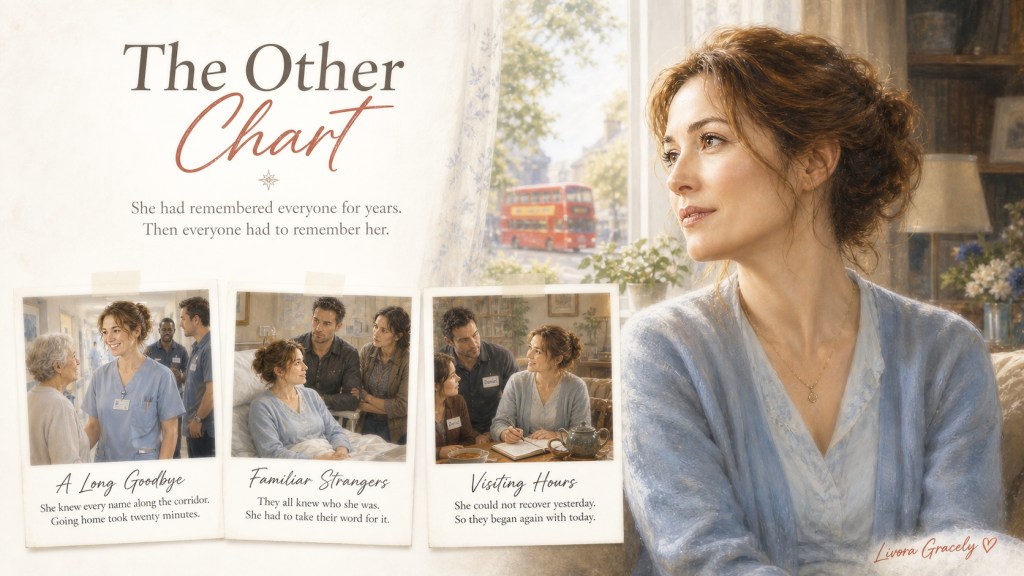
She had remembered everyone for years.
Then everyone had to remember her.
Mara Ellison was very good at leaving the hospital.
She simply never finished doing it.
On the morning of the accident, she crossed the ward carrying her coat and stopped to find Mrs. Parker’s glasses, ask the cleaner about his daughter’s birthday, and hear why Dr. Bell’s tomatoes had become “professionally disappointing.”
Nina found her near the exit twenty minutes later.
“I thought you were going home.”
“I am.”
“You said that upstairs.”
“It’s a long building.”
Mara knew every name along the corridor. She knew who disliked cold water, who pretended not to need company, and which porter had been hiding biscuits behind the discharge forms.
Outside, rain silvered the road.
She boarded the bus and sent her brother a message.
Home soon. Unless somebody talks to me.
The bus reached the next intersection.
Then came brakes, a violent turn, and the sound of ordinary things losing their places.
Mara’s hospital identification card slid beneath a seat.
Her name remained facing upward.
Three days later, Mara opened her eyes to several sorrowful faces.
A man leaned forward.
“Mara?”
She looked at him politely.
“Do I know you?”
He tried to smile.
“Quite well, unfortunately.”
His name was Daniel. He was her younger brother.
Beside him stood Nina, two colleagues, a neighbour, and Dr. Bell, whose tomatoes had apparently survived the night better than she had.
They all knew her.
Mara had to take their word for it.
She could understand where she was when someone explained it. A few minutes later, the explanation was gone.
“Why am I here?”
“There was an accident.”
“Who are you?”
“Daniel.”
“And yesterday?”
“Also Daniel.”
By the third day, his name stayed longer. It still felt like information written beneath a stranger’s photograph, but it stayed.
Her doctors explained that memory after a brain injury did not always return in order. Old rooms might remain while yesterday disappeared. A familiar face might bring warmth without bringing a name.
When Mara was considered safe to leave under Daniel’s care, he took her home.
The key fitted.
The shoes fitted.
The blue mug said MARA’S—ASK FIRST.
None of this seemed legally conclusive.
“Apparently I live here,” she said.
“The electricity company agrees.”
Then the doorbell rang.
Nina arrived with soup.
The neighbour brought flowers. A porter brought biscuits he denied having taken from anywhere. Dr. Bell came carrying tomatoes and said the visit was unrelated to their condition.
More people followed.
Mara had accumulated an unreasonable number of friends for someone who recognized none of them.
They tried photographs, stories, songs, and one holiday video in which everyone was shouting into the wind. Each memory was offered carefully, as if it might know the way home.
It did not.
Daniel began making name cards.
DANIEL — BROTHER
NINA — FRIEND / NURSE
MR. HUGHES — NEIGHBOUR
Mara studied them.
“These need clinical notes.”
Beneath Daniel’s name she wrote:
Makes tea when worried. Leaves the spoon in.
Beneath Nina’s:
Laughs before finishing sentences. Brings too much soup.
Mr. Hughes received:
Claims to be checking the boiler. Has not approached boiler.
The cards multiplied.
So did Mara’s notebook.
Every night she prepared a handover for the woman who would wake in her bed the next morning.
You are Mara.
Daniel is your brother.
The accident was on Tuesday.
The blue mug is yours.
You have already asked about work. Not yet.
Daniel still tried to recover the old Mara.
“Do you remember Mum’s kitchen?”
“No.”
“The seaside?”
“No.”
“What you used to call me?”
Mara closed the notebook.
“Everyone keeps telling me who I was.”
“I’m trying to help.”
“Then tell me who you are.”
The next morning, Daniel stopped testing her.
He made tea instead.
A week later, Nina returned with another pot of soup. Before she could display her name card, Mara looked at it.
“You brought too much again.”
Nina stopped in the doorway.
“It’s a smaller pot.”
Mara inspected it.
“That is not medically plausible.”
Nina laughed before finishing whatever she had meant to say.
That night Mara opened the notebook.
Daniel is my brother.
Nina is my friend.
I live here.
Yesterday stayed.
The following morning, Daniel found two cups waiting on the kitchen table.
“Do you remember making these?”
Mara looked at them.
“No.”
His face fell only slightly.
She pushed one cup toward him.
“But I remembered you take no sugar.”
Research basis: Mara, her family, and the accident are fictional. Post-traumatic amnesia may involve confusion, repeated questions, difficulty retaining new events, and failure to recognize familiar people. Older and procedural memories may be better preserved than newly formed memories, while notebooks, routines, alarms, and other compensatory strategies are commonly used during rehabilitation. Recovery varies and return to work should be gradual and medically assessed. Headway; MSKTC; Cambridge University Hospitals NHS


Leave a Reply