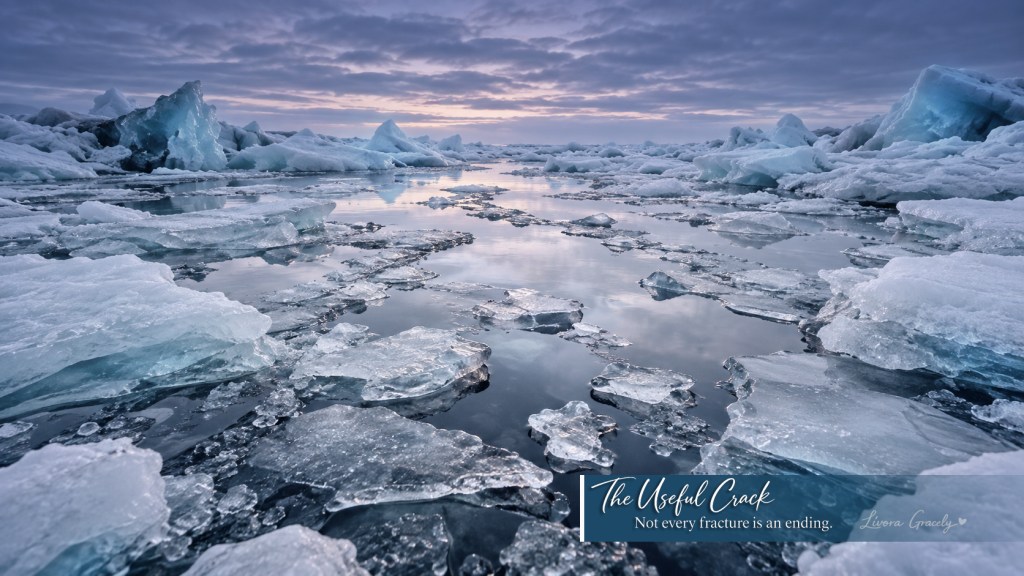
Not every fracture is an ending.
Some cracks are simply the first place where light finds its way in.
The first thing we notice is the broken surface.
Across the Arctic field, sheets of ice lie scattered in uneven patterns. Some are thin and almost transparent. Others are thick, cloudy, and heavy, with edges sharpened by pressure and cold. Between them, narrow channels of dark water lead toward the distant horizon.
At a glance, the landscape appears damaged.
It looks as though the ice has failed to remain whole.
But the longer we look, the more complicated the scene becomes. The fractures are not empty gaps. They hold reflections. They reveal layers. They allow the blue depth beneath the surface to appear. Light enters through the places where the ice has separated, turning weakness into color.
Perhaps this is why the landscape feels strangely alive.
A perfect sheet of ice might be beautiful, but it would tell us very little. Its surface would remain sealed, silent, and difficult to read. The cracks give it a history. They show where pressure has gathered, where the water has moved, and where the frozen surface has been forced to change.
Nature rarely makes a clean distinction between beauty and damage.
Human beings do.
We are taught to hide what is broken. A crack in a wall must be repaired. A damaged object should be replaced. A failed plan should be forgotten. Even the wounds we carry are often covered before anyone has the chance to ask how they arrived there.
We admire smooth surfaces because they suggest control.
Yet smoothness can also be a form of silence.
The ice in this photograph offers another possibility. Its fractures do not make the landscape less complete. They make its structure visible. Through them, we see that the surface is not a single solid thing, but a temporary arrangement of water, temperature, pressure, movement, and time.
The same may be true of a human life.
What appears to be a weakness may reveal the forces that shaped us. A change in direction may expose a truth that comfort kept hidden. A disappointment may create an opening through which a different future becomes possible.
This does not mean every painful experience is secretly good. Some losses remain losses. Some breaks leave permanent marks. The image does not ask us to romanticize suffering.
It asks us to look again.
The narrow crack in the ice is not useful because it is beautiful. It is beautiful because it performs a function. It releases pressure. It allows movement. It separates surfaces that can no longer remain together. It creates a passage for water and a mirror for the sky.
Without the crack, the reflected light would have nowhere to gather.
There is a quiet intelligence in that arrangement. The ice does not resist change forever. When pressure becomes too great, it gives way—not completely, not gracefully, but sufficiently. A new pattern forms from the break.
Perhaps survival sometimes looks like this.
Not remaining untouched, but finding a new shape after the old one can no longer hold.
The people who live through difficult seasons often understand this better than anyone. They may not describe themselves as strong. They may remember only the fear, the confusion, or the exhaustion. But later, when they look back, they discover that the opening they once considered a failure allowed something else to enter: a new friendship, an unexpected idea, a different kind of courage.
The light does not erase the fracture.
It travels through it.
That distinction matters. Healing is not always a return to the original form. Sometimes it is the ability to let meaning pass through the places that remain changed.
The Arctic landscape gives us no easy promise. The ice may freeze again, break again, and move again. Nothing here is permanently settled. The horizon is quiet, but beneath the surface, the world continues to shift.
What looks still is not necessarily motionless.
What looks broken is not necessarily useless.
And what looks like an ending may only be a narrow opening between two versions of the world.
The most important detail in this photograph is not the ice that remains intact.
It is the crack that makes the hidden water visible.


Leave a Reply