Genesis 12:17–20
After the LORD afflicted Pharaoh’s household, a question brought Abram and Sarai’s relationship into the open.
A Question in the Court
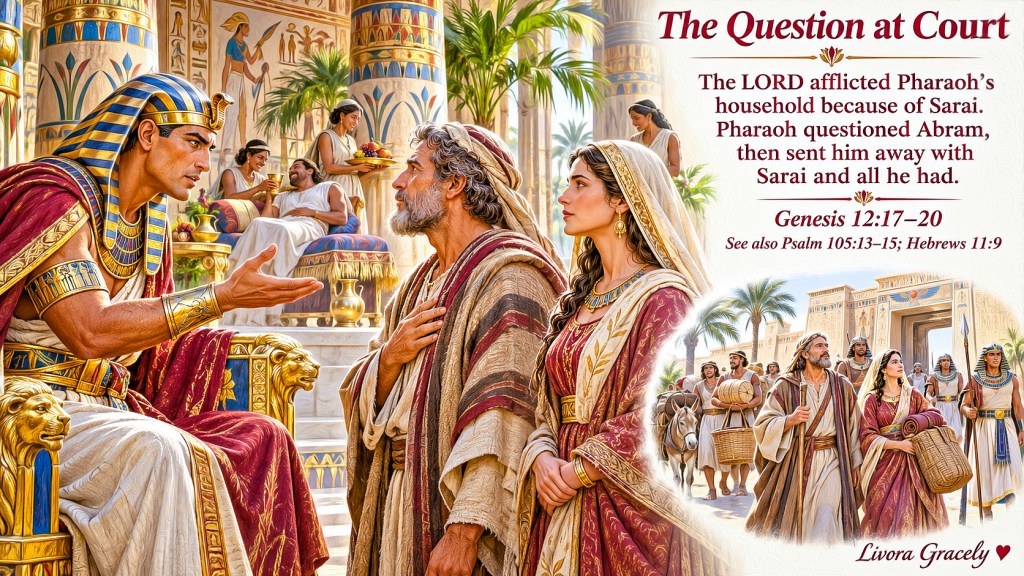
Pharaoh leans forward, one hand extended toward Abram. Sarai stands nearby, while members of the household attend to a man reclining farther back.
In a smaller scene, Abram and Sarai leave the palace with their company. Animals and attendants follow through the gateway.
The poster imagines the expressions, gestures, and setting of their encounter. Genesis records that Pharaoh called Abram and questioned him; it does not describe the room or say where Sarai stood during their conversation.
The LORD Acted
Sarai had been taken into Pharaoh’s house after his officials saw her and praised her beauty. Abram, who had asked her to say she was his sister, had been treated well because of her.
Then the LORD afflicted Pharaoh and his household with severe plagues because of Sarai, Abram’s wife.
The passage does not describe the symptoms or say how many people were affected. The figure receiving care in the poster gives the household’s distress a visible place, but the picture does not tell us the nature of the plagues.
In the midst of the account, Sarai is named again as Abram’s wife. The LORD’s action brings a change to the situation that had taken her into Pharaoh’s house.
What Pharaoh Asked
Pharaoh called Abram and asked why he had not told him that Sarai was his wife. He also asked why Abram had said she was his sister, so that Pharaoh took her as his wife.
The questions return to Abram’s earlier request to Sarai. Before entering Egypt, Abram had spoken of his fear that he would be killed if the Egyptians knew she was his wife. He had asked her to say she was his sister so that his life would be spared.
Genesis does not say how Pharaoh learned the truth. It also does not record an answer from Abram. The passage gives Pharaoh’s questions without filling those silences.
Sarai and the Road Out
Pharaoh told Abram to take his wife and leave. He then gave orders to his men, who sent Abram away with Sarai and all that he had.
The inset shows them walking together through a gateway. Their clothes, the attendants, and the path are imagined details. The account states that Sarai left with Abram; it does not describe her thoughts as she departed.
The next chapter continues the journey. Abram went up from Egypt to the Negeb with his wife and everything he had, and Lot went with him. The household that had entered Egypt during famine now moved on from that place.
Remembered on the Journey
A later psalm remembers the LORD’s care for the ancestors as they traveled from nation to nation. Hebrews also looks back at Abraham living as a foreigner in the land of promise. These passages reflect on a longer story; neither explains how Pharaoh came to know about Sarai.
In the poster, Pharaoh’s hand remains extended toward Abram. Beyond the court, the family is pictured on the road again.
The questions have been spoken. Sarai leaves with Abram, and their journey continues beyond Egypt.
Livora Gracely ♥
Sources
- Genesis 12:10–20 — The famine, Abram’s request to Sarai, the LORD’s action, and Pharaoh’s questions and instructions.
- Genesis 13:1 — Abram leaves Egypt for the Negeb with his wife, Lot, and all he has.
- Psalm 105:13–15 — The psalm remembers the LORD’s care for the ancestors as they moved among nations.
- Hebrews 11:9 — Abraham is remembered living by faith as a foreigner in the promised land.


Leave a Reply