Genesis 12:14–16
Sarai entered Pharaoh’s house while Abram received kindness because of her.
The Steps toward the House
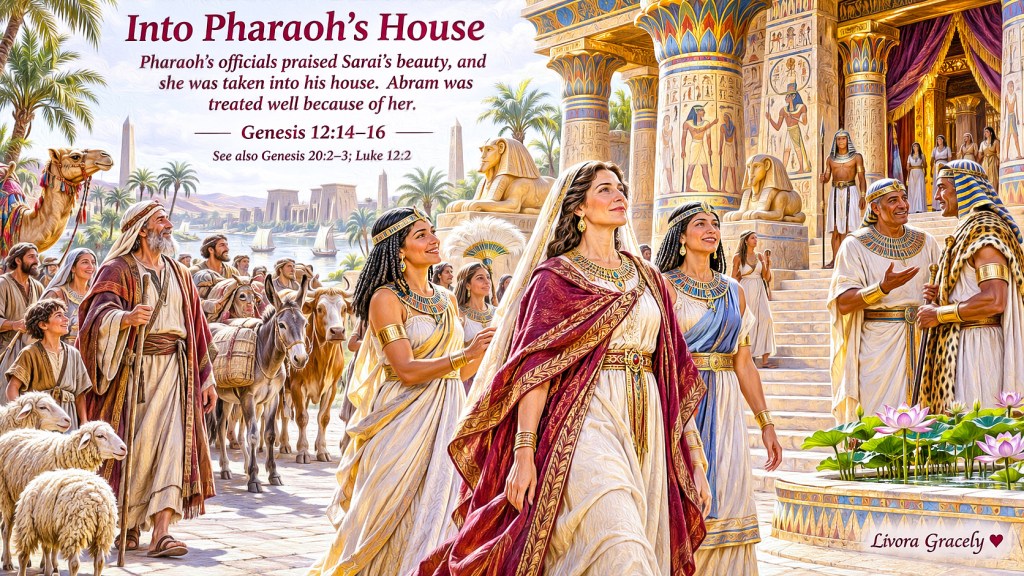
Sarai walks toward a great building, with women beside her and tall columns rising above the steps. Behind her are Abram, members of their household, and animals gathered near the road.
The poster imagines a scene in Egypt: painted walls, bright garments, and people moving around the entrance. Genesis does not describe the building or the people who accompanied Sarai along those steps. It says that she was taken into Pharaoh’s house.
The image gives her a place in the foreground. The passage draws attention to what happened after Abram and Sarai entered Egypt.
Sarai Was Seen
Before they arrived, Abram had asked Sarai to say she was his sister. He feared that if the Egyptians knew she was his wife, they would kill him and let her live.
When Abram came to Egypt, the Egyptians saw that Sarai was very beautiful. Pharaoh’s officials also saw her and praised her to Pharaoh. Then she was taken into his house.
The passage records the attention Sarai received and where she was brought. It does not tell us what she said or thought as these events unfolded.
The women and attendants in the poster are an artist’s way of showing her approach to the house. Their gestures and the details of the setting are not described in the verse.
Abram Was Treated Well
Genesis then turns to Abram. Pharaoh treated him well because of Sarai, and Abram had sheep and cattle, male and female donkeys, camels, and male and female servants.
The list shows how Abram’s circumstances changed while Sarai was in Pharaoh’s house. The servants named alongside the animals were people within the household; the passage does not give their names or individual stories.
In the poster, livestock and members of the household stand near Abram. The scene brings the verse’s details into view without explaining how or when each animal or person came into his household.
What the Passage Does Not Tell
Sarai’s beauty was praised, and she was taken to Pharaoh’s house. The account has not recorded her response. The grandeur of the illustrated building cannot tell us whether she wished to go or what she experienced there.
Pharaoh later says that he took Sarai as his wife. Genesis does not describe every detail of their relationship or the process by which she entered his household.
The passage leaves Sarai’s words unrecorded while allowing the reader to see the consequences of the situation. Abram was treated well because of her; Sarai was no longer beside him in the account’s setting.
A Story Not Yet Finished
Later in Genesis, Sarah is taken into the household of another ruler, Abimelech, after Abraham again says that she is his sister. That encounter has its own setting and details; it is not the same event as the one in Egypt.
Jesus later spoke in another context about what is hidden being brought to light. His words are not a direct explanation of Sarai’s story, but they invite attention to what is known and what remains concealed.
In the poster, Sarai approaches the house while Abram stands farther back. The picture imagines their positions; Genesis has brought them to a moment that the next verses have yet to resolve.
Livora Gracely ♥
Sources
- Genesis 12:11–16 — Abram’s request to Sarai, her being taken into Pharaoh’s house, and Abram’s treatment.
- Genesis 12:17–19 — The LORD afflicts Pharaoh’s household, and Pharaoh speaks about Sarai.
- Genesis 20:2–3 — Sarah and Abimelech in a later encounter.
- Luke 12:1–3 — Jesus speaks in a different context about what is hidden and what will be made known.


Leave a Reply