Genesis 12:10–13
The road toward Egypt began with famine and led to a difficult request between husband and wife.
A Road through Dry Land
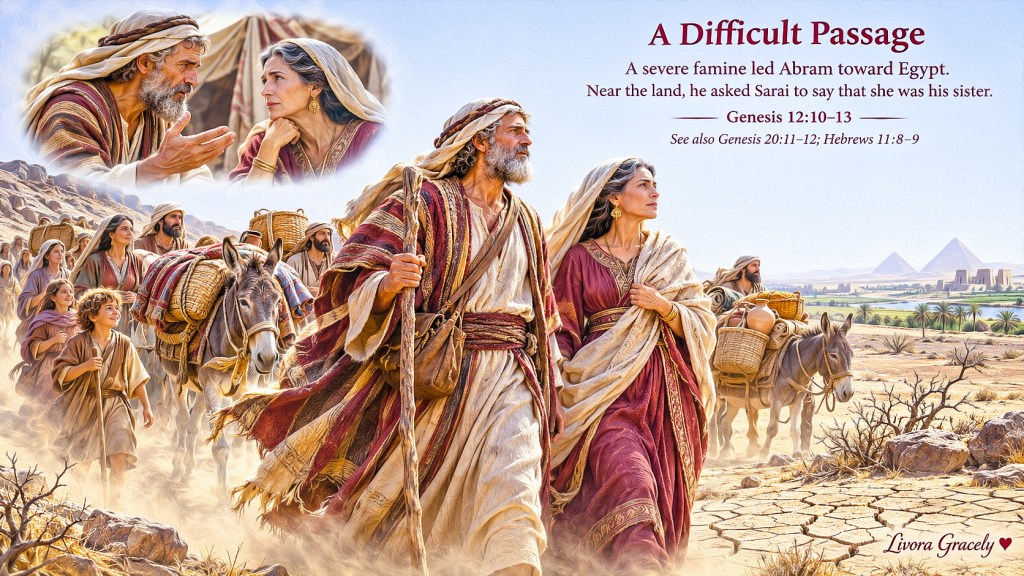
Dust rises around the travelers’ feet. Abram walks beside Sarai, while the household follows with animals and bundles. Ahead, the dry ground stretches toward a greener landscape in the distance.
In a smaller scene above the road, Abram speaks to Sarai. His hand is raised as she listens, her face turned toward him.
The poster imagines their journey and conversation. Genesis does not describe the dust, the road, or their expressions. It tells of a severe famine and records the words Abram spoke as he approached Egypt.
Famine in the Land
Abram had entered Canaan, traveled through the land, and heard the LORD’s promise concerning his offspring. He had built altars and continued by stages toward the Negeb.
Then a famine arose in the land. Because it was severe, Abram went down to Egypt to live there for a time.
The passage gives the famine as the reason for his journey. It does not say that God instructed him to go to Egypt, nor does it describe each difficulty the household faced along the way.
The cracked earth on the poster gives the famine a visible setting. The biblical account is brief: the need was great, and Abram went to another land for a time.
What Abram Feared
As they approached Egypt, Abram spoke to Sarai, his wife. He knew that she was beautiful, and he feared what might happen when the Egyptians saw her.
Abram said that they might recognize her as his wife, kill him, and let her live. These were the fears Abram expressed. Genesis does not say that anyone had already threatened him when he spoke.
Then he made a request. He asked Sarai to say that she was his sister, so that he would be treated well because of her and his life would be spared.
His words place his safety in view. They also lead toward a change in Sarai’s circumstances, which the following verses will describe.
A Sister—and a Wife
Much later, in a different encounter, Abraham explained that Sarah was the daughter of his father but not of his mother. By then their names had been changed from Abram and Sarai.
That later explanation gives a family connection to the word “sister.” In Egypt, however, the account also shows that Sarai was Abram’s wife and that this relationship was not made known to Pharaoh.
The passage does not record Sarai’s response to Abram’s request. The poster gives her a face and a place beside him, but her thoughts are not supplied by the verse.
A Journey Remembered
Hebrews later remembers Abraham leaving when God called him and living by faith as a foreigner in the promised land. Its words look across his journey; they do not describe this conversation near Egypt.
Genesis allows another moment to stand within that longer story: Abram speaks out of fear and asks Sarai to identify herself as his sister.
In the poster, the travelers continue along the dusty road. Above them, the imagined conversation remains close. The account has recorded Abram’s request; the next verses will show what happens after they enter Egypt.
Livora Gracely ♥
Sources
- Genesis 12:6–13 — Abram’s journey through Canaan, the famine, and his request to Sarai near Egypt.
- Genesis 17:5, 15 — God gives Abram and Sarai the names Abraham and Sarah.
- Genesis 20:11–12 — Abraham explains his family relationship with Sarah in a later encounter.
- Hebrews 11:8–9 — Abraham is remembered for obeying by faith and living as a foreigner in the promised land.


Leave a Reply