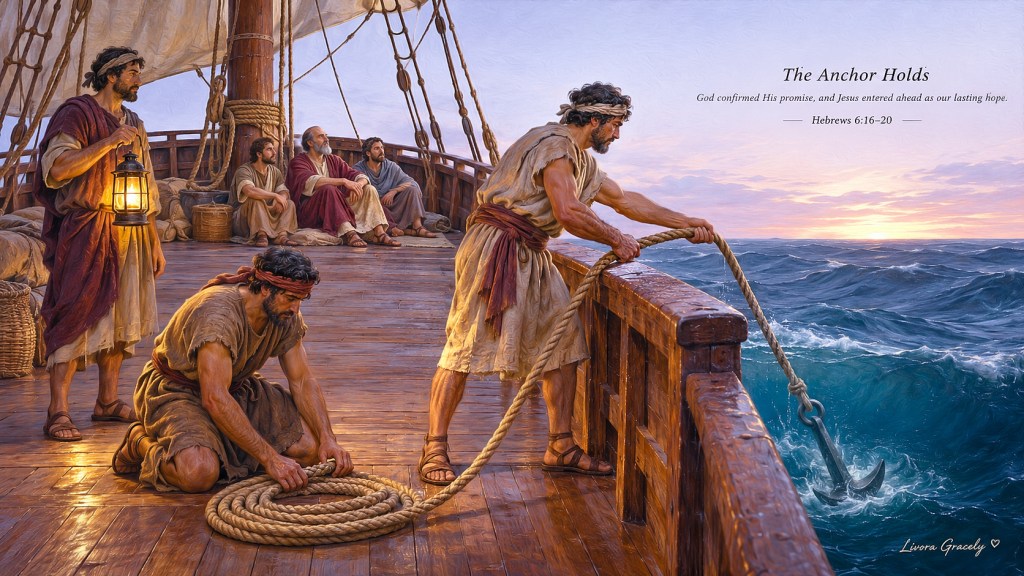
Hebrews 6:16–20
God confirmed His promise, and Jesus entered ahead as our lasting hope.
The sailors lowered anchors from the stern and prayed for daylight.¹
On the fourteenth night, the storm-driven ship was crossing the Adriatic Sea. The sailors sensed that land was near. When they measured the depth, the water was becoming shallower. Afraid the ship might strike rocks, they lowered four anchors from the stern and waited for morning. They did not yet know where they would land.¹
Paul was aboard with them, a prisoner on his way to Rome. The ship was still at sea, and the night had not yet given way.¹
The writer to the Hebrews also speaks of an anchor. This anchor is hope: firm and secure, reaching beyond a curtain to the place where Jesus has entered on behalf of His people.²
An Oath to Confirm
An oath gives weight to a person’s words. In a dispute, someone might call upon an authority greater than either party as witness. The writer of Hebrews draws on that familiar practice: people swear by someone greater, and the oath confirms what has been said.²
The Scriptures record such an oath in a dispute over an animal entrusted to another person’s care. An oath before the Lord could help settle the matter between its owner and the one who had kept it.³ Words spoken in God’s name carried a responsibility beyond the two people standing together.
Hebrews turns from human oaths to God’s own promise. God had spoken to Abraham and confirmed His purpose with an oath. There was no one greater by whom He could swear, so He swore by Himself.⁴
The oath did not make God truthful. His word was already trustworthy. Hebrews gives another reason: God wanted the heirs of the promise to see clearly that His purpose would not change.²
A Strong Encouragement
The letter speaks of two unchanging things in which it is impossible for God to lie. In the movement of the passage, the promise and the oath stand together. God gave His word, then confirmed His purpose to the heirs of what He had promised.²
The writer does not leave the assurance at a distance. He speaks of those who have fled for refuge and are encouraged to take hold of the hope set before them.² The words acknowledge people who need shelter and courage. They are addressed to a community asked to continue in faith and patience.
A promise broken by someone trusted can make the next promise difficult to hear. The person who has been disappointed may listen, waiting for words to prove dependable. Hebrews presents God’s oath as encouragement for those seeking refuge in Him.
The letter to the Ephesians uses another image. Those who believed were marked with the promised Holy Spirit, described as a seal and a guarantee of their inheritance.⁵ The images belong to different passages, yet both speak of God’s care in assuring His people of what He has promised.
An Anchor for the Soul
The ship in the Adriatic had not reached shore when the anchors went down. The sailors still had to wait through the darkness, with water beneath them and the coast somewhere ahead.¹
An anchor holds a vessel in place while the sea continues to move. Hebrews uses that image for hope, calling it an anchor for the soul, firm and secure.² Its strength rests in the God whose promise and oath the letter has just described.
The image does not promise a life without storms. A person may pray beside a hospital bed, wait for news that does not come, or carry grief into an ordinary morning. The letter does not measure hope by the absence of tears. It offers encouragement to hold fast while the full answer remains ahead.
Nor does the passage promise that every desired outcome will arrive in the form a person has imagined. The hope in Hebrews has a particular destination. It reaches behind the curtain, where Jesus has entered for His people.²
The sailors had lowered their anchors into the sea and were waiting for light. Hebrews directs its hearers beyond what they can see, toward the One who has already gone ahead.
Beyond the Curtain
The curtain recalls the sanctuary and the place set apart within it. In Israel’s worship, the high priest entered the Most Holy Place under the conditions God had given, bringing blood for himself and for the sins of the people.⁶ The way into that place was treated with care.
Hebrews declares that Jesus has entered on behalf of His people as their forerunner. He is also the high priest forever, according to the order of Melchizedek.² The letter will return to this priesthood.⁷
A forerunner goes ahead. The hope held by the community reaches where Jesus has already entered. Later, Hebrews invites its hearers to draw near to God with confidence and to hold fast to hope, because the One who promised is faithful.⁸
That invitation leaves room for weakness. Earlier, the letter describes Jesus as the high priest who understands it, and calls His people to approach the throne of grace for mercy and help.⁹
When daylight came, the sailors saw a bay with a sandy beach. They cut the anchors loose and tried to bring the ship ashore. The vessel struck a sandbar and broke apart, but everyone reached land safely, as God had told Paul.¹
The anchors belonged to that night; the ship did not survive the journey. The hope described in Hebrews reaches beyond the changing sea, to the presence of God. There Jesus has gone ahead, and there the promise holds.
Livora Gracely ♥
Scripture References


Leave a Reply