Genesis 11:31–32
Terah led his family from Ur toward Canaan, but they came to Haran and settled there.
Leaving the City
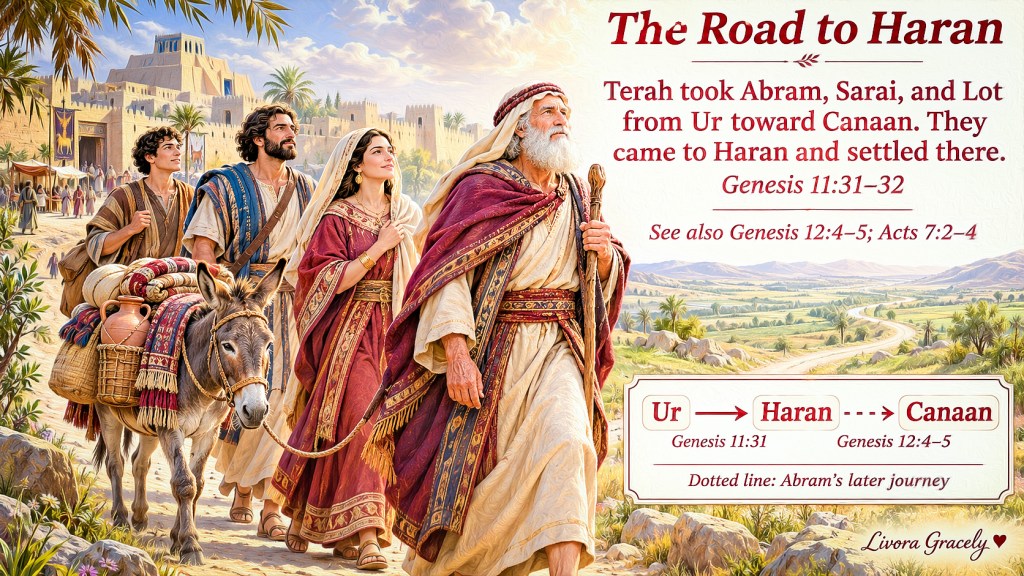
Terah walks ahead with a staff in his hand. Behind him are Abram, Sarai, and Lot, while a donkey carries woven cloth, baskets, and a clay vessel.
The city stands behind the travelers. Before them, the road winds through open land toward distant hills.
The poster imagines the family leaving Ur. Genesis names the people who departed and tells where they intended to go, but it does not describe their clothing, their possessions, or the animal beside them. The picture brings their journey into view; the account gives its direction and the place where they settled.
The Family Terah Took
Terah’s son Haran had died in Ur of the Chaldeans, the land of his birth. The son he left behind was Lot.
Genesis then says that Terah took his son Abram, his grandson Lot, and his daughter-in-law Sarai, Abram’s wife, and went out with them from Ur. The passage names Terah as the one who brought the family on this part of the journey.
Lot’s father was no longer among them. Lot, introduced through Haran’s name in the family record, now appears beside his grandfather, uncle, and Sarai as they leave Ur.
The account does not tell us what each person said at departure. It gives their relationships and gathers them on the road together.
Toward Canaan
Their destination was the land of Canaan. Yet Genesis says they came to Haran and settled there.
Haran the place is not the same as Haran the son of Terah. One name belongs to the place where the family made a home; the other belongs to Lot’s father, who had died in Ur.
The line on the poster marks the journey from Ur to Haran. A dotted line points toward Canaan, where Abram’s later journey will lead. At the close of Genesis 11, the family has reached Haran, not Canaan.
The chapter ends by telling us that Terah lived 205 years and died in Haran. It does not describe his final days there.
A Journey Continued
In the following chapter, Abram departs from Haran with Sarai and Lot. They take their possessions and the people they had acquired in Haran, and they set out for Canaan. Abram is seventy-five years old when he leaves.
Much later, Stephen recounts Abraham’s story and says that God appeared to him in Mesopotamia before he lived in Haran. Stephen also places Abraham’s move to the land after his father’s death.
Genesis 11 names Terah as the one who took the family from Ur; Stephen speaks of God’s call to Abraham. The accounts give different details, and the relationship between their chronology and the ages in Genesis has been understood in more than one way.
The Road in the Picture
On the poster, Terah’s staff touches the road while the others follow. The city remains visible behind them; ahead lies the place where they will settle.
The picture holds one part of a longer journey. The dotted line points beyond Haran, but the next stretch belongs to the chapter still to come.
Livora Gracely ♥
Sources
- Genesis 11:27–32 — Terah’s family, the departure from Ur, their settlement in Haran, and Terah’s death.
- Genesis 12:1–5 — The LORD’s call to Abram and Abram’s departure from Haran toward Canaan.
- Acts 7:2–4 — Stephen recounts God’s appearance to Abraham in Mesopotamia and his later move.


Leave a Reply