Genesis 11:28–30
Within Terah’s family were marriage, loss, and a story that had not yet reached its end.
The Cloth between Their Hands
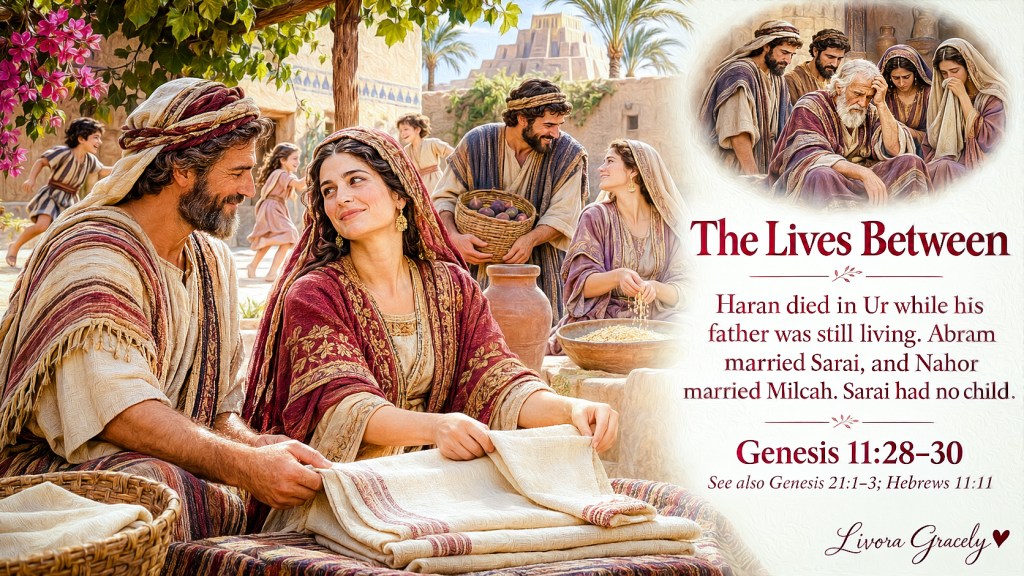
Abram and Sarai hold a length of linen together. Its pale folds rest across the table as they look toward one another.
Behind them, a woman sorts grain and a man carries a basket of fruit. Children move through the courtyard. Above the scene, a smaller picture shows Terah surrounded by family in a moment of sorrow.
The poster imagines these moments in the life of a household. Genesis does not describe the linen, the courtyard, or the family’s expressions. Its brief account names a death, two marriages, and the fact that Sarai had no child.
A Son Lost in Ur
Haran, one of Terah’s sons, died in Ur of the Chaldeans, the land of his birth. His father Terah was still living when he died.
The passage does not tell us what caused Haran’s death or describe the family gathered afterward. The inset offers an imagined glimpse of mourning, while the words of Genesis give the place and the family relationship.
Haran was the father of Lot. In the verses that follow, Lot remains within the family’s story and later leaves Ur with Terah, Abram, and Sarai.
Two Marriages, One Family
Abram married Sarai, and his brother Nahor married Milcah. The passage introduces Milcah as a daughter of Haran, who was also the father of Iscah.
These names cross the branches of one family. Milcah was Haran’s daughter and Nahor’s wife; Lot was Haran’s son. The account gives their relationships without describing the weddings or the household pictured on the poster.
The children in the courtyard are part of the illustration. Genesis does not identify them or place them at this gathering. Their presence helps create a picture of family life, but their names and parents are not supplied by these verses.
Sarai Had No Child
Then Genesis turns to Sarai. It says that she was unable to conceive and had no child.
The sentence is brief. It does not describe her thoughts at that moment or explain a medical cause. Sarai enters the account as Abram’s wife and as a person whose story will continue beyond this first introduction.
Much later, Genesis tells of the birth of Isaac to Sarah and Abraham—the names by which Sarai and Abram are known in that later chapter. The account says that the LORD did for Sarah what He had promised.
Hebrews also looks back to the promise and to faith. English translations differ in how they express the relationship between Abraham and Sarah in Hebrews 11:11, but the passage remembers God as faithful to His promise.
A Story Still Unfolding
At this point in Genesis, Isaac has not yet been born. Haran’s death has been named, the marriages have been introduced, and the family’s journey still lies ahead.
In the poster, Abram and Sarai continue holding the linen between them. Beyond the table, the household carries on beneath the courtyard trees. The picture is imagined; the passage leaves the family’s story open for the chapters to come.
Livora Gracely ♥
Sources
- Genesis 11:27–31 — Terah’s family, Haran’s death, the marriages, and Sarai’s circumstances.
- Genesis 17:5, 15 — God gives Abram and Sarai the names Abraham and Sarah.
- Genesis 21:1–3 — Sarah gives birth to Isaac as the LORD had promised.
- Hebrews 11:11 — Faith and God’s faithfulness in the account of Abraham and Sarah; translations differ in the verse’s phrasing.


Leave a Reply