Genesis 11:27
Within Terah’s family, one name leads to another—and to a nephew who would later travel with Abram.
A Hand beside His Father
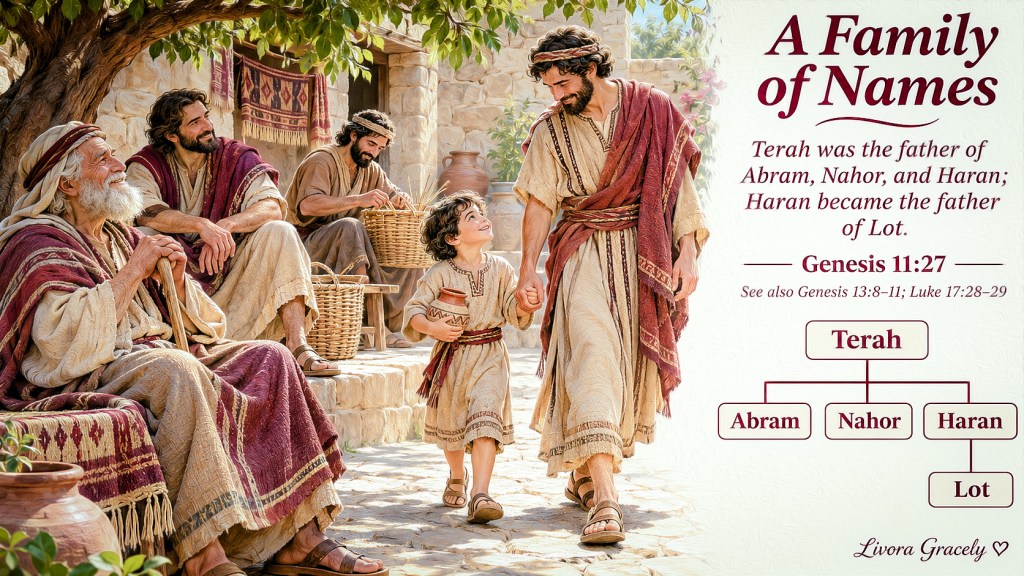
A boy carries a small vessel against his side. His other hand is held by the man walking beside him, and his face turns upward as they cross the courtyard.
Under the tree, an older man sits near two younger men. A basket rests by the steps, and the open doorway leads into the family home.
The poster imagines Haran and his son Lot among Terah’s family. Genesis does not describe this walk or tell us what Lot carried as a child. It introduces them through a few names and a relationship: Haran became the father of Lot.
The Names in Terah’s Family
The preceding genealogy followed Shem’s descendants through many generations until it reached Terah. Now the account draws closer to Terah’s own household.
Terah was the father of Abram, Nahor, and Haran. Haran was Lot’s father. These few names form the beginning of a family story that Genesis will continue to follow.
Lot was Abram’s nephew. When his name first appears, he is introduced beside his father’s; later, he will travel with his uncle into places neither of them is shown visiting in the poster.
The family tree on the image makes that connection visible. From Terah come three branches, and beneath Haran’s name is Lot’s.
A Choice of Land
After the family had left Ur and lived in Haran, Abram and Lot continued toward Canaan. In time, both had flocks and herds, and the land could not support them while they stayed together. A dispute arose between their herders.
Abram spoke to Lot about separating, so that the quarrel would not continue. He offered Lot a choice of land, saying that he would go in the other direction.
Lot looked toward the well-watered plain of the Jordan and chose it. The two men separated, each taking his own way. The account gives their choice a place within the wider story of their family.
When Lot Was Taken
Later, Lot was living in Sodom when the city was caught in a conflict between kings. He was taken captive along with his possessions.
When Abram heard what had happened, he pursued the captors with men from his household. He brought back Lot, the other people, and the goods that had been taken.
The passage does not return them to the courtyard in the poster. It follows their relationship into a moment of danger, where the name first introduced as Haran’s son appears again beside Abram’s.
A Name Heard Later
Much later, Jesus referred to the days of Lot when speaking to His disciples about the day of the Son of Man. He recalled ordinary activities in Lot’s time and the destruction that came upon Sodom after Lot left.
His words belong to a later conversation, not to the scene in Terah’s household. They show how Lot’s name continued to be remembered in the biblical story.
In the poster, the boy still holds the small vessel, his hand resting in his father’s. Genesis begins with a simple family connection. Beyond the courtyard, many chapters wait to follow it.
Livora Gracely ♥
Sources
- Genesis 11:27, 31 — Terah’s sons, Haran’s son Lot, and the family’s departure from Ur.
- Genesis 12:4–5; 13:5–11 — Lot travels with Abram, and the two men separate after disputes between their herders.
- Genesis 14:12–16 — Lot is taken captive, and Abram pursues the captors and brings him back.
- Luke 17:28–30 — Jesus refers to the days of Lot while speaking about the day of the Son of Man.


Leave a Reply