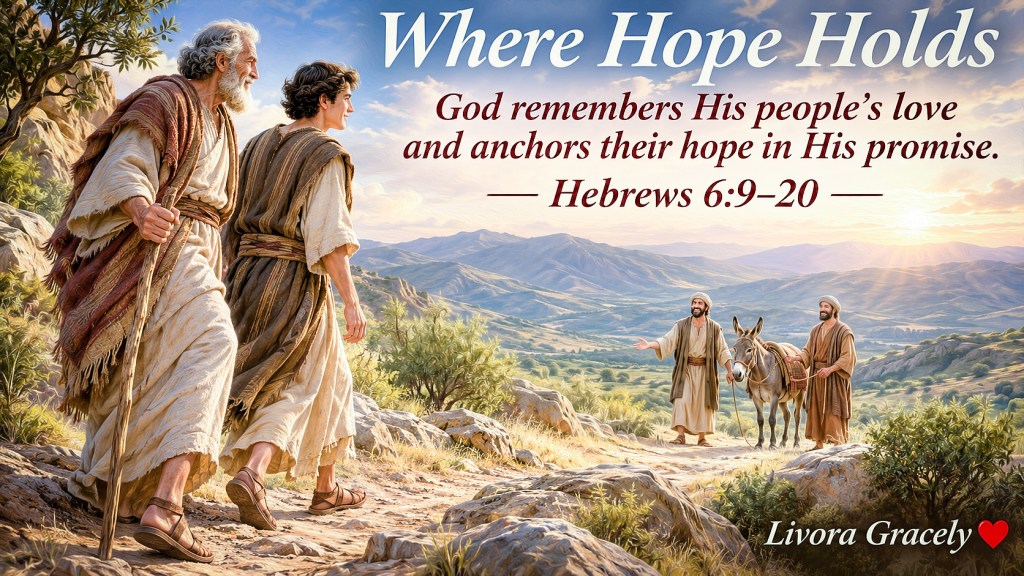
Hebrews 6:9–20
God remembers His people’s love and anchors their hope in His promise.
Abraham returned to the servants who had waited for him. Together they set out for Beersheba.¹
Before he came down from the mountain, he had heard the angel of the Lord speak a second time. God had sworn by Himself: He would surely bless Abraham and make his descendants as numerous as the stars in the sky and the sand on the seashore.¹
The journey had begun with a command Abraham could scarcely have expected. God had asked him to offer Isaac, the son through whom the promise would continue. At the last moment, Abraham was stopped, and God provided a ram.¹
Now Abraham had heard the promise confirmed by an oath. The letter to the Hebrews returns to that promise when it speaks to a community learning to hold on to hope.²
The Love God Sees
The writer has just given a severe warning, using the picture of land that produces thorns and is in danger of being cursed.³ Then his words turn toward the people listening: “Dear friends,” he says, “we are convinced of better things in your case.”²
He does not pretend the warning was unnecessary. Nor does he overlook what is already growing among them. They have shown love for God’s name by helping His people, and they are still helping them.²
“God is not unjust,” the writer says; He will not forget their work and love.²
The letter does not tell us every name or describe each act of service. It tells us enough to see that their love has reached other people. What may have passed without public notice has not passed beyond God’s sight. A meal prepared for someone who is ill, a visit to a lonely friend, or help offered when a household is struggling with loss can carry love into an ordinary day. These are examples, not details the letter gives about that community. Its words allow room to recognize care that continues without an audience.
Such love is not a price paid to purchase salvation. The writer speaks of things that accompany salvation, and he remembers a community whose faith has taken shape in care for others.
Faith That Waits
The writer wants each person to show the same diligence to the end, so that their hope may be fully assured. He urges them not to become sluggish, but to imitate those who inherit what God has promised through faith and patience.²
Their service belongs to the present. Their hope also looks ahead. Continuing to help one another and continuing to trust God are part of the journey together.
Abraham becomes an example. Hebrews says that, after waiting patiently, he received what was promised.² God had given him Isaac, the son promised to him and Sarah.⁴ Yet the promise of descendants as numerous as the stars reached beyond what Abraham could count in his own lifetime.
Later, Hebrews speaks of people who died in faith without receiving the promised things in their fullness.⁵ The journey of God’s promise was larger than one person’s lifetime. Abraham received what God gave him, while the story continued beyond him.
Waiting is not the same as seeing nothing and feeling nothing. A person may carry questions, weariness, and hope at the same time. Hebrews points to Abraham’s faith and patience without telling us that every prayer will be answered in the way or at the time we imagine.
A Promise Confirmed
When people swear an oath, they appeal to someone greater than themselves to confirm what they have said. God, having no one greater, swore by Himself.²
He did not need an oath to make His word truthful. Hebrews says that He confirmed His unchanging purpose to the heirs of the promise so that they might have strong encouragement. God’s promise and His oath give those who have fled for refuge reason to take hold of the hope set before them.²
That hope rests on the character of the One who speaks. God cannot lie. The promise is not made secure by the strength of the hand that holds it, but by the faithfulness of the One who gives it.
On the mountain, Abraham did not lose the son he had been called to offer. God provided a ram.¹ In another passage, Paul writes that God did not spare His own Son but gave Him up for us all; Christ died and was raised.⁶ The two accounts are not identical. Together they invite us to consider the generosity of God, whose care is greater than the gift Abraham could provide for himself.
Hope Beyond the Veil
Hebrews gives this hope a picture: an anchor for the soul, firm and secure.²
An anchor does not stop the wind from rising. It holds a vessel fast while the water moves around it. The writer’s image reaches beyond the familiar scene of a boat: this hope enters behind the curtain, where Jesus has gone before us.²
Jesus is not merely waiting at a distance. He has entered on behalf of His people as their forerunner, a high priest forever in the order of Melchizedek.² The letter will return to that priesthood, but already it has invited those who need mercy and help to come near to the throne of grace.⁷
Abraham came down from the mountain having heard God’s promise confirmed. The community addressed in Hebrews had shown love and was invited to continue in faith and patience.
The promise of God stands. Jesus has gone before His people. And the hope set before them holds firm, even while the journey continues.
Livora Gracely ♥
Scripture References
- Genesis 22:1–19.
- Hebrews 6:9–20 — main passage.
- Hebrews 6:4–8.
- Genesis 21:1–7.
- Hebrews 11:8–13, 17–19.
- Romans 8:32–34.
- Hebrews 4:14–16.


Leave a Reply