Genesis 6:19–20
Noah was to bring living creatures, male and female, into the ark to preserve life with him.
A Table Full of Creatures
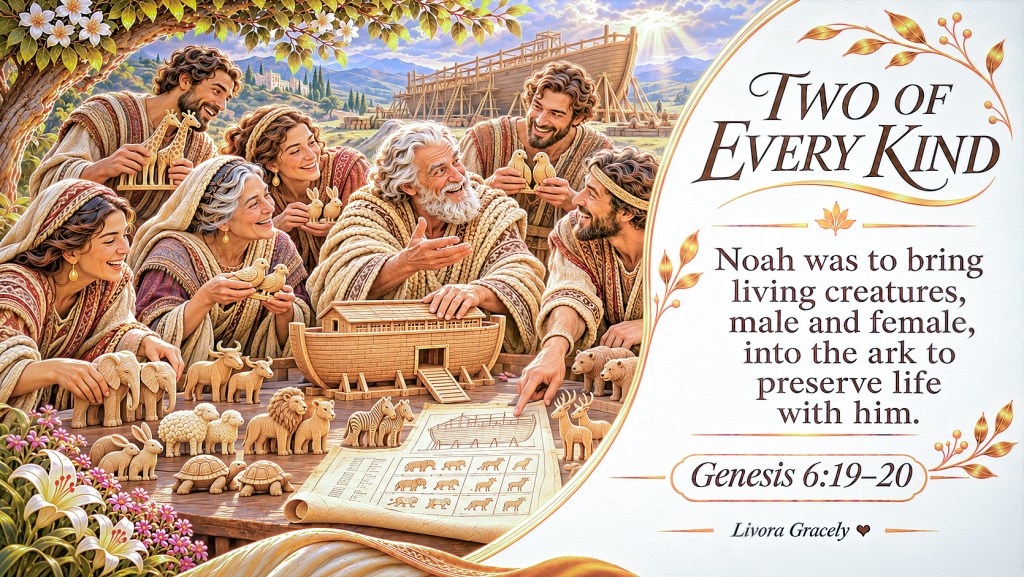
Two little elephants stand at one end of the table. Nearby are sheep, rabbits, and tortoises, while birds and other animals rest in the hands of Noah’s family. At the centre sits a small model of the ark, its doorway reached by a short ramp.
The poster imagines a table covered with animal figures. Each pair helps make the instruction visible: living creatures, male and female, are to come into the ark.
Genesis does not describe Noah’s family arranging models or making the illustrated list. It speaks instead of the lives for which space is to be prepared.
The ark is not only for a household. Other creatures are to be kept alive with Noah.
Room Beyond the Family
God’s instructions name birds, animals, and creatures that move along the ground, each according to its kind. A male and a female are to be brought into the ark and kept alive.
The account says that creatures of each kind will come to Noah. It does not explain every detail of how they arrived or how each was cared for during the journey. The focus of the instruction is clear, however: their lives are to be preserved.
The poster gathers a great variety around a small wooden vessel. Its animals are an imaginative selection; the passage does not give a complete list of species or assign a particular room to each.
Beyond the door in the ark’s side lies a place prepared for more than human passengers.
Two, and Then Seven Pairs
The pairs on the table make a familiar picture. But the next chapter gives a further instruction that deserves attention.
In the New International Version, God tells Noah to take seven pairs of every kind of clean animal and one pair of every kind of unclean animal. The same passage speaks of seven pairs of every kind of bird, male and female, so that their kinds may continue on the earth.
Some translations note that the Hebrew wording can also be understood as seven animals of each clean kind. The NIV and the ESV render it as seven pairs, while the ESV includes the alternative in a footnote.
The distinction between clean and unclean appears in this later instruction; the passage does not explain the categories here. It gives more detail than the first mention of pairs. The poster’s pairs illustrate the instruction in Genesis 6. They are not a complete count of the additional animals described in the next chapter.
Life to Be Preserved
Later, Jesus speaks of birds when teaching His listeners about anxiety. They do not gather food into barns, yet the heavenly Father feeds them. His words belong to a different setting, but they draw attention to God’s care for creatures that might easily be overlooked.
Noah’s instructions will continue with a practical need: food is to be gathered for the family and the animals. Before the journey begins, the account makes room for that provision too.
On the table, small figures stand beside a model ark. In Genesis, the instruction concerns living creatures—and the purpose is to keep them alive.
Livora Gracely ♥
Sources


Leave a Reply