Genesis 6:13
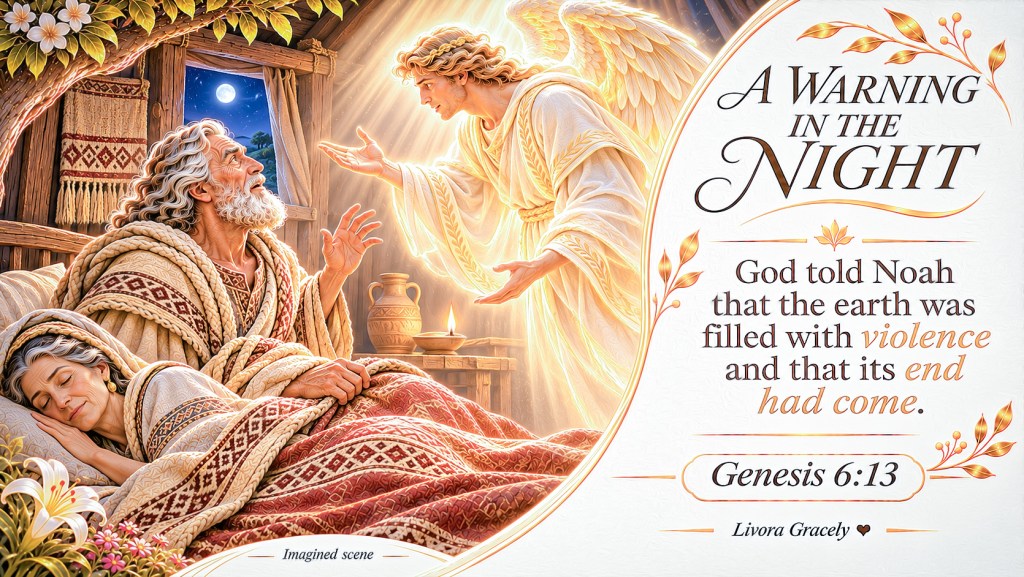
God told Noah that the earth was filled with violence and that its end had come.
A Light Beside the Bed
A small lamp burns beside Noah’s bed. Through the window, the moon hangs above the hills. Noah has raised a hand toward a radiant figure, while his wife sleeps beside him.
The poster imagines the moment when Noah receives a warning. Its night sky and winged messenger make the scene visible, but Genesis does not say that God spoke at night, that Noah was in bed, or that an angel delivered the message. Those details belong to the artist’s imagination.
The account gives a shorter introduction: God spoke to Noah.
What follows is a difficult word about the world Noah inhabits.
What God Saw
The previous lines have described an earth filled with violence. Now God tells Noah that the end of all flesh has come before Him, and that He will bring destruction because the earth is filled with violence through them.
The words are severe. They follow the account of God’s grief over human wickedness and His sight of the earth’s corruption. Violence is not treated as a small disturbance in an otherwise peaceful story.
The verse does not describe each act of violence or record Noah’s immediate response to the announcement. It places God’s judgment and its reason before him. The account speaks of destruction reaching beyond one family or settlement, giving the declaration a breadth as unsettling as the violence it names.
In the previous poster, Noah stands at a doorway looking toward an imagined scene of conflict. Here, the attention shifts. Whatever Noah may have seen, the words he receives tell him what God has seen and what God has determined to do.
A Name Remembered
Long after Noah’s time, the prophet Ezekiel names him alongside Daniel and Job while speaking of judgment on a land that has acted unfaithfully. In that setting, their righteousness cannot rescue everyone around them; the passage stresses the seriousness of the judgment being described.
Ezekiel’s words belong to another time and another situation. They do not retell the conversation with Noah. Yet the mention shows that Noah’s name continued to be remembered in the biblical story when righteousness and judgment were being considered together.
Genesis has already described Noah as a man who walked with God. The warning now reaches that man within the troubled world around him.
Before the Building Begins
The New Testament letter to the Hebrews remembers that Noah was warned about things not yet seen. It then speaks of his faith and the ark he built for his household.
Those instructions and the work that followed belong to the next movement of the Genesis account. The verse before us first gives the warning its weight. Before the measurements, the rooms, and the door, there is a world filled with violence and a word spoken by God.
A warning can be difficult to hear, especially when the danger it describes has not yet arrived. In the picture, the light falls across Noah’s face. In the account, the light of attention falls on the words themselves.
God spoke to Noah. The story will continue with what Noah is told to do.
Livora Gracely ♥
Sources


Leave a Reply