Genesis 6:14–16
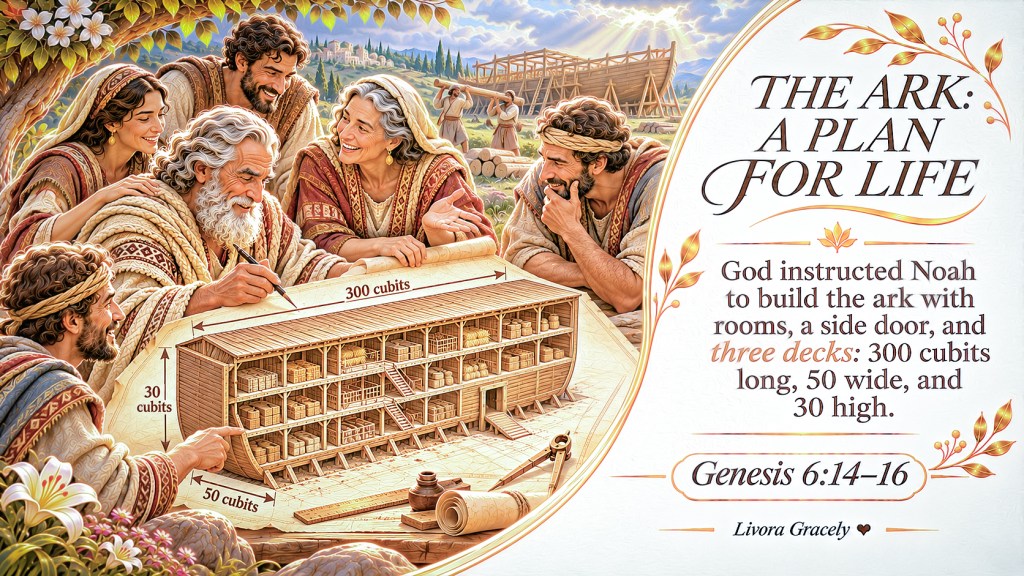
God instructed Noah to build the ark with rooms, a side door, and three decks: 300 cubits long, 50 wide, and 30 high.
Lines on a Page
A long wooden vessel stretches across the drawing. Lines mark its length, width, and height. Inside, the picture shows rooms on three levels, with a door in the side.
Noah holds a pen above the plan while his family gathers around the table. On the hillside behind them, another structure is taking shape.
The poster imagines a design meeting. Genesis does not say that Noah drew a plan or that his family stood around one. But the picture gives shape to a passage filled with instructions: God told Noah to make an ark.
After the warning about a world filled with violence, the account turns to wood, measurements, rooms, and a door.
A Vessel Measured in Cubits
The dimensions come first as numbers: 300 cubits long, 50 cubits wide, and 30 cubits high. A cubit was an ancient measure based on the forearm; its exact length could vary.
Using an estimate of about 45 centimetres per cubit, the ark would be roughly 135 metres long, 22.5 metres wide, and 13.5 metres high. The conversion helps give a sense of scale, though it remains an approximation.
The numbers on the poster stretch across the drawing. They remind us that the vessel was not simply an idea: the instructions described something to be made.
Genesis does not provide every detail needed to draw its appearance. The curved hull, supports, and arrangements within the poster are the artist’s interpretation of the features the passage names.
Rooms and a Door
God tells Noah to make the ark of wood, with rooms, and to coat it with pitch inside and out. Some translations call the material gopher wood; others suggest a particular kind of tree. Its precise identity is uncertain.
The instructions also include a door in the side and lower, middle, and upper decks. Translations differ in how they describe the feature near the top: some refer to a roof and an opening, others to a window.
A door gives the drawing a place to enter. The rooms suggest space within, though Genesis does not tell us exactly how each was arranged. The same passage will soon speak of food and living creatures, giving these spaces a purpose beyond their measurements.
Much later in the biblical story, another small vessel appears on the water: the basket in which Moses’ mother places her baby. The circumstances are different, but both accounts describe a prepared container coated to help protect its occupant.
A Work Still Ahead
Hebrews looks back to Noah as someone who acted in faith when warned about things not yet seen. It remembers the ark as a means by which his household was saved.
At this point in Genesis, the instructions are being given. The animals have not yet entered, and the rain has not begun. The following verses will tell more about the flood, the family, and the living creatures for whom space is to be prepared.
On the poster, the family leans toward a drawing. In the account, the measurements lead toward a task.
Before the door can be entered, the ark must be made.
Livora Gracely ♥
Sources
- Genesis 6:13–18, New International Version — Bible Gateway
- Genesis 6:14–16, New American Standard Bible and New International Version — Bible Gateway
- Exodus 2:1–3, New International Version — Bible Gateway
- Hebrews 11:7, New International Version — Bible Gateway
- Genesis 6, New English Translation and notes — NET Bible


Leave a Reply