Genesis 6:11–12
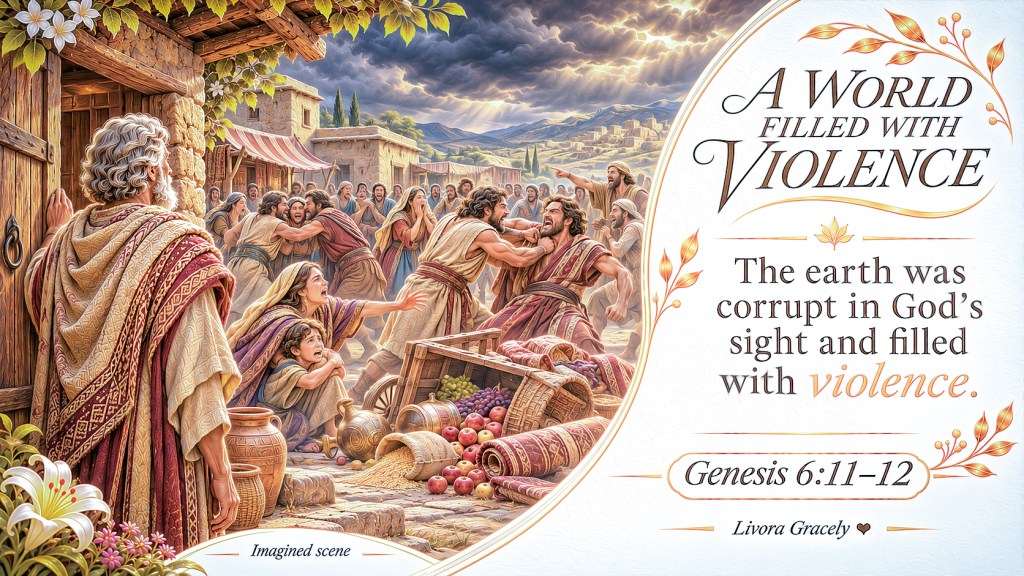
The earth was corrupt in God’s sight and filled with violence.
At the Doorway
Fruit has spilled across the street. A basket lies on its side, and a woman reaches out while holding a child close.
At the doorway, Noah stands with his back to the scene’s edge, looking toward the struggle. The poster imagines a moment in a crowded settlement: people pulling at one another, others caught nearby, and a family trying to find safety amid the confusion.
Genesis does not describe this particular street or say that Noah witnessed this encounter. Its view stretches wider than the picture. The earth, the account says, was corrupt in God’s sight and filled with violence.
Beyond One Street
The word “violence” gives a name to something that reaches beyond a single argument. In the biblical story, harm has already entered a family: Cain killed his brother Abel in a field. A place where the brothers stood together became the setting of a terrible loss.
By the time the story reaches Noah, Genesis describes a world filled with violence. The passage does not list every act or identify every person who suffered. Its sweeping words present corruption as the condition of the earth, not simply the trouble of one household.
The scene on the poster cannot contain everything the verse describes. Still, the fallen fruit and the child held close suggest something about violence: its effects can reach people beyond those who began a struggle.
A basket can be lifted again. Fear and injury do not always disappear so quickly.
God Saw the Earth
The account says that God saw how corrupt the earth had become. Nothing in this description suggests that violence went unnoticed because it had become widespread. The repeated mention of the earth brings the scale into focus, while the words “God saw” show whose attention rests upon it.
Earlier, Genesis described Noah as a righteous man who walked with God. That introduction stands alongside the description of the world around him. The passage does not explain every encounter between Noah and his neighbours, and the illustration does not reveal what he was thinking at the doorway.
The contrast is nevertheless part of the story: Noah is named, and the condition of the earth is named too. His presence does not make that condition harmless. The people and creatures who share the earth remain part of the account that follows.
The Fruit of Peace
Much later, James writes about envy and selfish ambition producing disorder. He contrasts them with wisdom from above, describing it as peace-loving, considerate, and full of mercy. His letter addresses a different community, yet its attention to the fruit of human conduct gives another perspective on life shared with others.
Peace in James’s words is more than a street without a visible struggle. It belongs with a way of living that makes room for mercy and righteousness.
The next line in Genesis will turn from what God saw to what He says to Noah. For now, the account remains with the condition of the earth.
Noah’s imagined doorway frames one troubled street. The words beside the picture tell of a world seen by God.
Livora Gracely ♥
Sources


Leave a Reply